
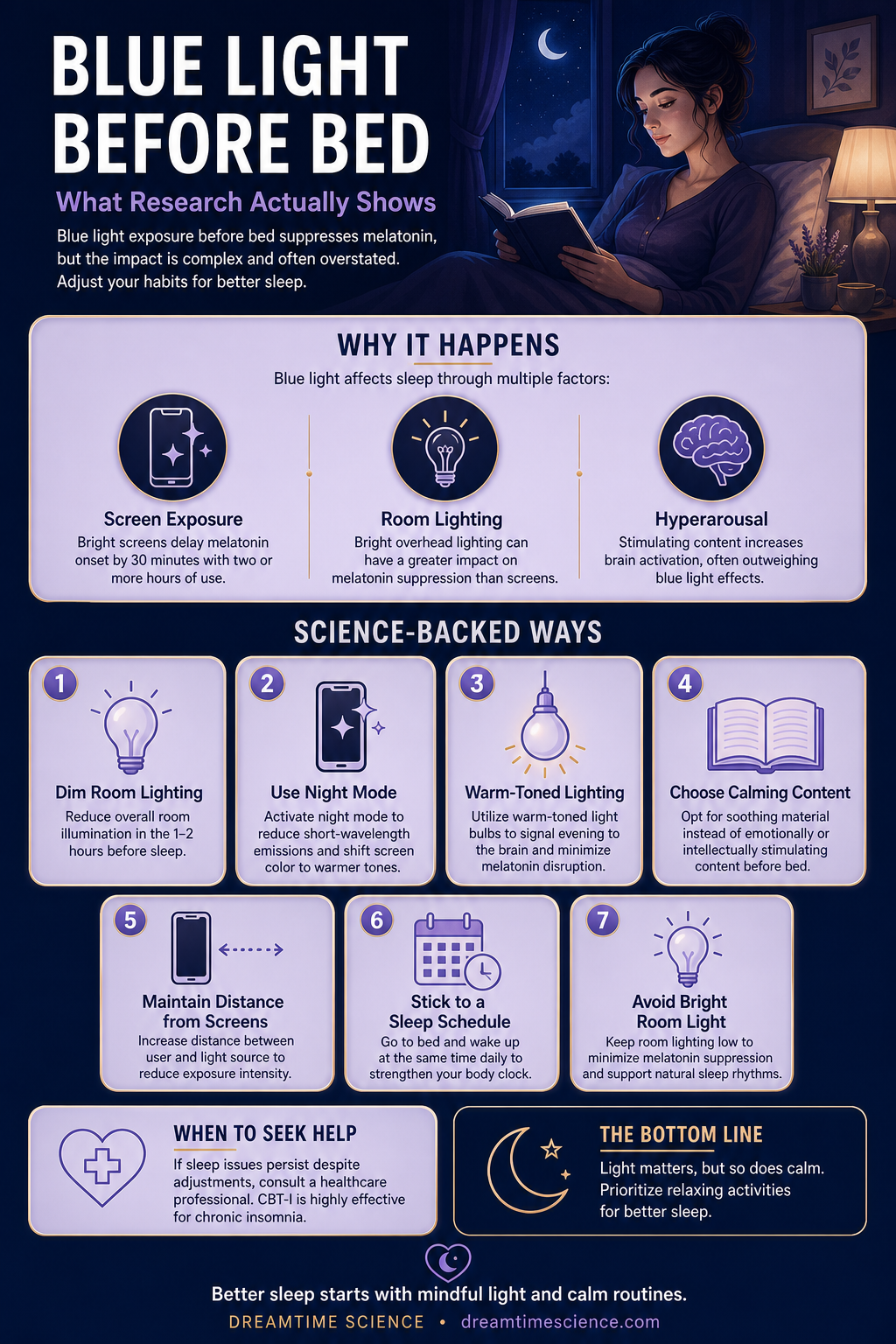
The short answer: Blue light exposure before bed does suppress melatonin production, potentially delaying melatonin onset by around 30 minutes with two or more hours of bright screen time. However, the impact is often overstated as factors like room lighting and content viewed play significant roles. Strategies like dimming screens and using night mode can minimize these effects, highlighting that it's the timing and intensity of light, rather than blue light itself, that matters most for sleep.
Blue light before bed does suppress melatonin production, but the effect is complex and often overstated. Research indicates that two or more hours of exposure to bright screens can delay melatonin onset by approximately 30 minutes [1]. However, strategies like dimming screens, utilizing night mode features, and maintaining low room lighting levels can substantially mitigate these effects.
Key takeaways
- Blue light is a natural part of sunlight and supports alertness during the day.
- Evening exposure to blue light can suppress melatonin production and delay sleep onset.
- The psychological impact of pre-sleep activities often has a greater effect than blue light alone.
- Dimming screens and increasing distance from light sources can lessen melatonin suppression.
- Creating a calm and dimly lit environment before bed can promote better sleep patterns.
What Is Blue Light, Exactly?
Blue light is a high-energy portion of the visible light spectrum, with wavelengths ranging from 450 to 495 nanometers. While often discussed as a modern issue, blue light is naturally present in sunlight, and daytime exposure is beneficial for various physiological processes. Blue light stimulates the production of hormones like cortisol, promoting alertness and concentration. Exposure can also enhance reaction times and cognitive performance, as well as influencing neurotransmitters such as serotonin and contributing to mood regulation [1]. Crucially, blue light plays a vital role in synchronizing the circadian rhythm—the body's internal clock that governs sleep and wakefulness.
The issue is not blue light per se, but rather exposure to it at a biologically inappropriate time.
How Blue Light Affects Melatonin
The circadian rhythm, responsible for regulating sleep-wake cycles, is heavily influenced by light exposure. Specialized cells in the retina, called intrinsically photosensitive retinal ganglion cells (ipRGCs), detect light and send signals to the suprachiasmatic nucleus (SCN) in the brain, which regulates melatonin release. Melatonin is often referred to as the “darkness hormone” because its production increases in low-light conditions, facilitating sleep by lowering alertness and body temperature. Evening exposure to blue-enriched light can suppress melatonin production and delay the onset of sleep [4]. A study by Harvard Medical School demonstrated that blue light suppressed melatonin production roughly twice as long as green light, and shifted circadian rhythms by approximately 3 hours in some participants [4].
Is Blue Light the Main Cause of Insomnia?
While blue light can delay melatonin secretion, insomnia is rarely solely attributable to light exposure. Hyperarousal—a state of increased physiological and psychological activation—commonly plays a significant role in sleep difficulties. Engaging with stimulating content, such as stressful emails or emotionally intense television shows, can activate the brain to a greater extent than the light emitted from screens [8]. Therefore, the psychological impact of evening activities often outweighs the effects of blue light.
Screens vs. Bright Room Light
Research suggests that typical smartphone usage at moderate brightness may have a lesser impact on melatonin suppression compared to exposure to bright overhead room lighting [8]. Both the intensity and proximity of light are important factors; dimming a phone and increasing the distance between the user and the source of light can reduce its impact compared to sitting in a brightly lit room. Lower-intensity, warmer-colored light sources also exhibit less disruptive effects on melatonin suppression [8]. This does not equate to screens being harmless, but clarifies the nuanced relationship between light and sleep.
What Actually Helps Reduce Blue Light Impact
Several gentle adjustments can effectively mitigate the potential negative effects of blue light before bed:
- Dim Room Lighting: Reduce overall room illumination in the 1–2 hours preceding sleep.
- Use Night Mode and Blue Light Filters: Activate these features to reduce short-wavelength emissions, shifting the color temperature of screens to warmer tones.
- Warm-Toned Lighting: Utilize warm-toned light bulbs, as they signal evening to the brain and are less disruptive to melatonin production.
- Reduce Emotional and Cognitive Stimulation: Choose calming content to view before bed. Reading soothing material may be preferable to engaging with emotionally or intellectually stimulating content.
Is Blue Light a Myth or Reality?
Blue light before bed is not a myth; it has a measurable influence on melatonin and circadian timing. However, it should not be considered the sole cause of insomnia or problematic sleep. Multiple factors contribute to healthy sleep, including the circadian rhythm, sleep pressure, and stress levels [9]. Light is one component of a complex biological system, and achieving balance within that system is crucial for optimal sleep.
Conclusion: Light Matters—But So Does Calm
Blue light exposure before bed is biologically real, affecting both melatonin production and circadian rhythm. However, it is not the singular determinant of poor sleep. The brain responds not only to light, but also to emotion, thought, and expectation. Implementing gentle lighting practices, prioritizing relaxed evenings, and engaging in calming activities can signal safety to the brain, ultimately promoting more favorable sleep patterns.
Frequently Asked Questions
Does one night of screen use ruin my sleep?
No. The effects of blue light on melatonin are generally cumulative and modest in typical real-world scenarios. A single night of screen usage is unlikely to significantly disrupt overall sleep quality.
Are blue light glasses effective?
Some evidence suggests they may reduce melatonin suppression in the evening, although results are variable [1]. For example, one study showed improved sleep quality in teenagers wearing blue light-blocking glasses.
Is TV better than phone use?
Distance from the screen reduces the intensity of light exposure, but the emotional stimulation from content remains a factor. Watching calming content on TV from a distance may be less disruptive than engaging in interactive activities on a phone.
Should I avoid all screens at night?
Not necessarily. Dimming the screen, using night mode features, and choosing calming content can substantially reduce the impact of screens on sleep.
What’s more important—light or stress?
For many individuals experiencing insomnia, stress and hyperarousal are more significant contributors than light exposure. Addressing these factors through relaxation techniques like progressive muscle relaxation may yield more substantial improvements in sleep than solely managing light.
Fall Asleep to a Science Lecture
Put tonight's reading into practice — pick a gentle, softly-narrated episode and let the Professor talk you to sleep.
 Tonight's episodeHow Gravity Can Bend Time: The Cosmic Clock Puzzle
Related articles

The Role of Darkness: Why Light Exposure Matters for Sleep
Darkness plays a crucial role in sleep by signaling the brain to release melatonin, the hormone that promotes relaxation and initiates sleep. Exposure to light,…

The Role of the Pineal Gland: Understanding Melatonin Production
The pineal gland, often called the "third eye," produces melatonin, the hormone that signals the body to wind down and prepare for sleep. Exposure to blue light, like…

Magnesium for Sleep: What the Research Actually Shows
Magnesium is an essential mineral involved in hundreds of bodily processes, and emerging research indicates a significant role in regulating sleep.