← Back to Articles
Sleep Supplements

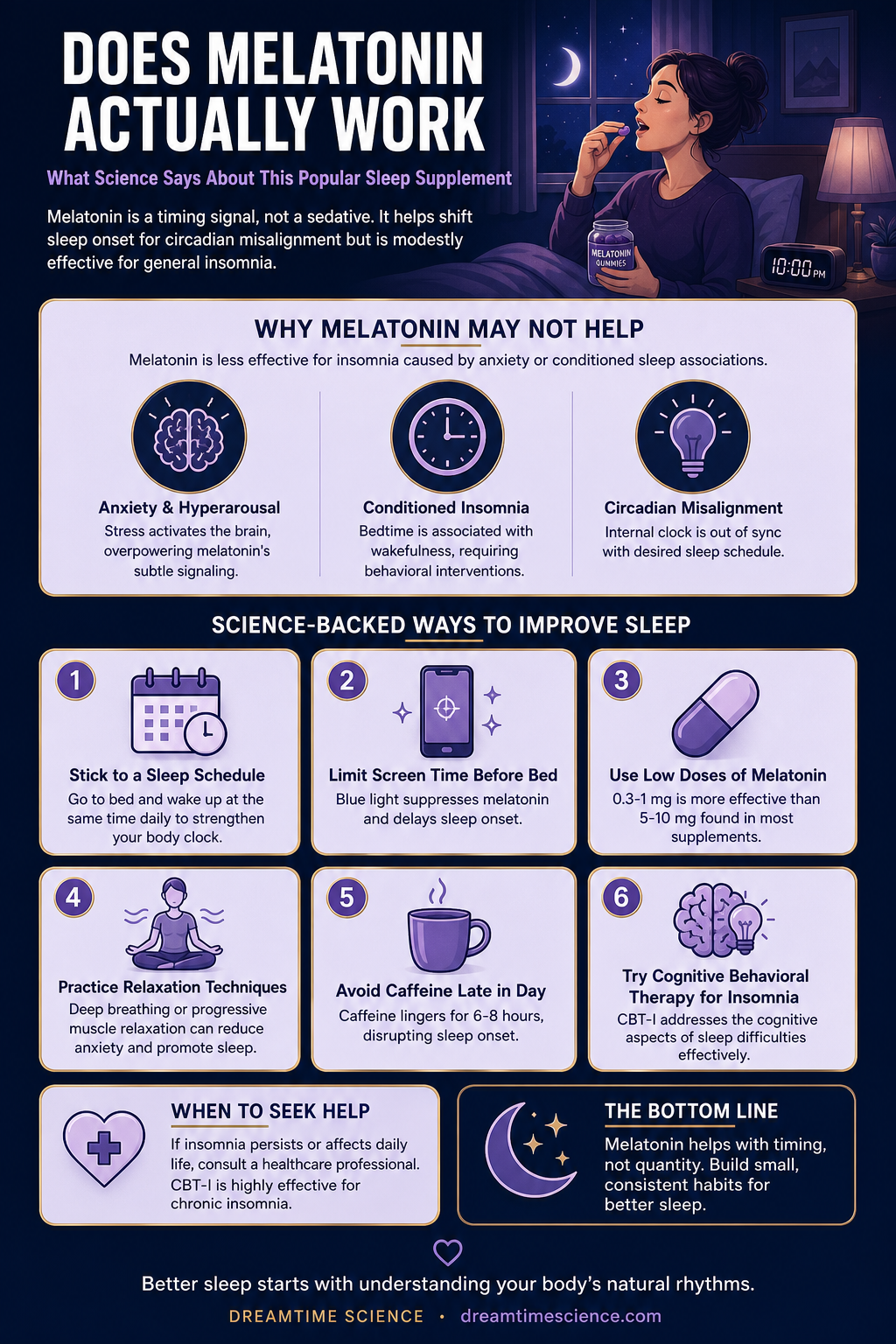
The short answer: Melatonin is a timing signal, not a sedative. It works best for circadian misalignment such as jet lag and delayed sleep phase, where it can shift sleep onset by 30-60 minutes. For general insomnia it is modestly effective, reducing sleep onset by about 7-12 minutes on average. Doses of 0.3-1mg are more effective than the 5-10mg found in most supplements.
Walk into any pharmacy and you’ll see it:
Melatonin gummies.
Melatonin tablets.
Melatonin sprays.
But does melatonin actually work — or is it simply the most popular placebo in the sleep aisle?
If you’ve stared at the ceiling at midnight wondering whether to try it, you’re not alone. Melatonin is one of the most widely used sleep supplements in the world. According to a 2020 report from the National Center for Complementary and Integrative Health, melatonin usage in the U.S. doubled over a decade, highlighting its increasing popularity.
The truth is both simpler and more nuanced than marketing suggests. Let’s look at what science says.
Key takeaways
- Melatonin helps shift your body’s internal clock, signaling the start of nighttime.
- It’s most effective for adjusting to jet lag or shift work, realigning your sleep schedule.
- Higher doses of melatonin can cause unwanted side effects like grogginess or vivid dreams.
- Creating a calming bedtime routine alongside melatonin can enhance its effectiveness.
- Melatonin may work partly because taking it creates a ritual that signals sleep preparation.
What Melatonin Actually Is
Melatonin is not a sedative. It’s a hormone naturally produced by your pineal gland in response to darkness. It signals: “Night has begun.” It does not “knock you out.” Instead, it shifts timing. According to a 2017 review in the journal Sleep Medicine Reviews, melatonin plays a key role in regulating circadian rhythms, your body's internal clock that dictates when you feel sleepy and when you feel alert.
Think of it as a dimmer switch — not a sleeping pill. The pineal gland releases melatonin in response to the absence of light, a process finely tuned through evolution to sync our sleep patterns with the night. This hormone’s primary role is to orchestrate the timing of your sleep-wake cycle, allowing your body to transition smoothly into rest.
What This Means for You
Understanding that melatonin is a timing cue rather than a knockout agent can help manage expectations. If you’re struggling with sleep onset due to misaligned circadian rhythms, melatonin might be a useful ally. But if your sleep struggles stem from anxiety or stress, other strategies might be more effective.
When Melatonin Works Well
Melatonin is most effective for:
1. Circadian Rhythm Disorders
If your internal clock is delayed, as in a night owl pattern, low-dose melatonin taken earlier in the evening may help shift timing earlier. This adjustment is especially useful given that modern society often demands early morning productivity, which can clash with natural late-night tendencies.
2. Jet Lag
Crossing time zones rapidly throws your internal clock off balance. Melatonin can help realign your rhythm to a new time zone, easing the transition and reducing symptoms of jet lag. A 2014 meta-analysis in the Cochrane Database of Systematic Reviews found melatonin effective in reducing jet lag symptoms, especially when traveling across five or more time zones.
3. Shift Work Adjustment
In some cases, melatonin supports circadian adaptation for those working irregular hours. It can help shift workers adjust their sleep patterns to align with their unusual schedules, as noted in research published in PLOS Medicine, which highlights melatonin’s modest effect in reducing the time it takes to fall asleep — usually by about 7–12 minutes on average.
What This Means for You
For those experiencing circadian misalignment, melatonin can be a useful tool to realign your internal clock. Whether you're adjusting to a new time zone or a new shift schedule, melatonin offers a gentle nudge to help your body adapt more swiftly.
When Melatonin Doesn’t Help Much
Melatonin is less effective for insomnia driven by:
Anxiety and Hyperarousal
If your brain is activated by stress, adding melatonin won’t override adrenaline. Research published in Journal of Clinical Sleep Medicine indicates that melatonin does not significantly help with anxiety-related insomnia, where the mind races with worry, overpowering melatonin’s subtle signaling.
Conditioned Insomnia
In cases where insomnia is conditioned, such as those described in The Science of Why You Can't Sleep, melatonin might not provide relief. This form of insomnia involves a learned association between bedtime and wakefulness, often requiring behavioral interventions instead.
What This Means for You
If your sleep issues are rooted in stress or anxiety, consider exploring evidence-based approaches like Cognitive Behavioral Therapy for Insomnia (CBT-I), which address the underlying cognitive aspects of sleep difficulties.
Dosage: More Is Not Better
Here’s where confusion happens. Many supplements contain 5–10 mg. However, research suggests physiological doses are closer to 0.3–1 mg. Higher doses can cause side effects such as grogginess, vivid dreams, headaches, and morning sleep inertia. According to a 2018 study in the Journal of Clinical Pharmacology, smaller doses are often more effective and pose fewer risks.
What This Means for You
Start with the lowest effective dose to minimize side effects. Remember, melatonin is about timing, not quantity. Adjusting the dose to match your body’s natural levels can improve effectiveness and comfort.
Is Melatonin Safe?
Short-term use appears safe for most adults. However, it can interact with medications, and long-term effects are still being studied. Quality control varies between brands, so choosing reputable sources is crucial. The American Academy of Sleep Medicine recommends behavioral approaches like CBT-I as first-line treatments for chronic insomnia before relying on supplements.
What This Means for You
While melatonin is generally safe, consult a healthcare provider before starting, especially if you have underlying health conditions or are taking other medications. Consider melatonin as part of a broader sleep strategy rather than a standalone solution.
The Psychological Effect
Interestingly, melatonin may help partly through expectancy. Taking it signals: “I’m preparing for sleep.” That ritual alone can calm the nervous system. Pairing melatonin with consistent bedtime routines enhances effectiveness, as explored in Why Bedtime Stories Work for Adults Too.
What This Means for You
Creating a calming pre-sleep routine, including melatonin, can reinforce healthy sleep habits. This synergy between supplement and routine can cultivate a more conducive environment for restful sleep.
Conclusion: A Tool, Not a Cure
Does melatonin actually work? Yes — for circadian timing issues. No — as a cure-all for stress-driven insomnia. It’s a gentle biological signal, not a sedative force. When used thoughtfully, in small doses, alongside calming bedtime rituals, it can support your natural rhythm. But the deepest sleep improvements often come from retraining the nervous system — not supplementing it.
Want to experience these sleep science concepts with our soothing narration and ambient soundscapes? Check out our latest video on YouTube @dreamtimescience.
Frequently Asked Questions
Will melatonin knock me out?
No. Melatonin signals sleep timing, not sedation. It helps your body recognize when it’s time to transition into sleep but doesn’t force sleep itself.
How long before bed should I take it?
Typically 1–2 hours before desired sleep time for circadian shifting. This timing allows your body to align with the natural increase in melatonin production as evening approaches.
Can I take it every night?
Occasional use is common; long-term daily use should be discussed with a healthcare provider. Regular use might diminish its effectiveness over time, and potential risks should be considered.
Why do I feel groggy after taking it?
The dose may be too high. Lowering the dose can often reduce or eliminate grogginess, aligning more closely with the body’s natural melatonin levels.
Is it addictive?
Melatonin is not habit-forming in the traditional sense. However, reliance on it for sleep initiation might develop, so it’s best used as part of a broader strategy.
Tonight's Listening
 Tonight's episodeHow Gravity Can Bend Time: The Cosmic Clock Puzzle
Fall Asleep to a Science Lecture
Put tonight's reading into practice — pick a gentle, softly-narrated episode and let the Professor talk you to sleep.
Tonight's episodeHow Gravity Can Bend Time: The Cosmic Clock Puzzle
Related articles

Remedies & Relaxation
Sleep Supplements: Beyond Melatonin - What Actually Works
Several supplements beyond melatonin can potentially improve sleep. Herbal remedies like valerian root and chamomile have shown promise, with chamomile demonstrated…

Food, Body & Health
What Your Sleep Position Says About Your Health
Your sleep position can offer insights into your health, with side sleeping potentially reducing sleep apnea symptoms and back sleeping often considered best for…
Remedies & Relaxation
Cannabis, CBD, and Sleep: What the Evidence Actually Says
Cannabis and CBD have stirred significant interest in the realm of sleep science, with many people turning to these substances for potential solutions.