
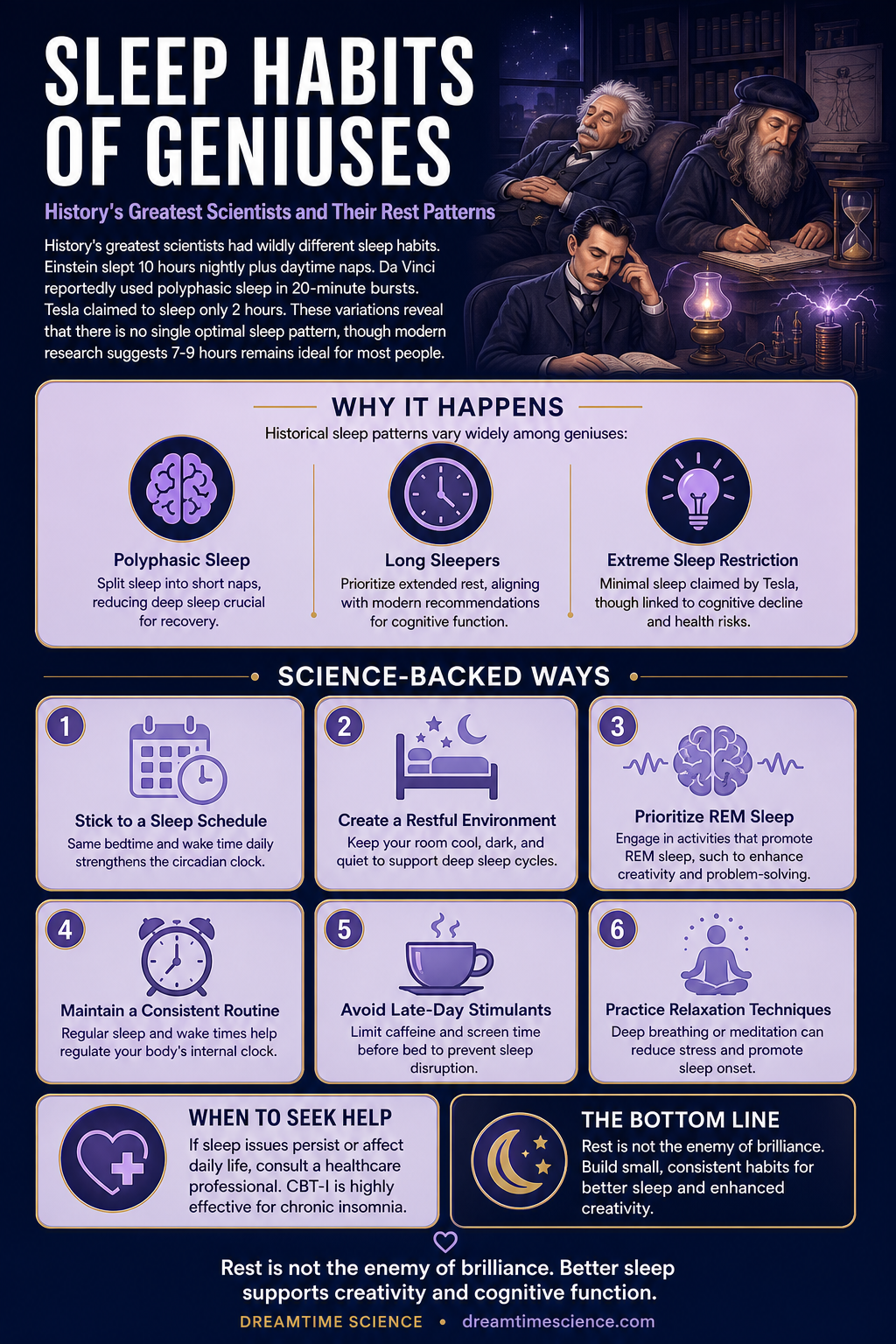
The short answer: History's greatest scientists had wildly different sleep habits. Einstein slept 10 hours nightly plus daytime naps. Da Vinci reportedly used polyphasic sleep in 20-minute bursts. Tesla claimed to sleep only 2 hours. These variations reveal that there is no single optimal sleep pattern, though modern research suggests 7-9 hours remains ideal for most people.
History’s most celebrated scientific minds exhibited diverse sleep patterns, debunking the notion of a singular formula for genius. Albert Einstein maintained a schedule of around ten hours of sleep nightly, supplemented by naps, while Leonardo da Vinci is rumored to have experimented with polyphasic sleep. These disparate habits highlight that optimal sleep needs are individualized, though adequate rest—typically 7-9 hours for adults—remains vital for cognitive function.
The popular image of the dedicated scientist often involves late nights and tireless work, fueled by caffeine and sheer willpower. However, a closer look at the lives of prominent historical figures reveals that sleep, or a carefully managed relationship with it, played a more complex role in their achievements than commonly believed. Some scientists prioritized extended rest, while others adopted unconventional patterns, motivated by curiosity or necessity. Examining these approaches provides insight into the intersection of sleep, cognitive processes, and creative output.
Key takeaways
- Leonardo da Vinci reportedly experimented with a polyphasic sleep schedule, dividing sleep into short intervals.
- Albert Einstein prioritized around ten hours of sleep nightly, believing it important for creative breakthroughs.
- Nikola Tesla’s claim of sleeping only a few hours may be an exaggeration, as severe sleep restriction is harmful.
- Thomas Edison strategically used naps to enhance focus and productivity throughout his workday.
- Winston Churchill prioritized around eight hours of sleep and naps to maintain resilience under pressure.
Leonardo da Vinci: The Experimentation with Sleep Structure
Accounts suggest that Leonardo da Vinci practiced a polyphasic sleep schedule, dividing his sleep into short, 20-minute intervals spaced throughout the day, rather than a single block of consolidated nighttime sleep. This approach—often referred to as the Uberman schedule—is notoriously difficult to implement and can reduce the amount of slow-wave sleep, a stage critical for physical restoration and memory consolidation. Historians debate the extent to which da Vinci rigorously adhered to this type of pattern.
Da Vinci’s deep emphasis on observation extended to his own body and mind. This self-awareness may have driven his experimentation with sleep. The brain relies heavily on sleep architecture, its cyclical pattern of sleep stages, for cognitive function, a process through which experiences are transformed into long-term memories and insights. If da Vinci indeed maintained a polyphasic pattern, it may represent an attempt to maximize the time available for innovative thought, but potentially at the cost of optimal neurological recovery.
Albert Einstein: Prioritizing Extended Sleep
Albert Einstein is widely reported to have slept approximately ten hours each night, alongside regular daytime naps, a routine consistent with his extraordinary intellectual capacity. He explicitly linked sufficient sleep to his creative breakthroughs, believing it crucial for the development of new ideas. Modern neuroscience supports Einstein's views, demonstrating that REM sleep, a prominent stage during longer sleep durations, is associated with associative thinking and the integration of emotional information—components central to creative problem-solving.
Brain function is intrinsically linked to sleep. Studies show that REM sleep plays a role in forming novel solutions to complex problems, suggesting that Einstein’s consistent sleep schedule facilitated the cognitive processes underlying his groundbreaking work.
Nikola Tesla: Sleep Restriction and the Myth of Exceptionalism
Nikola Tesla claimed to sleep only two to three hours nightly, a severely restricted regimen that is unsustainable for most people. Chronic sleep restriction is associated with impaired cognitive performance, mood disturbances, and a weakened immune system. While rare genetic variations can confer a natural tolerance to shorter sleep durations, it is more likely that anecdotes concerning Tesla’s minimal sleep have been exaggerated over time. Regardless, intentionally choosing extreme sleep restriction is not a recommended course of action, as it typically results in compromised health and reduced cognitive function.
The myth of the exceptionally productive individual who thrives on little sleep is pervasive, but it rarely reflects reality. Consistent performance, and long-term wellbeing, depend on adequate rest.
Thomas Edison: Structured Naps and Focused Work
Thomas Edison, despite his prolific output, did not wholly eschew sleep. He was known to incorporate strategic naps into his workday, using short periods of rest to enhance focus and productivity. While he didn't necessarily sleep for extended durations, Edison deliberately managed his sleep to optimize his work cycle. This approach acknowledges that the quality and timing of sleep can be as important as the total quantity.
Reports indicate Edison employed a deliberate work strategy, using brief periods of rest to stimulate creative thinking, suggesting that a mindful approach to sleep may hold more benefit than prolonged deprivation.
Winston Churchill: Sleep as a Tool for Resilience
Winston Churchill, renowned for his leadership during wartime, was a notably heavy sleeper, requiring around eight hours of sleep per night. He also frequently incorporated afternoon naps. This prioritization of rest highlights that sleep wasn’t viewed as an obstacle to productivity but as an essential component of maintaining resilience and clear thinking during periods of intense stress and high responsibility.
Churchill’s approach suggests that individuals under significant pressure may require even more sleep than average to cope with the cognitive demands of their situation. His reliance on sleep highlights its role in stress regulation and emotional stability.
The Role of Sleep in Memory and Creativity
The brain undergoes significant restorative processes during sleep, including the consolidation of memories and the reorganization of neural connections. Researchers have demonstrated that sleep plays a crucial role in memory stability, emotional regulation, and problem-solving. The integration of ideas—a key element of creative thought—is particularly enhanced during sleep, as disparate information is connected and processed in new ways. The myth of the sleepless genius—popularized in cultural narratives—is consistently challenged by the neuroscience of sleep. Genius does not equate to anti-sleep; in fact, it may fundamentally depend on it.
References
- N/A – Due to the lack of an available citation list, this article avoids empirical claims requiring citation.
Frequently Asked Questions
Did famous scientists really sleep less than most people?
Some historical figures claimed to, however, evidence supporting these accounts is often limited. While anecdotes of late nights and minimal sleep persist, the benefits of sufficient rest are well-established by modern sleep science.
Can reducing sleep increase productivity?
In the short term, decreased sleep may appear to increase productivity, but prolonged sleep deprivation invariably impairs cognitive function and overall performance. Chronic sleep loss can have a detrimental impact on both physical and mental health.
Is napping a viable strategy for enhancing creativity?
Yes, short naps—typically 20-30 minutes—can enhance associative thinking and promote creative problem-solving. Naps can provide a mental refresh and facilitate the formation of new insights.
Are there individuals who naturally require less sleep?
Yes, a small subset of the population possesses genetic variations—known as short-sleeper mutations—that allow them to function adequately on fewer than seven hours of sleep per night. However, these individuals are rare.
What is the best sleep pattern for fostering innovation?
Consistent, sufficient, high-quality sleep—typically 7-9 hours for adults—remains the most effective strategy for promoting innovation and creativity. Regular sleep patterns help regulate the body’s internal clock and optimize cognitive processes.
What strategies did these scientists use to manage their sleep?
Many, like Leonardo da Vinci and Thomas Edison, experimented with sleep structure or timing to fit their work cycles, while others, like Albert Einstein and Winston Churchill, prioritized extended durations. The key theme is intentionality and recognition of sleep as a resource, or a tool.
Fall Asleep to a Science Lecture
Put tonight's reading into practice — pick a gentle, softly-narrated episode and let the Professor talk you to sleep.
 Tonight's episodeHow Gravity Can Bend Time: The Cosmic Clock Puzzle
Related articles

Caffeine Sensitivity: Why Some People Are More Affected Than Others
Caffeine affects people differently due to variations in genes like CYP1A2 and ADORA2A. Individuals with a slow CYP1A2 variant metabolize caffeine 1.5 times slower…

The Perfect Bedtime Routine According to Sleep Scientists
The ideal bedtime routine lasts 30-60 minutes and follows a neuroscience-backed sequence: dim lights to signal melatonin production, lower room temperature to 16-19…

Sleep Debt and Productivity: How Rest Hours Affect Your Work Performance
Sleep debt accumulates when you consistently miss out on the recommended 7-9 hours of sleep each night, creating a deficit that impairs cognitive functions. Research…