
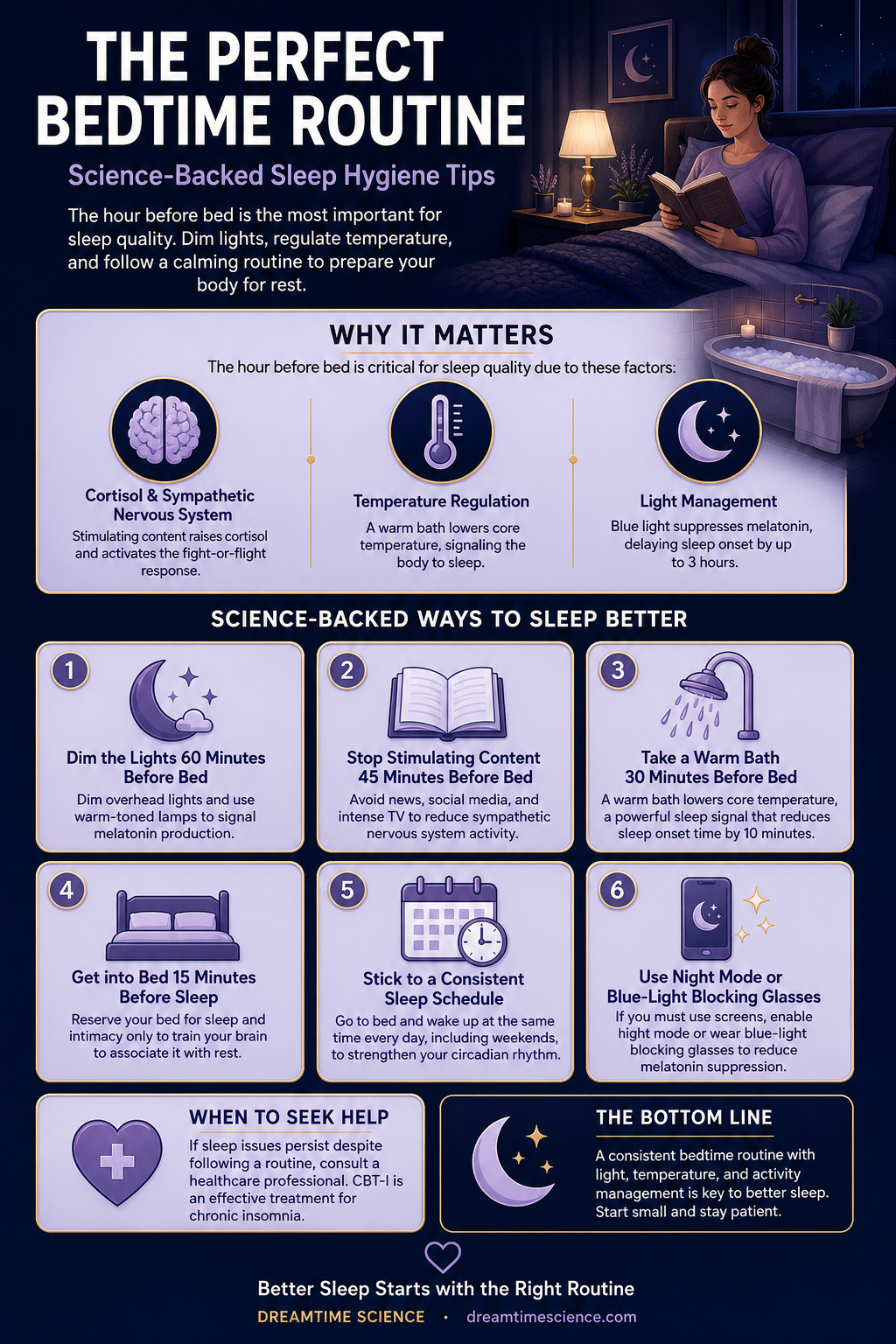
The short answer: The ideal bedtime routine lasts 30-60 minutes and follows a neuroscience-backed sequence: dim lights to signal melatonin production, lower room temperature to 16-19 degrees Celsius, engage in a calming activity like reading or gentle stretching, and maintain a consistent schedule. Research shows routines that reduce cortisol and sympathetic nervous system activity are the most effective at improving sleep onset and quality.
Your body does not have an off switch. Sleep is a process that requires preparation, and the hour before bed is arguably the most important hour of your day for sleep quality. Here is what the research says about building an effective wind-down routine.
Key takeaways
- Dimming lights before bed helps your body produce melatonin, a key sleep hormone.
- Calming activities replace stimulating ones to reduce stress and promote relaxation.
- A warm bath or shower can lower your core body temperature, signaling sleepiness.
- Reserve your bed for sleep and intimacy to strengthen its association with rest.
- Maintaining a consistent sleep schedule strengthens your body’s natural sleep-wake cycle.
60 Minutes Before Bed: Dim the Lights
Artificial light, particularly the blue wavelengths emitted by screens, suppresses melatonin production — the hormone that signals your brain it is time to sleep. Research from Harvard Medical School shows that blue light can shift your circadian rhythm by up to 3 hours. Dim your overhead lights, switch to warm-toned lamps, and if you must use screens, enable night mode or wear blue-light blocking glasses.
45 Minutes Before: Stop Stimulating Content
News, social media, intense television, and work emails activate your sympathetic nervous system — the fight-or-flight response. Switch to calming activities: light reading, gentle stretching, journaling, or listening to relaxing audio content.
30 Minutes Before: Temperature Regulation
A warm bath or shower 30 minutes before bed is one of the most effective sleep interventions known to science. Counter-intuitively, warming your body causes vasodilation — your blood vessels expand, allowing heat to escape through your skin, rapidly dropping your core temperature. This temperature drop is a powerful sleep signal. A 2019 meta-analysis found that a warm bath 1-2 hours before bed reduced the time it took to fall asleep by an average of 10 minutes.
15 Minutes Before: Get into Bed
Your bed should be reserved for sleep and intimacy only. This trains your brain to associate the bed with sleepiness. Make your bed a screen-free zone. If you like to listen to something, put on a Dreamtime Science episode and let the Professor guide you through the transition from wakefulness to sleep.
Consistency is Everything
The single most impactful change you can make to your sleep is going to bed and waking up at the same time every day — including weekends. Your circadian rhythm is a biological clock, and like any clock, it works best when it runs on schedule. Even a one-hour shift on weekends (known as social jet lag) can measurably impair your sleep quality during the week.
Frequently Asked Questions
What is the best bedtime routine for adults?
Sleep scientists recommend a structured wind-down: dim lights 60 minutes before bed, stop stimulating content at 45 minutes, take a warm bath at 30 minutes, and get into bed at 15 minutes. Consistency is the most important factor — same time every day, including weekends.
How long before bed should I stop using screens?
At least 45 to 60 minutes. Blue light suppresses melatonin production and can shift your circadian rhythm by up to 3 hours. If you must use screens, enable night mode or wear blue-light blocking glasses.
Does a warm bath help you sleep?
Yes. It is one of the most effective sleep interventions known to science. The warming triggers vasodilation, which rapidly drops your core temperature — a powerful sleep onset signal.
What is social jet lag?
The shift in sleep schedule when you stay up later on weekends versus weekdays. Even a one-hour shift impairs sleep quality during the following week.
Why is a consistent sleep schedule important?
Your circadian rhythm works best on a fixed schedule. Irregular sleep times confuse your internal clock, making it harder to fall asleep and wake naturally.
Fall Asleep to a Science Lecture
Put tonight's reading into practice — pick a gentle, softly-narrated episode and let the Professor talk you to sleep.
 Tonight's episodeHow Gravity Can Bend Time: The Cosmic Clock Puzzle
Related articles

Famous Scientists’ Sleep Habits: Da Vinci, Einstein, and Others
History's greatest scientists had wildly different sleep habits. Einstein slept 10 hours nightly plus daytime naps. Da Vinci reportedly used polyphasic sleep in…

Does Melatonin Actually Work? What Science Says About This Popular Supplement
Melatonin is a timing signal, not a sedative. It works best for circadian misalignment such as jet lag and delayed sleep phase, where it can shift sleep onset by…

Orthosomnia: When Chasing Perfect Sleep Scores Keeps You Awake
You've felt it. The lure of a perfect sleep score, a digital badge of honor lighting up on your wrist.