Teenagers experience a natural biological shift in their sleep patterns that makes it difficult for them to fall asleep and wake up at the same time as younger children or adults [1]. This delay is not a result of laziness or poor habits, but rather a fundamental change in their internal clock, which impacts both when they feel tired and when they feel alert.
Understanding the Adolescent Circadian Rhythm
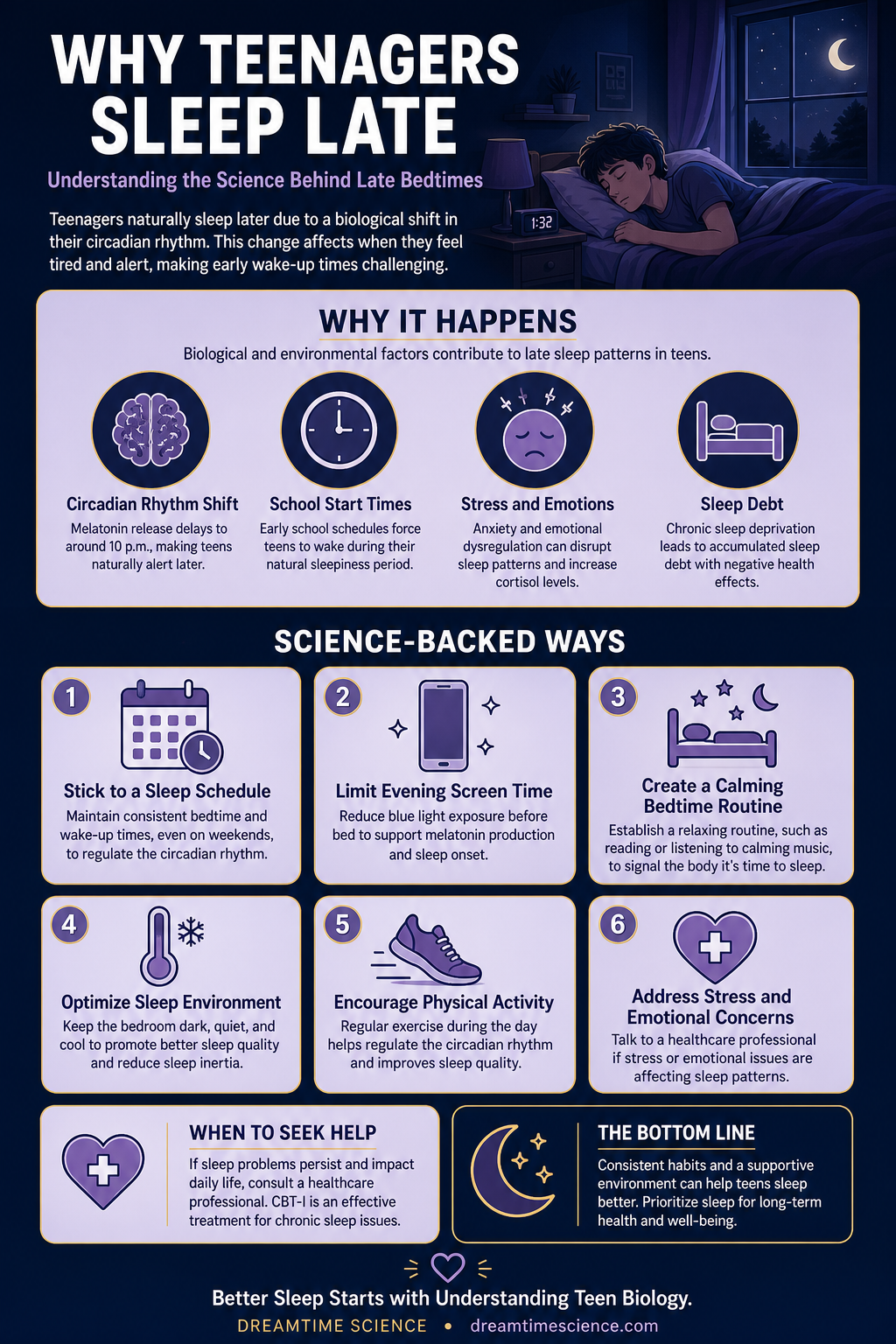
The circadian rhythm—the internal process that regulates the sleep-wake cycle—undergoes significant changes during adolescence [1]. In teenagers, melatonin, a hormone critical for inducing sleepiness, begins to be released approximately 2.5 hours later than in children or adults, typically around 10 p.m. compared to 8 p.m [1]. This means teens naturally experience a surge in alertness later in the evening and are less likely to feel tired until much later at night. This is not a behavioral choice, but rather a physiologically driven phenomenon.
The Forbidden Zone for Adolescent Sleep
Adolescents experience a narrower “forbidden zone” for sleep—the period when sleep is most difficult to initiate—compared to adults [3]. This larger window of wakefulness makes it harder for them to fall asleep even when they attempt to do so at a reasonable hour. Coupled with the delayed melatonin release, this creates a perfect storm for consistently late bedtimes and wake-up times. The forbidden zone, essentially a period of heightened alertness, expands during adolescence, hindering sleep onset.
Why School Start Times Conflict with Teen Biology
Early school start times often directly conflict with the adolescent circadian rhythm, forcing teenagers to wake up during a period of natural sleepiness [1]. This misalignment leads to chronic sleep deprivation, with detrimental effects on cognitive function, mood, and overall health. Research indicates that even a one-hour delay in school start times can result in an average increase of 45 minutes of sleep per night among teenagers, accompanied by improved alertness and emotional regulation [1].
Factors Beyond Biology: Stress and Emotional Regulation
While the circadian rhythm plays a central role, other factors contribute to the sleep challenges experienced by adolescents. Stress, anxiety, and emotional dysregulation can further disrupt sleep patterns [6, 7]. The teenage years are characterized by significant emotional and social changes, which can lead to increased cortisol levels—a stress hormone—and difficulties in falling or staying asleep. Qualitative research suggests that adolescents often perceive a link between stress and poor sleep [2].
The Impact of Sleep Debt on Teen Health
The chronic sleep deprivation resulting from this mismatch can lead to significant sleep debt. This accumulated lack of sleep has consequences beyond simply feeling tired. Sleep debt in adolescence is associated with increased risk of depression, anxiety, weakened immune function, and impaired academic performance [1]. Weekends often become a time for “catch-up” sleep, but this irregular sleep-wake schedule can further exacerbate circadian rhythm disruptions.
Snoozing and Sleep Quality: A Complicated Relationship
Many teenagers rely on the snooze button, but research indicates that intermittent waking can negatively affect sleep quality and cognitive function [4]. While temporarily alleviating morning grogginess, snoozing can fragment sleep and contribute to greater sleep inertia—the feeling of being groggy and disoriented upon waking.
References
- Dijk DJ (2013). Why do we sleep so late?. Journal of sleep research. doi:10.1111/jsr.12111
- Kosticova M, Dankulincova Veselska Z, Sokolova L et al. (2024). Late Bedtime from the Perspective of Adolescents: A Qualitative Study.. Nature and science of sleep. doi:10.2147/nss.s492595
- Monterastelli AJ, Adams J, Eastman CI et al. (2024). The forbidden zone for sleep is more robust in adolescents compared to adults.. Frontiers in sleep. doi:10.3389/frsle.2023.1304647
- Sundelin T, Landry S, Axelsson J (2024). Is snoozing losing? Why intermittent morning alarms are used and how they affect sleep, cognition, cortisol, and mood.. Journal of sleep research. doi:10.1111/jsr.14054
- Badawy RA, Macdonell RA, Jackson GD et al. (2009). Why do seizures in generalized epilepsy often occur in the morning?. Neurology. doi:10.1212/wnl.0b013e3181ae7ca6
- Åkerstedt T, Orsini N, Petersen H et al. (2012). Predicting sleep quality from stress and prior sleep--a study of day-to-day covariation across six weeks.. Sleep medicine. doi:10.1016/j.sleep.2011.12.013
- Elovainio M, Kuula L, Halonen R et al. (2020). Dynamic fluctuations of emotional states in adolescents with delayed sleep phase-A longitudinal network modeling approach.. Journal of affective disorders. doi:10.1016/j.jad.2020.07.050
Frequently Asked Questions
Why do teenagers need more sleep than adults?
Teenagers require approximately 8-10 hours of sleep per night due to the intensive physical and neurological development occurring during this period [1]. This sleep is crucial for brain maturation, memory consolidation, and hormonal regulation. Growth spurts, coupled with cognitive changes, demand increased restorative sleep.
How can parents help a teenager establish a better sleep schedule?
Encouraging a consistent bedtime and wake-up time—even on weekends—is the most effective strategy, alongside minimizing evening screen time [1]. Creating a calming bedtime routine and ensuring a dark, quiet, and cool sleep environment can also promote sleep. Open communication about sleep challenges and addressing underlying stress or emotional concerns is also beneficial.
What is “social jetlag” and why does it affect teenagers?
Social jetlag refers to the discrepancy between a teenager’s natural sleep-wake cycle and their social obligations, particularly differing sleep schedules between weekdays and weekends [1]. This disruption can lead to chronic sleep debt and negative health consequences.
Is there a connection between mental health and sleep in teenagers?
Yes, disruptions in sleep patterns are often associated with increased risk of depression, anxiety, and other mental health disorders [7]. The relationship is bidirectional; sleep disturbances can exacerbate mental health conditions, and vice versa.
Why do some teenagers struggle with sleepiness specifically in the morning?
Adolescents may also experience increased seizure activity in the morning, due to the interaction between sleep patterns and brain activity [5]. In addition, fluctuations in emotional states can contribute to daytime sleepiness [7].
Fall Asleep to a Science Lecture
Put tonight's reading into practice — pick a gentle, softly-narrated episode and let the Professor talk you to sleep.
 Tonight's episodeUnveiling the Mind's Labyrinth