The Tesseract's Whisper
This part will introduce the concept of dimensions beyond the three we perceive, drawing on pop culture references like 'Interstellar' and 'A Wrinkle in Time'. We'll bust the myth that dimensions are merely spaces we live in, instead introducing them as constructs that define our reality.
There is a hush that falls between waking and sleep, an hour when the mind’s boundaries grow soft and the world’s sharp lines blur. It is here, in this liminal hush, that the imagination tiptoes into forbidden gardens — where the known and the unknown breathe together. In that velvet darkness, let us begin by asking a question whose answer slips through our fingers like starlight: What, truly, is a dimension?
To the child within each of us, the word calls to mind simple things: length, width, height. The block in a hand, the shadow on the wall, the rooms of a house stacked one above another. We live and move in three familiar dimensions, and for most, that is where the story ends. Yet, sometimes, through the cracks in our ordinary days, strange whispers drift in: tales of a tesseract, a fourth direction, corridors that do not exist in any building we have ever known. These whispers gather in the spaces between science and story, mathematics and myth.
Let us listen, then, to the tesseract’s whisper.
Long before the word “tesseract” appeared in stories or films, there were ancient questions. The Greeks, gazing at the geometry of their world, wondered if space itself was a kind of music: each line and plane, each solid shape, a note in the cosmic song. Euclid mapped out a kingdom of points, lines, and surfaces, whose rules we still teach today. But he could not imagine a world beyond the three visible axes, for the very idea seemed to mock the senses. What could it mean to move not north or east or up, but along a direction you could not point to?
Still, the mind is stubborn. In the late 19th century, mathematicians began to pry open the walls of their own imaginations. Charles Howard Hinton, a dreamer with a taste for paradox, named the “tesseract”: a four-dimensional analog of the cube. A cube, he explained, is to the square as the tesseract is to the cube — a shape unseeable, but describable, a thing not of this world and yet, curiously, a part of its logic.
So what is a dimension? It is not, as we often suppose, merely a line drawn on a page or a direction we walk in. It is a rule — an independent way in which something can change, or be measured, or shifted. Length is one such rule: the distance from here to there. Width — the side-to-side sweep. Height, the climb from earth to sky. Each is a freedom, a possibility, an axis along which reality can unfold.
And yet, in stories and science alike, we hear of more. The tesseract appears in the pages of “A Wrinkle in Time,” a book that dares children to picture a shortcut across the universe, a folding of space so that the farthest stars draw close. There, the tesseract is not simply a geometric curiosity, but a vessel for the imagination — a symbol of how reality might bend if only we could see it whole.
In the film “Interstellar,” a tesseract is rendered as a labyrinth of time itself, a place where moments become visible and past and future lie side by side like the books on a shelf. Here, the fourth dimension is not a spatial direction but a new axis altogether: time, laid bare, its secrets revealed.
But let us pause. Is this merely fancy, or is there substance beneath these dreams?
To understand, we must first shake ourselves free of a common mistake. Dimensions are not spaces in which things are placed, like marbles in a box. Rather, they are the very threads from which the fabric of reality is woven. Each dimension is a way in which the universe is allowed to move, to change, to express itself. If there were only two dimensions, you and I would be flat as paper, our organs and bones mere drawings, unable to reach out, unable to hide anything behind anything else.
With three, we gain volume, the mystery of insides and outsides, the dance of shadow and light. We can turn things over, nest one thing within another, walk around a corner and vanish. It is not simply that three dimensions are where we live: they are what make living as we know it possible.
But why stop at three? Why, indeed, should the music of the universe end on this note, when so many others are waiting?
In mathematics, the act of adding another dimension is almost childishly simple. Take a line: it has one dimension. Draw another line at a right angle, and you have a plane — two dimensions. Stand a new line up from the page, and you have a space: three. Now, close your eyes and imagine a fourth line, at right angles to all previous ones. You cannot draw it, nor build it, nor point to it in your room. But in the mind, it exists — mathematically pure, untroubled by flesh or matter.
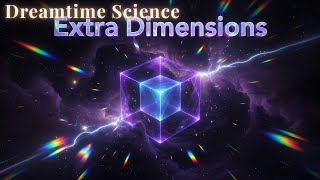
A tesseract, then, is a four-dimensional hypercube. Just as a shadow of a cube is a square, the shadow of a tesseract is a cube. It is a shape that can only be described by analogy, for our senses rebel at the notion of a direction that has no place in our world.
Yet, the mathematics is precise. If you could live in four spatial dimensions, your world would be a strange and haunted place. Locked doors would be meaningless, for one could slip around them in a direction unseen. Knots could not hold, for they could be unraveled with a twist through the fourth axis. You could step outside a box without ever passing through its walls — just as we, in three dimensions, can lift a coin off a piece of paper, to the astonishment of the flat creatures that might live within.
We are, in a sense, like those flatlanders, hemmed in by the boundaries of our senses. Yet the logic of higher dimensions surrounds us, just out of view. In the patterns of mathematics, in the laws of physics, in the dreams of artists and children, the possibility persists.
Perhaps you have felt this, walking at twilight, when the world seems layered, and every shadow hints at a hidden corridor. Perhaps you have glimpsed it in the strange correspondences of music, where a melody is echoed in a harmony, and both together form something more than the sum of their parts. The notion of dimension is not confined to space alone; it is a property of all things that can vary independently.
In physics, we speak of phase space, in which each possible state of a system is a point in a many-dimensional realm. The orbit of a planet, the motion of a molecule, the fluttering of a heart — all can be described by a sequence of numbers, each one a dimension, each one marking a freedom. In this view, the universe is not a static box, but a dance of possibilities, each step a journey along a new axis.
It is easy to become dizzy in the face of such abstraction. Yet, the world itself offers hints, if we know how to look. Consider time: the relentless drift from past to future. We cannot retrace our steps in time as we can in space, but it is, by all the rules of physics, another dimension — a way in which things can differ, a direction of change.
Einstein, in his theory of relativity, bound space and time together in a single fabric: spacetime. Here, the geometry of the universe is not threefold, but fourfold, with time as the fourth dimension. The tesseract, in this light, is not merely a trick of geometry, but a symbol of the deep unity between motion and sequence, place and moment.
It is here that science and story entwine. In “A Wrinkle in Time,” the tesseract is a means of travel — a folding of the universe so that distant points become neighbors. This is not mere fantasy: the idea echoes in the equations of general relativity, where the curvature of spacetime by mass and energy can, in principle, allow for shortcuts known as wormholes. The language of fiction becomes a mirror for the language of physics.
And yet, always, our senses lag behind. We cannot see four dimensions, but we can project them — casting their shadows onto the world we know. In mathematics, the projection of a tesseract into three-dimensional space forms a figure of haunting beauty: cubes within cubes, connected by lines that seem to defy logic. These are not mere curiosities but tools for thinking, ways to stretch the mind beyond habit and into wonder.
Even in popular culture, the idea of higher dimensions has become a shorthand for mystery and transcendence. In “Interstellar,” the hero finds himself in a tesseract constructed by beings who inhabit more dimensions than we do. Here, time becomes a place, every moment accessible, every possibility real. The geometry is impossible, yet the metaphor is powerful: there are ways of being, ways of knowing, that transcend the limits of our perception.
This is the lesson the tesseract whispers: Reality is not exhausted by what we can see or touch. The axes of the universe may be more numerous than our senses allow, and the rules by which things are arranged may be deeper than our intuition can grasp.
To think in higher dimensions is to admit that the world is more than it appears. It is to sense the presence of hidden freedoms — perhaps not accessible to our bodies, but present in the laws that govern all things. It is to imagine that, somewhere beyond the veil of appearances, there are doors we have not yet learned to open, corridors we have not yet dreamed.
If you could step outside the three axes of your room, what would you find? If you could see the shadow of your own life cast by a fourth spatial direction, what would it reveal? Would you glimpse new forms of beauty — patterns and symmetries unknown, a geometry richer than any architect could draw? Would you feel, perhaps, the truth that mathematics has always whispered: that dimensions are not mere containers, but the very grammar of existence?
As sleep draws nearer and the walls of the room fade to suggestion, let the mind wander along those invisible axes. Let it imagine, for a moment, the possibility of more — not just in space, but in the fabric of reality itself. For dimensions are not simply where we live; they are the rules by which we are allowed to be.
In the next breath, something deeper stirs: a sense that the universe is not finished, that its music continues beyond the notes we know. The tesseract’s whisper lingers, gentle and insistent, promising that, just beyond the edge of sight, the story unfolds in directions we have yet to name.
Unseen Shadows: The Fourth Dimension and Beyond
In this part, we'll delve into the complexities of higher dimensions, exploring theories such as string theory and quantum mechanics. We'll discuss the limits of our understanding, discussing paradoxes such as Schrodinger's Cat and the concept of superposition.
To contemplate the notion of dimensions beyond the three that cradle our daily experience is to peer into an expanse at once mathematically precise and utterly surreal. We are, each of us, beings sculpted by length, width, and height, drifting through the slow current of time. These are the axes upon which our every action is measured, the coordinates that give the universe its familiar frame. Yet, as the 20th century unfurled, a deeper curiosity took hold—a whisper suggesting that reality may be more intricately woven, its threads entangled in realms our senses cannot directly perceive.
Settle into this thought as darkness settles over your room. Let your mind soften its grip on the ordinary, and consider: What if there are shadows cast not just by objects in three-dimensional space, but by entire realities folded in directions we cannot point toward? The world of higher dimensions is both an abstract landscape and a necessary scaffold for some of the most ambitious ideas in physics. Here, the fabric of reality may ripple in ways that defy our native intuitions. To explore this, we must first loosen ourselves from the tyranny of the familiar, and step lightly into the fourth dimension and beyond.
To begin, let us revisit the comfort of a square—a simple two-dimensional shape, its edges tracing a flat domain. A square, for all its familiarity, cannot imagine the upward leap that births a cube: the third dimension. Now, imagine this cube, its six faces enclosing a miniature universe, casting a shadow on the wall. The shadow is a distortion, a two-dimensional echo of the cube’s true form. If we, like the characters of Edwin Abbott’s “Flatland,” lived as sentient squares, the cube’s third-dimensional existence would be forever hidden—its passing only observable as inexplicable changes and apparitions upon our flat world.
In the same manner, the fourth spatial dimension remains veiled to us, its existence inferred only through mathematical shadowplay. We call this hypothetical form a tesseract, or hypercube: an object whose edges, faces, and inner spaces extend into a direction perpendicular to all we know. The tesseract’s shadow, projected into our world, flickers and warps, its meaning elusive. We can describe it with equations, unfold it into two or three dimensions, but we cannot truly grasp its fullness any more than a square can reach up and touch a cube.
The notion of extra dimensions, once the stuff of philosophical speculation, has become a crucial pillar in the ongoing effort to reconcile the universe’s deepest mysteries. The grand tapestry of physics is woven from two very different threads: the stately, continuous curvature of spacetime described by Einstein’s general relativity, and the jittery, probabilistic dance of particles and forces in the quantum realm. For much of the twentieth century, these two descriptions seemed irreconcilable, like languages devised by separate, uncontacted tribes. But as physicists probed deeper, they discovered that both might be mere shadows cast by a richer, higher-dimensional reality.
This is where string theory unfurls its silken strands. At its heart, string theory proposes that the fundamental constituents of the universe are not point-like particles, but rather one-dimensional filaments—tiny, vibrating strings whose oscillations encode the properties of all known particles: quarks, electrons, photons, and even the elusive graviton. The catch is that for the mathematics to work, these strings must vibrate not in our familiar three spatial dimensions, but in ten, or perhaps even more, depending on the version of the theory. The extra dimensions, it is said, are compactified—curled up so minutely that they escape direct detection, like the fine threads in the weave of a distant tapestry, visible only when one peers with infinite care.
Visualize a garden hose lying across the grass. From a distance, it appears as a simple line—a one-dimensional pathway. But draw closer, and the hose reveals itself as a cylinder, its surface rolled into a tiny circle at every point along its length. If you were the size of an ant, you could crawl not just along the hose, but around its circumference—a hidden dimension available only on the smallest scales. In string theory, the universe may be threaded with similar hidden loops and folds, each one a route through an unseen direction.
Why invoke such extravagance? The answer lies in the quest for unity. Gravity, the force that binds planets and gives weight to our bodies, is described by the geometry of curved spacetime—a smooth, continuous surface. The other forces—electromagnetism, and the strong and weak nuclear interactions—are best understood as the exchange of quantum particles, their behavior governed by the rules of probability and uncertainty. String theory, by dispersing the sharpness of point particles into the gentle undulations of strings, promises a framework in which gravity and quantum mechanics may finally coexist, their contradictions softened by the flexibility of higher dimensions.
Yet, for all its elegance, string theory remains a theory—a vision glimpsed in the mathematics, but not yet confirmed by experiment. The extra dimensions, if they exist, have so far eluded our finest instruments. And so, we are left with models, analogies, and the paradoxical certainty that the universe is stranger than we can imagine.
This strangeness finds its most evocative expression in the quantum world. Here, the rules of the everyday dissolve into a shimmering haze of possibilities. The act of measurement, so mundane in classical physics, becomes a moment of profound mystery. Consider the paradox of Schrödinger’s Cat, a thought experiment devised by Erwin Schrödinger in 1935 to illustrate the peculiarities of quantum superposition.
Picture a sealed box, within which sits a cat, a vial of poison, a Geiger counter, and a single radioactive atom. The fate of the cat is tied to the quantum state of the atom: if the atom decays, the counter triggers the release of poison; if not, the cat survives. Quantum mechanics tells us that until an observation is made, the atom exists in a superposition of decayed and undecayed states. Accordingly, the cat is both alive and dead—a superposed being, neither one thing nor the other, until the box is opened and the wavefunction collapses.
This paradox is not a mere quirk of logic or language. It is a direct consequence of the mathematics underpinning quantum theory. Particles can exist in multiple states at once, their properties undefined until measured. Electrons whirl around nuclei not in fixed orbits, but as clouds of probability, their locations described by a wavefunction that encodes all possible outcomes. The universe at this scale is not a clockwork machine, but a shifting interplay of potentialities—a symphony in which every note is played at once, until the listener chooses which melody to hear.
Superposition is not confined to the realm of thought experiments. It is the engine behind quantum computing, a nascent technology that harnesses the ability of particles to occupy many states simultaneously. In a classical computer, bits may be 0 or 1; in a quantum computer, qubits can be both at once, enabling calculations that would overwhelm even the fastest supercomputers. The promise is vast, but so too are the challenges, for the quantum world is exquisitely sensitive. The mere act of observation—of extracting information—disrupts the delicate superpositions, collapsing the possibilities into a single outcome.
This, then, is the quantum measurement problem: Why does observation have such power? What counts as a measurement? Does consciousness play a role, or is the collapse of the wavefunction a physical process, independent of observers? Interpretations abound, from the Copenhagen view, which holds that probability becomes actuality upon measurement, to the many-worlds interpretation, in which every possibility is realized in a branching multiverse, each outcome unfolding in a parallel universe inaccessible to the others.
Here, the boundary between philosophy and physics blurs. The many-worlds interpretation, first proposed by Hugh Everett III in 1957, suggests that every quantum event spawns new realities, each as real as our own. Somewhere, a universe exists in which Schrödinger’s cat lives; somewhere else, it dies; in each, the observer continues, unaware of the branching. In this view, the cosmos is a boundless fractal of possibility, its every moment fissioning into new dimensions of existence.
Other interpretations attempt to preserve a single, shared reality, positing hidden variables or invoking the role of information itself as the bedrock of the universe. Some, like the pilot-wave theory, imagine particles guided by an unseen wave, their apparent unpredictability masking a deeper order. Others, like quantum Bayesianism, recast probability not as a property of the world, but as a measure of our knowledge—an epistemic shadow flickering on the wall of the unknowable.
Yet, for all their differences, these interpretations share a sense of humility before the unknown. The quantum world is not merely small; it is fundamentally alien, governed by rules that mock our common sense. A particle can be in two places at once, or none at all. Entangled particles, separated by vast distances, respond to each other’s states with a synchrony that seems to defy the speed of light. Reality, at this scale, is woven from contradiction and paradox, its fabric shimmering with uncertainty.
It is here, in the interplay between higher dimensions and quantum uncertainty, that the limits of our understanding become most apparent. The mathematics of string theory, of quantum field theory, of the Standard Model and beyond—these are the tools we wield to probe the darkness. Yet, for all their power, they remain models, shadows on the cave wall. The true nature of reality may be forever beyond our grasp, folded into dimensions too small to see, or branching into universes forever out of reach.
Still, we persist. The drive to understand, to illuminate the unseen, is woven into the heart of our species. With each new experiment, each refinement of theory, we inch closer to the edge of mystery. The Large Hadron Collider smashes protons together at near-light speed, searching for echoes of extra dimensions, for the faint footprint of supersymmetric particles, for clues to the quantum gravity that may yet bind the universe into a single, elegant whole.
And as night deepens, as consciousness drifts toward dreams, these mysteries remain. The fourth dimension and its kin wait at the edge of thought, their presence hinted at in the equations, their reality shimmering just out of reach. We are, for now, creatures of three dimensions, adrift in the quantum sea. But our minds, restless and yearning, are forever drawn toward the shadows beyond—toward the next question, the next paradox, the next layer of the unseen.
Somewhere, perhaps, in a universe curled tightly within another, or in the quiet superposition of possibility, the answers whisper to themselves. The journey into the unknown continues, each step opening new vistas, each question deepening the wonder. And as the boundaries of space, time, and understanding blur, we find ourselves poised on the threshold, waiting for the next glimmer of insight, the next shadow to reveal its hidden shape.
Tools of the Unseen: Probing the Extra Dimensions
This act reveals the inventive ways scientists study dimensions beyond our perception, from Large Hadron Collider to cutting-edge mathematical models. We'll dive into the history of these studies, from the early philosophical thoughts of Immanuel Kant to the groundbreaking theories of Albert Einstein.
It is a curious feature of the mind, perhaps, that we can so easily accept the limits of our perception as the limits of reality. The world presents itself to us as a tapestry of three spatial dimensions, unfolding in time like a river that cannot be reversed. Yet, for as long as humans have pondered the nature of existence, there have been those who wondered: what lies beyond the curtain drawn by our senses? Are there spaces in which we cannot move, directions we cannot point, landscapes folded so tightly into the fabric of being that we cannot even glimpse their outlines?
Long before the age of particle accelerators and mathematical formalism, in the candlelit quiet of 18th-century Königsberg, the philosopher Immanuel Kant wrestled with the concept of space itself. At his writing desk, surrounded by volumes of natural philosophy and the steady tick of his clock, Kant proposed that space and time might not be inherent properties of the universe, but forms of intuition—ways in which the human mind organizes experience. He wondered if our apparent three-dimensional world was not a given, but a consequence of the structure of our own perception.
Kant’s ideas drifted like a subtle current beneath the surface of later scientific revolutions. In the centuries to come, as mathematics and physics grew ever more precise, the question shifted from “Why do we perceive three dimensions?” to “Could there be more?” And if there are, how could we ever hope to study them?
The tools of the unseen are as varied as the imaginations of those who wield them. Some are mathematical, conjured in the abstract spaces of algebra and geometry. Others are mechanical, built of steel and silicon and guided by the hum of superconducting magnets. All share a single purpose: to press gently, persistently, against the boundaries of perception, in hopes that something from beyond might answer.
The story of this quest is both ancient and startlingly modern. In the late 19th century, a quiet revolution took root in the world of mathematics. Bernhard Riemann, a German mathematician with a contemplative gaze, dared to envision spaces of more than three dimensions. He spoke of “n-dimensional manifolds”—vast, generalized landscapes where the familiar rules of geometry might warp and twist in ways unimaginable to the denizens of our three-dimensional world. Riemann’s work became the scaffolding upon which later generations would build, a lattice of possibility stretching far past the horizon of ordinary experience.
Yet, for most scientists, these dimensions remained mathematical curiosities—tools for calculation, not candidates for physical existence. It would take a leap of genius to propose that the very universe itself might be shaped by the geometry of higher dimensions.
That leap arrived with Albert Einstein. In 1915, as Europe convulsed with war, Einstein published his general theory of relativity. With astonishing boldness, he declared that space and time were not rigid backgrounds, but active, malleable participants in the cosmic dance. Mass and energy, he wrote, curve the very fabric of spacetime, and this curvature is what we experience as gravity.
It is hard now to recapture the shock of this idea. For the first time, the geometry of the universe was not merely an intellectual abstraction—it was a physical reality, inseparable from the forces that shape the heavens. Einstein’s equations, when solved, described not merely the motion of planets, but the shape of spacetime itself. And in the subtleties of those equations, there lurked the tantalizing possibility of dimensions beyond the four we know.
A few years later, the Polish mathematician Theodor Kaluza and the Swedish physicist Oskar Klein pursued this hint. They proposed a bold extension: perhaps the universe contains not four, but five dimensions. The extra dimension, they suggested, might be curled up so tightly—so infinitesimally small—that it escapes direct detection. In this framework, the mysterious force of electromagnetism could be reinterpreted as a subtle twisting of spacetime in the hidden dimension. Though the idea was met with skepticism, it planted a seed. If one extra dimension could give rise to a physical force, might there be others, each with its own secrets?
The decades that followed saw the rise of quantum mechanics, a theory that described the behavior of matter and energy on the very smallest scales. In the strange, probabilistic world of the quantum, particles flickered in and out of existence, their properties determined not by certainty, but by the rolling of cosmic dice. Physicists struggled to reconcile this new theory with Einstein’s smooth, geometric spacetime. Again and again, they found themselves reaching for higher dimensions—sometimes as mathematical devices, sometimes as possible realities.
By the late 20th century, the notion of extra dimensions had become a central theme in the search for a unified theory of nature. String theory, with its intricate tapestry of vibrating loops and surfaces, required not four, but ten or even eleven dimensions for mathematical consistency. In these theories, the particles of ordinary matter are not points, but tiny strings or membranes, whose vibrations in the unseen dimensions give rise to the zoo of particles and forces we observe.
But how can such hidden dimensions be studied? How can we hope to detect spaces so tightly curled, so fundamentally inaccessible to ordinary experience?
Here, the ingenuity of scientists takes center stage. Some tools are mathematical, wielded like lanterns to probe the labyrinths of possibility. Others are experimental, great machines built to smash together the building blocks of matter and catch the faintest echoes of the unseen.
Consider, for a moment, the Large Hadron Collider—a ring of superconducting magnets buried deep beneath the countryside outside Geneva. This machine, the largest and most powerful particle accelerator ever built, is a cathedral to the pursuit of the unknown. Protons, accelerated to near the speed of light, are hurled into each other with energies once found only in the heart of stars. In the showers of debris that result, physicists search for anomalies—tiny deviations from expectation that might whisper of dimensions hidden just beyond reach.
If extra dimensions exist, they may subtly alter the behavior of particles at these energies. The mathematics predicts that, in certain scenarios, energy might appear to vanish from the collisions, as if it had slipped away into the hidden folds of higher-dimensional space. Or, perhaps, new particles might emerge—gravitons, the hypothetical quanta of gravity—hinting at the leakage of gravitational force into these unseen realms.
The search is delicate, like listening for the faintest echo in a cathedral. Every collision is recorded, its products tracked through layers of silicon and gas, its energies measured with exquisite precision. Most events are ordinary, the expected noise of the quantum world. But in the vast flood of data—petabytes of information streaming from detectors—scientists hope to spy a pattern that does not fit, a fingerprint from a dimension beyond.
Mathematics, too, is a tool for the unseen. In the abstract worlds of algebraic geometry and topology, researchers map the properties of higher-dimensional spaces, searching for clues about how they might interact with the universe we know. They construct models—compactifications, Calabi-Yau manifolds, orbifolds—each a potential blueprint for how extra dimensions might be hidden, their effects rippling subtly through the physics we can observe.
Some of these models predict that extra dimensions are not merely small, but twisted and convoluted in intricate ways—a kind of origami of space, folded so tightly that only the most energetic processes can probe them. Others suggest that our three-dimensional world might be a “brane,” a kind of membrane floating in a higher-dimensional “bulk,” with gravity alone able to leak into the greater expanse. In this vision, the ordinary particles of matter—electrons, quarks, photons—are confined to the brane, unable to escape into the higher dimensions, while gravity, weaker but more pervasive, seeps through the fabric of the bulk.
To test such ideas, physicists devise ever more precise experiments. Some seek to measure the force of gravity at the smallest possible scales, hoping to detect a deviation from Newton’s law—a sign that gravity is bleeding away into extra dimensions. Others use astronomical observations, searching for evidence that the universe’s expansion or the behavior of black holes is shaped by the geometry of the unseen.
Even the cosmic microwave background—the faint afterglow of the Big Bang—serves as a canvas upon which the influence of extra dimensions might be painted. Tiny fluctuations in its temperature, mapped by satellites with detectors cooled to near absolute zero, might betray the influence of forces or particles leaking from the hidden folds of space.
The tools are many. Some are as simple as a tabletop experiment, weighing tiny objects with unimaginable delicacy. Others are as grand as the LHC, or as subtle as the algorithms that sift through mountains of data, searching for patterns that do not belong. And always, there is the mathematics—a language of symbols and logic, powerful enough to describe spaces we can never visit, to predict phenomena we can barely imagine.
Of course, the search is fraught with uncertainty. The universe is under no obligation to reveal its secrets, and many hints have proven to be mirages—anomalies explained by more mundane physics, or signals lost in the noise of measurement. Yet, the tools themselves grow sharper with each passing year, their reach extending deeper into the fabric of reality.
As night falls over the laboratories and offices where these investigations unfold, one can imagine the quiet persistence of those who probe the unseen. Some work late into the evening, adjusting the settings on delicate equipment, or poring over code that sifts through the digital haystack of particle collisions. Others walk beneath the stars, pondering the immensity of a universe that may be far stranger than it appears.
The history of this search is a testament to human curiosity. From Kant’s philosophical musings to Riemann’s mathematical innovations, from Einstein’s vision of curved spacetime to the roaring energies of the Large Hadron Collider, the journey has been one of expanding possibility. Each new tool, each act of imagination, has pushed the boundaries of what can be known—suggesting that the universe may hold far more than meets the eye.
Yet, for all the sophistication of our instruments, for all the beauty of our mathematics, the unseen remains elusive. The evidence for extra dimensions is tantalizing but incomplete—a puzzle with missing pieces, a song heard only in fragments. Still, the quest continues, driven by the conviction that to ask what lies beyond is itself an act of discovery.
In the hush of the late hours, the mind drifts to strange geometries and hidden spaces. What would it mean, truly, to inhabit a universe with more than three dimensions? How would matter and light, gravity and time, behave in such a place? Can we ever hope to glimpse the shadow of the higher realms, or are we forever confined to the surface of a deeper reality?
The questions linger, unanswered, as the tools of the unseen rest, awaiting the dawn. Perhaps, somewhere in the interplay between mathematics and experiment, in the dialogue between imagination and observation, an answer waits to be discovered. For now, we listen, and we search, and we dream of dimensions just out of reach—spaces folded within the spaces we know, calling softly from the other side of possibility.
And so, the journey winds onward, deeper into the labyrinth of the hidden, guided by the faintest glimmers of evidence and the patient work of those who dare to ask if the world is larger, stranger, and more beautiful than the senses alone can tell.
The Unseen Symphony: A Human Connection to Higher Dimensions
Finally, we'll reflect on the philosophical implications of extra dimensions and their connection to humanity. We'll explore the idea that our lives could be mere shadows of a higher-dimensional reality, and ponder what this means for our understanding of ourselves and our place in the cosmos.
There is a hush that settles over the world in the hours before sleep, when the familiar contours of our lives become softened by shadow and the mind, unburdened by daily urgency, begins to wander through more abstract terrain. In this half-lit territory, the boundaries of our experience seem less fixed—our thoughts, like fingers trailing through water, can reach for forms that lie just out of sight. It is here, in the gentle uncertainty of night, that we may find ourselves contemplating the deepest mysteries of existence: the hidden nature of reality, the possibility of worlds layered beyond our perception, and the subtle, haunting notion that our lives may be but echoes of something grander—an unseen symphony, playing on unseen strings.
Throughout the ages, philosophers and poets alike have sensed that there is more to the universe than what greets the eye. Plato, in his allegory of the cave, conjured an image of humanity shackled beneath the earth, watching shadows cast upon a wall by objects they could not see. The prisoners, he mused, would take these shifting silhouettes for the whole of reality, never suspecting the richer, more luminous world that existed just beyond the mouth of the cave. What if, he wondered, our perceptions were similarly limited—what if what we call “real” is only the shadow of a higher dimension?
Centuries later, as mathematics and physics unfurled their own abstract wings, this ancient intuition found new expression in the language of dimensions. The notion that our three-dimensional world might be a projection, or a slice, of a greater reality is no longer mere philosophical fancy; it is woven into the fabric of modern theoretical physics. We have seen how geometry, once confined to the spaces we can see and touch, blossoms into realms that defy direct experience. Four, five, ten, even twenty-six dimensions—the numbers swirl, not as idle speculation, but as the necessary architecture for the deepest symmetries of nature.
Yet for all the power of these equations, a simple, poignant question remains: what does it mean to be human in a universe that may possess more layers than we can ever directly know? How might the existence of extra dimensions shape not just the laws of physics, but the contours of our own identity, the meaning of our striving, the texture of our consciousness?
Consider, for a moment, the possibility that the world we know—the dance of light and shadow, the solidity of matter, the passage of time—arises from higher-dimensional forms whose full majesty is forever hidden from us. Imagine a being who, like the Flatlanders of Edwin Abbott’s parable, lives entirely within a two-dimensional plane. To such a creature, the idea of “up” or “down” would be as alien as the notion of a fourth spatial dimension is to us. Its universe would seem complete; its physics, self-contained. Yet, unknown to it, three-dimensional objects could pass through its world, appearing as shapes that change and morph in ways that defy explanation.
If our own lives are cast as shadows from higher dimensions, we may be similarly blind to the true causes of our experience. The events that shape our history, the patterns that govern nature, and even the structure of our own minds could be the fleeting intersections of vast, unseen forms, rippling through the fabric of a reality we cannot fully grasp. Is it possible, then, that our deepest yearnings—our sense that there is something more, something just beyond reach—are themselves the echoes of a higher-dimensional existence, resonating within the thin shell of perception that we call the world?
Physicists who explore the realms of string theory and higher-dimensional models sometimes speak of “compactified” dimensions—extra spatial directions that are curled up so tightly, so minutely, that they elude all direct detection. These hidden dimensions, though invisible, may be responsible for the fundamental properties of our universe: the types of particles that exist, the strengths of the forces that bind them, the very possibility of chemistry and life. The reality that we inhabit, with its familiar three-dimensional space and linear time, may therefore be a kind of surface pattern, an emergent phenomenon arising from the intricate geometry of a multidimensional cosmos.
Some have likened this to the way a melody arises from the vibration of strings—an unseen symphony, whose harmonies and discords shape the world we know, even as the music itself remains beyond our hearing. Just as an audience might sense the presence of a vast orchestra from the trembling of a single note, we may sense the hidden presence of higher dimensions in the subtle symmetries and patterns that pervade nature. The laws of physics, in this view, are not arbitrary commands, but the resonant chords of a grander structure—an order that transcends our immediate senses.
This idea—at once humbling and exhilarating—invites us to reconsider the meaning of our limitations. Our inability to perceive higher dimensions is not a failure, but a condition of our existence, a necessary frame for the kind of beauty and meaning that our world contains. Just as a two-dimensional painting gains its power from the interplay of shape and color within its plane, so too does our three-dimensional universe find its order and coherence within the boundaries of our perception. The richness of our experience does not depend on knowing the whole of reality, but on being attuned to the patterns that are visible to us—the shadows that hint at something more.
Yet, even as we accept the limits of our perception, there remains a profound sense of connection—a feeling that we are somehow linked to the greater whole, even if only through the faintest of threads. In the quantum world, particles can be entangled across vast distances, their states intertwined in ways that defy classical logic. In the world of higher dimensions, perhaps our very being is entangled with structures that stretch far beyond the confines of space and time as we know them. Our thoughts, our dreams, the mysterious spark of consciousness itself—could these be the shimmering footprints of higher-dimensional patterns, reflected in the mirror of our neural machinery?
The question of consciousness, in particular, takes on new dimensions—both literally and figuratively—when considered in this light. Neuroscience has revealed the intricate networks of the brain, the ceaseless dance of electrical signals, the delicate chemistry of thought and memory. Yet the “hard problem” of consciousness—why subjective experience arises at all from physical processes—remains persistently unsolved. Some have speculated that consciousness may be a phenomenon that cannot be fully explained within the three dimensions of space and the one of time that we inhabit. Perhaps the unity and depth of inner experience, the palpable sense of “I am,” is a kind of resonance with higher-dimensional structures, a shadow of a mind that extends into realms we cannot see.
Such musings border on the mystical, yet they are not wholly divorced from the scientific impulse. Throughout history, the greatest scientific breakthroughs have often emerged from the willingness to ask questions that seem, at first, naive or fantastical. To wonder whether our minds are shaped by dimensions beyond our ken is not to abandon reason, but to honor the mystery that lies at the heart of all understanding. The scientific method is, after all, a disciplined form of wonder—a way of listening for the faint music that plays beneath the noise of everyday experience.
In the face of such vastness, it is easy to feel small, to shrink from the immensity of a universe that may be layered and infinite. Yet there is another response, more subtle and sustaining: the recognition that we are, in some sense, participants in this cosmic unfolding. The human mind, with its capacity for abstraction, for empathy, for self-reflection, is itself one of the universe’s most intricate creations. We are, as the physicist Carl Sagan once said, “a way for the cosmos to know itself.” Our questions, our wonder, our longing for meaning—they are not accidents, but the natural flowering of a universe that is, at its core, a symphony of patterns, harmonies, and emergent forms.
If our lives are indeed shadows of higher dimensions, then every act of perception, every moment of insight, is a kind of communion—a fleeting touch with the greater whole. The boundaries of self and world, so sharp in everyday experience, become blurred at the edges, as if the light of a hidden sun were shining through the cracks. We may never know the full extent of the reality that gives rise to us, but we can sense its presence in the beauty of a mathematical equation, the elegance of a physical law, the quiet awe that stirs beneath the stars.
This sense of connection, fragile yet profound, has always been at the heart of the human journey. In ancient myth, the boundary between the mortal and the divine was porous—gods walked among men, and the world was alive with unseen forces. In the language of modern science, these old intuitions find new form: the gods become symmetries and dimensions, the unseen forces become fields and particles, the divine mystery becomes the deep structure of space and time. Yet the yearning is the same—the desire to feel, even for a moment, the pulse of the cosmos within our own lives.
To live in the shadow of higher dimensions is, perhaps, to dwell in a space of perpetual openness—a readiness to be surprised, to find wonder where we least expect it. It is to recognize that every ordinary moment is touched by the extraordinary, that the world is always more than it seems. The cup on the table, the warmth of a hand, the play of light on the wall—each might be, in its own way, a doorway, a thin place where the hidden structure of the universe shines through.
And so we continue to search, to ask, to dream. The quest to understand higher dimensions is not just a scientific pursuit, but a human one—a way of grappling with the deepest questions of meaning and belonging. In the equations of string theory, in the paradoxes of quantum mechanics, in the silent spaces between the stars, we catch glimpses of a reality that is at once alien and intimately our own. The journey will never be complete; the mystery will never be fully unveiled. Yet in the seeking, there is a kind of fulfillment—a sense that, even as shadows, we are part of the song, part of the dance, part of the vast, unseen symphony that is the universe itself.
As night deepens and the world grows quiet, this awareness lingers—a hush, a pause, as if the cosmos itself were holding its breath, waiting for the next note to sound. We lie in our beds, suspended between waking and dreaming, our minds adrift on seas of possibility. Somewhere, perhaps, in the hidden folds of higher dimensions, the music continues, weaving its intricate patterns, inviting us to listen, to wonder, to remember that we, too, are threads in the grand tapestry—a fleeting, precious part of the mystery that will never be fully revealed. And so, with questions unanswered and the song still playing, we drift a little further into the night, feeling the gentle pull of what lies just beyond the edge of knowing.