The Ticking Tale Begins: Sundials and Shadows
This part will cover the birth of timekeeping from ancient sundials to the invention of mechanical clocks. We will explore how cultures across the world, from Egypt to China, have intertwined their existence with the passage of the Sun. References to timekeeping in popular culture and mythology, such as the Greek Titan Chronos and the iconic sundial scene in Disney's 'The Lion King', will be included to create a captivating narrative.
In the hush before dawn, when the world is painted in the palest shades of blue and silver, there is a moment of exquisite anticipation. The birds await their cue, the dew trembles on every blade of grass, and all of nature seems poised for the first golden lance of sunlight. This moment, fleeting yet profound, is both an ending and a beginning—the last heartbeat of night and the first breath of day. From the earliest times, humans have gazed at this daily drama in awe, sensing in the rhythm of light and shadow a deeper order, a silent ticking beneath the surface of the world. In this slow, whispering hour, the ancient tale of timekeeping begins.
Long before gears or pendulums, before the caress of hands across a clock face or the pulse of quartz, there was only the turning Earth and the patient journey of the Sun. Our distant ancestors noticed how the world transformed as light shifted—how the shadow of a tree would stretch and curl, shrinking into itself as the Sun climbed, then unfurling again as the day slipped towards dusk. These shadows, cast by sunbeams across stone and sand, became the first silent storytellers of time.
In the river valleys of ancient Egypt, where the Nile unraveled its green ribbon through the desert, the Sun was more than a celestial body—it was Ra, the eternal voyager, whose daily passage ordered both the heavens and the daily affairs of mortals. The Egyptians, gazing at the interplay of shadow and light, crafted the earliest sundials—simple, elegant instruments that captured the Sun’s story on Earth. A stick thrust upright into the ground, or a carefully carved obelisk, became a gnomon, its shadow marking the hours as surely as any clock. The great obelisks of Karnak and Luxor, soaring pillars of stone, were more than architectural wonders; they were timekeepers, their shadows falling with slow majesty across the temple courtyards, measuring out the days of priests and pharaohs.
To read a sundial is to experience time as something almost tactile. The shadow’s edge creeps across a face marked with lines—hour lines, each awaiting its brief moment of darkness. But this is not the mechanical, relentless tick-tock we know today. It is a softer, more variable rhythm, shaped by the tilt of the Earth and the dance of seasons. In summer, the shadow’s arc is short and bold; in winter, it stretches long and thin, a fragile brushstroke on pale stone. Sundials teach patience. They remind us that time is not a machine but a living, breathing rhythm, woven into the very fabric of the cosmos.
Yet Egypt was not alone in this shadow play. Far to the east, in the Great Plain of China, the ancient astronomers of the Zhou dynasty raised their own stone gnomons—“gui biao”—and mapped the shifting shadows with mathematical precision. Here, timekeeping was a matter of imperial importance, for the harmony of the calendar was believed to reflect the harmony of the empire itself. The length of the midday shadow at the solstice foretold the turning of the year, the coming of planting and harvest, the rituals of ancestor and sky. In the Chinese records, we find meticulous tables of shadow lengths, careful diagrams of sundial faces, and the first inklings of a universal order—an ancient attempt to bind human life to the immutable cycles of the heavens.
Across the Mediterranean, in Greece, the Sun’s journey was the province of gods and titans. The Greeks peopled the sky with myth: Helios, the radiant charioteer, drawing the day across the dome of heaven; and Chronos, ancient Titan of time, whose scythe cuts both harvest and lifespan. Chronos, with his long beard and hourglass, lingers in our imagination as the embodiment of time’s inescapable march. He is not time as measured by machines, but time as felt—fleeting, inexorable, ever-consuming. The Greeks, too, built sundials—ingenious stone hemispheres with pegs at their center, and later, complex equatorial dials that could be adjusted for latitude. For the philosophers of Athens, the passage of the shadow was a metaphor for life itself—a journey from dawn to dusk, from ignorance to wisdom, from youth to age.
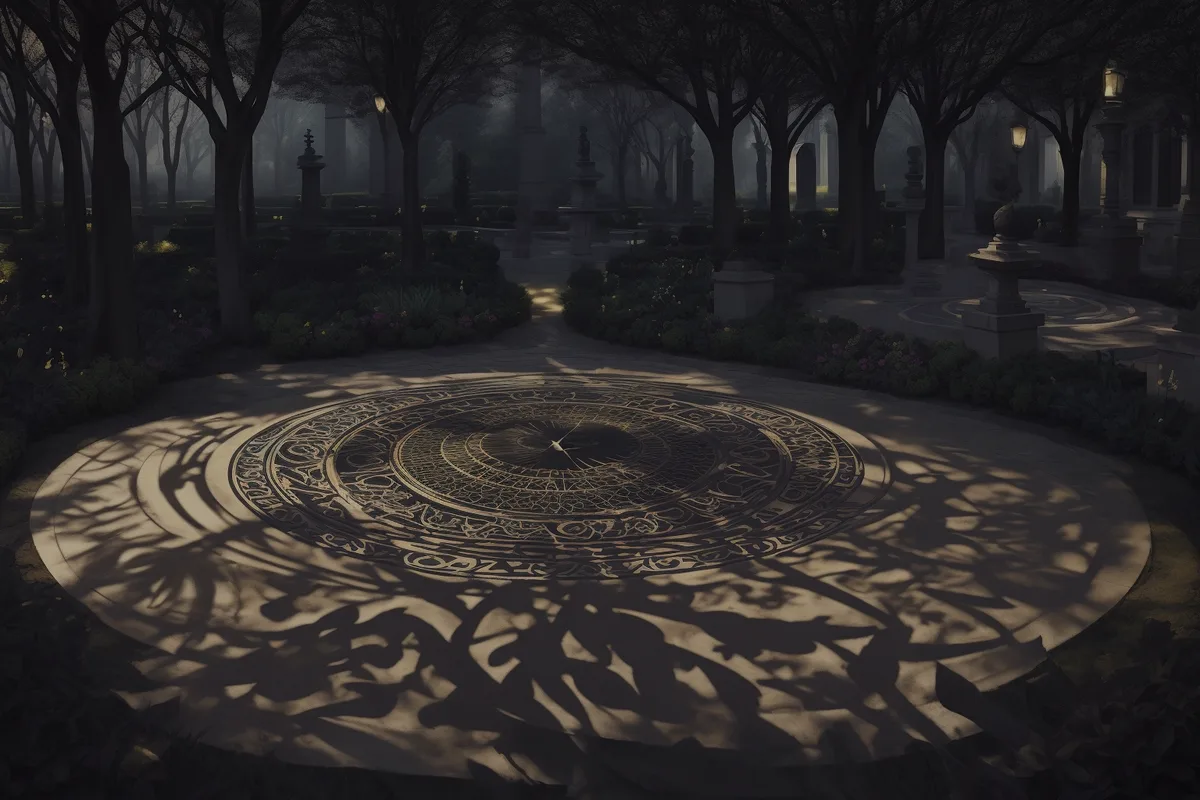
The Romans inherited these instruments and, with characteristic thoroughness, set about standardizing them. In the bustling forum of Rome, sundials stood as public monuments, casting their shadows over the throngs of merchants and citizens. Yet the Romans discovered a curious inconvenience: sundials imported from Greece or Egypt told the wrong time in Roman latitudes. The shadow’s behavior changed with location, and so the Romans embarked on a campaign of measurement and adjustment, striving to bring the unruly Sun under human command. In doing so, they began to sense the limitations of sundials—their dependence on clear skies, their silence at night, their slow drift as the seasons turned.
And so, even as the Sun continued its stately progress, human ingenuity began to stir restlessly in search of something more constant, more reliable—a way to harness the elusive flow of time even when the heavens were hidden. The shadow, so long our companion, began to yield to water and wheels, to the first stirrings of mechanical thought.
But before we leave the realm of sundials, let us pause to consider the way these ancient instruments have lingered in the tapestry of human culture. The sundial is not merely a tool; it is a symbol, a motif that recurs in art, story, and song. In the tale of the Lion King, for instance, there is a moment when Simba, the young lion prince, stands atop Pride Rock at sunrise. The light breaks over the savannah, casting long shadows and illuminating the world in gold. This is the hour of inheritance, of new beginnings, of the circle of life. Though not a sundial in the strict sense, the scene echoes the ancient idea that the Sun’s passage is linked to destiny, to the turning of generations, to the very heartbeat of the Earth.
In poetry and literature, too, the sundial is a persistent presence. Shakespeare’s sonnets are peppered with references to the “dial’s shady stealth,” and to the way “each minute as it passes, steals from me.” The sundial’s shadow becomes a metaphor for the fleeting nature of youth, the slow but certain approach of mortality. In gardens across Europe, stone sundials still stand, inscribed with Latin mottoes: “Horas non numero nisi serenas”—I count only the sunny hours. They are reminders to cherish the present, to treasure the warmth of daylight, to live in harmony with the flow of time.
Yet the sundial, for all its poetry, is bound to the caprices of weather and the turning of the sky. As civilizations grew more complex, as trade and ritual and governance demanded ever greater precision, the limitations of shadow-time became more apparent. In the bustling streets of Baghdad and Damascus, in the academies of Alexandria and the monasteries of medieval Europe, scholars and artisans began to seek new ways to measure the hours.
One of the earliest answers was the water clock—the clepsydra—whose name means “water thief.” In its simplest form, a vessel filled with water would drain through a narrow hole, the falling level marking the passage of time. Water, unlike the Sun, could be kept in motion even at night, even on cloudy days. The Egyptians, Greeks, and Chinese all built intricate clepsydrae, some with floats and dials, others with gears and bells. In the court of the Han emperors, Chinese engineers designed water clocks that not only marked the hours, but also sounded chimes and moved mechanical figures in elaborate displays. In the heart of ancient Babylon, priests timed their rituals by the steady drip of water through carefully calibrated vessels.
But water, too, is fickle. It evaporates, it freezes, it flows faster or slower depending on temperature and material. And so, in the long, slow arc of history, the quest for time’s true measure pressed onward. In the shadowed cloisters of medieval Europe, monks rose in darkness to chant their prayers, guided by flickering candle clocks and hourglasses filled with sand. The need for accuracy grew ever more acute as societies became more interconnected, as ships ventured across uncharted seas, as cities pulsed with commerce and invention.

From the twelfth century onward, in the crowded workshops of Italy and Germany, the first mechanical clocks began to stir into being. They were vast, weight-driven machines, their iron gears and wooden escapements groaning and chattering in the gloom of cathedral towers. These clocks did not rely on Sun or water; instead, they harnessed the steady pull of gravity, the measured release of stored energy. The escapement—a cunning device that allowed a gear to advance, tooth by tooth, at regular intervals—was the beating heart of the new technology. Each tick was a triumph of order over chaos, a tiny assertion of human will against the vast, indifferent flow of time.
The earliest mechanical clocks were imprecise by modern standards, often losing or gaining hours in a day. Yet they marked a profound shift in human consciousness. For the first time, time could be measured and divided independent of the sky. The hours became uniform, abstract, capable of being carved up and allotted to work, to rest, to prayer. The great clock towers of Europe—at Salisbury, at Milan, at Strasbourg—became symbols of civic pride, their bells tolling the hours for all to hear, binding the rhythms of city life to the mechanical heart beating in their midst.
Even as the mechanical clock gained ascendancy, the language of sundials lingered in the collective imagination. The dial’s shadow, the Sun’s journey, the circle of the day—all these motifs found their way into the new world of gears and springs. Clocks were decorated with images of Helios and Chronos, with zodiac signs and astronomical diagrams. The old and the new coexisted, each reminding us that time is both a natural phenomenon and a human construct, both relentless and ineffable.
In distant lands, other forms of timekeeping blossomed. In India, the giant sundials of Jaipur—some reaching several stories high—offered astonishing precision, their marble faces carved with the geometry of the heavens. In Mesoamerica, the shadow of the Sun at the equinox was captured in the serpentine descent of light on the pyramid of Kukulcán at Chichén Itzá—a cosmic clock writ large in stone. In Japan, incense clocks released their fragrance by the hour, marking the passage of time in scent rather than shadow.
Everywhere, the quest to measure time entwined with myth and ritual, with art and science. The Greeks told stories of Chronos devouring his children, a warning of time’s voracity. The Egyptians painted the journey of Ra through the underworld, a promise of renewal with each dawn. In the modern world, the sundial scene in “The Lion King” serves as a visual poem—a reminder that time is both circular and linear, that each generation rises and sets in its turn, that the dance of shadow and light is as old as the world itself.
And so, the tale of timekeeping unfolds, from the first gnomons thrust into the earth to the chattering gears of medieval clocks. At its heart is our eternal fascination with the Sun—the giver of life, the marker of days, the silent companion to all our journeys. As the shadow creeps across the dial, as the hours slip silently by, we are reminded that to measure time is, in some small way, to measure ourselves—our hopes, our fears, our fleeting passage through the world.
But the ticking tale of time is far from finished. As mechanical clocks take their place in towers and towns, a new chapter beckons—a story of invention, rivalry, and the relentless pursuit of precision. The shadow’s reign may be ending, but the quest to tame time is only just beginning, and the quiet heartbeat of the clock awaits its turn to shape the world’s destiny.
Mechanisms of Minutes: The Inner Workings of Clocks
This part will delve into the fascinating complexities of mechanical clocks and the genius of the minds that invented them. We will bust the myth that 'time is constant' by discussing how mechanical clocks introduced the concept of 'relative time'. We will also explore the role of clocks in popular fiction like The Time Machine by H.G. Wells and their depiction in films like 'Back to the Future'.
Beneath the ancient skin of civilization, where cities rose and fell and empires flickered like candle flames, there was a quiet but persistent urge: to possess time, to weigh its invisible flow on human scales. Early on, time was measured by nature’s own breath—the sun’s ascent, the waxing and waning of the moon, the subtle shifting of shadows across the earth. Yet as societies grew dense and ambitions sharpened, these celestial guides proved imprecise, incapable of dividing the day into slices thin enough for the finer machinery of commerce, faith, and personal promise.
From this yearning emerged the clock—a device not merely for marking moments, but for commanding them. Here, in the gentle tick and tock, we find the intersection of artistry, ingenuity, and a restless desire to bring order to the unruly river of time. Tonight, we peer through the latticework of brass and steel, beyond the faces and hands, into the labyrinthine heart of mechanical clocks.
Picture, if you will, a quiet workshop in fourteenth-century Europe—perhaps in the shadowed alleys of Nuremberg, or some bustling Italian city-state. The air is thick with the scent of oil and metal filings. On the bench lies a tangle of gears, levers, and wheels, each piece shaped by hands both steady and inspired. The clockmaker, half craftsman, half philosopher, bends over his creation. His eyes are trained not on the present, but on the intricate ballet his invention will perform for years, perhaps centuries, to come.
The earliest mechanical clocks were vast and ponderous, their gears the size of cartwheels, their weights heavy as a farmer’s burden. Installed in the belfries of cathedrals and town halls, they told time not with silent grace, but with the solemn tolling of bells, announcing the hours to all within earshot. These behemoths were not born of idle curiosity; they were answers to a pressing demand. The regular rhythms of monastic life, the synchronization of markets, even the scheduling of city life depended on the ability to coordinate—to agree, for the first time, on what time it was.
But what is a clock, truly? At its core, it is a governor, a negotiator between chaos and order. It tames the continuous, unyielding march of time by breaking it into manageable pieces. The earliest mechanical clocks relied on a mechanism called the verge escapement. Imagine a wheel with teeth, striving to spin but met with resistance: a pair of pallets, like tiny gates, alternately block and release the wheel’s progress. With each shift, the wheel lurches forward by a precise increment, and the energy stored in a wound weight or spring is released in measured doses. This is the heartbeat of the clock—tick, tock, tick, tock—a mechanical imitation of nature’s own pulse.
Yet even this apparent mastery was laced with imperfection. Early escapements were crude; their ticks uneven, their pace subject to the stretching and shrinking of components with temperature and the slow exhaustion of their driving weights. The clock, for all its promise, told not an absolute time, but a relative one—its hours drifting subtly from day to day, from season to season. It was in these small but persistent errors that humanity first glimpsed a profound truth: time, as experienced and measured, is not constant. It is shaped by the tools we use, by the materials we trust, by our very expectations.
This revelation, quietly embedded in the gears and wheels of medieval timepieces, would echo down the centuries. It is tempting to imagine that time, as the universe knows it, is a single, steady river, flowing unchanged from moment to moment. But the clockmaker’s art teaches otherwise. Each clock, each ticking device, is a world unto itself—its rhythm set by the length of its pendulum, the tension of its spring, the friction of its bearings. No two clocks, left to their own devices, will agree for long. Time, then, is not a single fabric but a tapestry woven from countless, subtly differing threads.
The story of clockwork innovation is, in many ways, a saga of genius and obsession. Consider Christiaan Huygens, a Dutch mathematician and physicist of the seventeenth century. He gazed upon the erratic swings of earlier clocks and saw the possibility of harmony. In 1656, he introduced the pendulum to clockmaking—a weight suspended so that it could swing with a reliable, repeating motion, governed by the iron law of the square root of its length. The pendulum clock, with its serene, almost meditative swing, was a revolution. Its accuracy transformed not only the measurement of hours, but the very structure of society. Meetings could be set for a specific minute; trains could be scheduled and expected to arrive on time; the world grew tighter, more synchronized.
Yet even the pendulum was not immune to the subtle betrayals of reality. Air pressure, temperature, the very latitude of the clock’s location—all could conspire to shift its rhythm by fractions of a second. These were small errors, but in the world of precision, even a single heartbeat’s drift could spell disaster. The race for accuracy continued: with the invention of the balance spring by Robert Hooke and further refinements by Thomas Tompion and John Harrison, clocks grew ever more precise, their discrepancies ever more minute.
But in chasing perfection, clockmakers revealed something deeper. Each advance exposed another layer of relativity, another way in which time’s passage was shaped by human hands. The clock, far from being a mere recorder of an absolute truth, was a participant in the drama of time—a collaborator, not just an observer.
Step back for a moment and consider the implications. Before the age of mechanical clocks, time was communal and flexible, measured by the habits of the sun, the ringing of church bells, the opening and closing of city gates. With the arrival of clocks, time became personal and portable. A small watch could be carried in a pocket, its face a secret window into a private world of minutes and hours. And yet, every such device told time in its own way, slightly out of step with its neighbors, revealing the subtle truth that synchrony is an artifice, painstakingly constructed.
This new, relative time seeped into the fabric of culture and imagination. Writers and philosophers began to toy with the idea of time as something that could be bent, stretched, even manipulated. Nowhere is this more vivid than in the pages of fiction, where clocks are both symbols and engines of narrative magic.
Consider H.G. Wells, whose 1895 novella "The Time Machine" stands as one of the earliest and most enduring explorations of time travel in popular culture. The story’s unnamed protagonist, known only as The Time Traveller, is not a wizard or a prophet, but a scientist—a man who builds a machine to navigate the fourth dimension, as one might sail across a sea. The machine itself is described in mechanical terms: levers, dials, and spinning wheels, a device as much a cousin to the clock as to the locomotive. Wells’s genius lies in his recognition that to travel in time, one must first measure it, divide it, and render it tangible.
The Time Traveller’s journey is a meditation on the relativity of time. He moves forward by degrees, watching the world flicker and blur, day following night in a dizzying spiral. Time, in Wells’s vision, is not an immutable flow, but a landscape to be traversed—a landscape mapped, in part, by the devices humanity has built. The clockwork at the heart of the story is a symbol of both mastery and limitation: we can navigate time only to the extent that we can measure it, and every measurement is bounded by the frailties of our tools.
This theme echoes in the glittering, paradoxical labyrinths of later fiction. In the film "Back to the Future," time is made visible and malleable through another machine—the DeLorean, a car transformed into a vessel for temporal exploration by the eccentric Doc Brown. Here, the mechanics of time travel are rendered almost playful, yet at the heart of the narrative is the clock: the courthouse clock tower, its hands frozen at the fateful moment when lightning strikes, is both a literal and symbolic anchor. The characters’ attempts to synchronize their actions to the split-second—down to the ticking of the clock—mirror the precision and peril of real-world timekeeping.
But even in this world of science fiction, the lesson is clear. Time is not a monolith, but a mosaic. Each journey, each intervention, creates ripples, fractures, echoes. The very possibility of changing the past, of revisiting or revising moments, depends on the notion that time is, in some sense, flexible—shaped by the observer, altered by the act of measurement.
This interplay between clocks and fiction is not mere whimsy. It reflects a deeper truth about our relationship with time. The more precisely we strive to measure it, the more elusive it becomes. Einstein, in the twentieth century, would formalize this dance in his theories of relativity, showing that time itself can stretch and contract depending on speed and gravity. But long before physics caught up, the tick and tock of mechanical clocks had already hinted at this reality: each device, each ticking heart, creates its own private chronicle of the universe.
In every clock, then, there is a paradox. We build them to impose order, to carve the day into work and rest, promise and memory. Yet their very workings reveal the instability of the thing they seek to command. The escapement that ticks with such apparent regularity is, in truth, a compromise—a negotiation between energy and resistance, between ideal and real. The minute hand’s steady circuit is a triumph of engineering, but behind it lies a world of tiny errors, cumulative and inescapable.
These subtleties are not flaws; they are the signature of the clockmaker’s art. Each imperfection, each deviation, is a reminder that time as we experience it is always a human creation—a tapestry woven from the interplay of intention and limitation. The mechanical clock, with its whirring gears and swinging pendulum, is not a dictator but a companion, guiding us through the day while whispering, always, of the mystery that underlies all measurement.
As you listen to the gentle cadence of these words, imagine the hush of a midnight room, a single clock marking the passage of hours with its muted song. Outside, the world is wrapped in shadow, the stars wheeling overhead in their ancient, indifferent arcs. Yet within these walls, time is tamed—made audible, visible, almost tangible. The hands crawl across the face, indifferent to the dreams and worries of those who watch them. And yet, for all their indifference, they are shaped by every choice, every adjustment—a legacy of minds both humble and grand, reaching out to touch the infinite.
Tomorrow, or perhaps another night, we will peer further into the labyrinth of time. For now, let the image linger: a world held together, not by the iron laws of the cosmos, but by the delicate, persistent ticking of countless clocks—each one a small miracle, each one a quiet rebellion against the silence of eternity. The story of time is not finished, nor ever truly begun; it is a journey, measured in minutes and marked by wonder, unfolding with each tick, each tock, into the endless dark.
Atomic Accuracy: The Science of Timekeeping
This part will explain how we study and measure time with incredible precision today using atomic clocks. We will discuss the history of this technology, the clever experiments that led to its creation, and the tools used in its operation. The role of atomic clocks in synchronizing global systems like GPS will be highlighted, and we'll debunk the myth that atomic clocks 'never lose time'.
Beneath the hum of civilization, in hidden laboratories and quiet vaults, a delicate heartbeat pulses—one that is not born of flesh or earth or sun, but from the shiver of atoms themselves. This is the domain of atomic timekeeping, the art and science of measuring time not with the swing of a pendulum or the turning of gears, but with the fundamental rhythms woven into the fabric of the universe. Here, in this world of unparalleled precision, we find the atomic clock: humanity’s most faithful guardian of time.
The journey to such precision was neither swift nor straightforward. For centuries, humankind’s clocks were crude and capricious companions. Sundials surrendered to clouds; hourglasses trickled differently with each grain or gust. Even the finest mechanical clocks—those marvels of Enlightenment ingenuity—could drift by seconds each day, their gears subject to the whims of temperature, friction, and wear. The quest for something truer, something rooted in nature itself, drove inventors and scientists to ever deeper inquiries: what, after all, is a second? How might one measure time not by Earth’s faltering spin, but by something utterly constant, immune to the chaos of weather or the slow flexing of continents?
In the early twentieth century, the answer began to take shape, not in the grand sweep of celestial mechanics, but in the subtlest flicker of the atom. Physicists probing the heart of matter discovered that atoms, those tiny sovereigns of the physical world, possess their own rhythms—oscillations so regular and unwavering that they could, in principle, serve as nature’s own metronome.
At the heart of this revelation lies quantum mechanics, a domain where energy comes in discrete packets, and the dance of electrons around an atomic nucleus is both mysterious and mathematically precise. Each type of atom, depending on its internal structure, possesses unique energy levels. When an electron jumps from one level to another, it emits or absorbs electromagnetic radiation of a frequency determined, with uncanny reliability, by the difference between those levels.
For the element cesium, this quantum leap is particularly suitable. In cesium-133, the transition between two specific hyperfine energy states of its ground state yields radiation with a frequency so stable that it forms the bedrock of our modern timekeeping. In the late 1940s and early 1950s, scientists such as Harold Lyons in the United States, and Louis Essen at the National Physical Laboratory in Britain, began to construct clocks based on this atomic rhythm. Their efforts culminated in 1955, when Essen and Jack Parry unveiled the world’s first practical cesium atomic clock. The era of atomic time had dawned.
How does such a clock work? Set aside, for a moment, all thoughts of gears and pendulums. Instead, picture a vacuum chamber, a small tube through which a beam of cesium atoms travels, cooled and isolated from the jostling world outside. These atoms are nudged by microwaves tuned near the frequency of their hyperfine transition—precisely 9,192,631,770 cycles per second, as defined by international convention. When the microwaves strike exactly the right frequency, the cesium atoms flip from one state to another, and this change is detected downstream. The system continually fine-tunes the microwave generator, seeking the frequency that maximizes this atomic response. In effect, the atoms themselves dictate the beat, correcting any deviation and forcing the clock to follow their immutable rhythm.
This mechanism is a marvel of feedback and fidelity, a dance of matter and energy choreographed by the laws of quantum physics. The result is a timepiece so accurate that it would drift by less than a second over millions of years. Yet, this astonishing precision is not merely a technological curiosity. It is the foundation upon which much of our modern world is built.

Consider the Global Positioning System, or GPS—a constellation of satellites circling the Earth, each carrying atomic clocks within their metallic hearts. The principle behind GPS is simple, yet profound: by measuring the time it takes for signals to travel from several satellites to a receiver on the ground, your position can be pinpointed anywhere on the globe. But this calculation demands exquisite accuracy. A timing error of just one billionth of a second—one nanosecond—translates to a positional error of nearly a foot. If the atomic clocks aboard the satellites were to drift by even a few microseconds, your smartphone’s map would place you streets, or even miles, away from your true location.
To sustain this precision, GPS satellites are equipped with not just one, but several atomic clocks—cesium beam tubes, rubidium oscillators, and increasingly, hydrogen masers. These clocks are cross-checked and synchronized with even more accurate time standards on the ground, maintained by national laboratories around the world. This global network forms the backbone of Coordinated Universal Time (UTC), the ticking pulse that unites the world’s clocks, stock exchanges, power grids, and data centers in a grand choreography. Each second that passes in your daily life has been defined, measured, and distributed by these atomic guardians.
Yet, despite their almost mythic accuracy, it is a misconception to believe that atomic clocks “never lose time.” In reality, they are not immune to the subtle influences of the universe. The ticking of an atomic clock is affected by gravity—a consequence of Einstein’s general relativity. Place one clock on a mountain and another at sea level, and the one at altitude will tick slightly faster, for gravity tugs less fiercely at its atoms. Likewise, a clock in a speeding satellite experiences the strange slow-down of special relativity, ticking more slowly than its earthbound siblings. The designers of GPS must account for these effects, correcting the satellite clocks so that their signals remain synchronized with those on the ground.
Moreover, even the most refined atomic clocks are not perfect. While the cesium transition is astoundingly stable, it is still subject to minute perturbations—stray magnetic fields, temperature fluctuations, and the physical limitations of the apparatus. Scientists speak of “systematic uncertainties,” tiny errors that must be measured, modeled, and minimized. The best atomic clocks today, known as optical lattice clocks, use elements like strontium or ytterbium, and operate at much higher frequencies than cesium clocks—hundreds of trillions of cycles per second. These clocks can achieve fractional uncertainties of less than one part in 10^18, a precision so extreme that they could measure the passage of time differently on the top and bottom steps of a staircase.
The evolution from cesium beam clocks to optical lattice clocks is a testament to the relentless ingenuity of timekeepers. In optical clocks, atoms are trapped in a lattice of intersecting laser beams, their motion cooled to near absolute zero. A separate laser is tuned to the precise frequency of an atomic transition in the optical range, and an elaborate system of electronics and feedback ensures that the laser follows the atom’s ticking. The higher frequency of the optical transition allows for even finer subdivisions of the second, yielding clocks that are both exquisitely precise and astonishingly stable.
But why pursue such extremes? What need could there be for time measured so finely that it blurs the boundary between science and philosophy? The answer lies both in the practical and the profound. On the practical side, ever more accurate clocks allow for improved navigation, more precise synchronization of communication networks, and more sensitive tests of the laws of physics. On the profound side, atomic clocks have become tools for probing the very nature of reality. By comparing clocks at different altitudes, researchers can test the predictions of general relativity with unprecedented rigor. By monitoring for tiny drifts over years, they can search for signs that the fundamental constants of nature might be changing—a possibility with deep implications for our understanding of the universe.
The story of atomic timekeeping is also a story of collaboration and consensus. The International Bureau of Weights and Measures, based in Sèvres near Paris, gathers data from atomic clocks maintained by national laboratories around the world. These clocks, each a marvel of engineering, collectively define International Atomic Time (TAI), a timescale so stable that it serves as the ultimate reference for scientific and technological applications. From this foundation, Coordinated Universal Time is derived, incorporating occasional “leap seconds” to keep our civil time in step with the slightly erratic rotation of the Earth.
Leap seconds themselves are a reminder that, for all our technological prowess, humanity remains tethered to the natural world. The Earth’s rotation is not perfectly regular; it wobbles and slows, nudged by the moon and the shifting of oceans and winds. When atomic time and astronomical time drift apart by more than nine-tenths of a second, a leap second is inserted—typically on June 30 or December 31—to bring the two back into harmony. These adjustments, rare as they are, can cause headaches for computer systems and financial markets, but they serve as a poetic bridge between the ancient and the modern, the spinning planet and the ticking atom.
Within the hushed halls of national metrology institutes, the pursuit of perfect time continues unabated. Physicists cool atoms to near absolute zero, trapping them in electromagnetic fields and shining lasers of unimaginable purity. They shield their experiments from every stray vibration and magnetic ripple, striving to push the limits of accuracy ever further. The signals from these clocks are transmitted by fiber-optic cables and radio links, compared and averaged, their data woven into the global fabric of time.
And while the cesium second is still the official definition of time, the horizon beckons with the promise of optical clocks that may someday redefine our measurement of the second itself. Already, researchers envision a future in which portable optical clocks could be carried into the field, mapping the gravitational potential of the Earth with centimeter precision—a kind of chronometric cartography, where the flow of time itself reveals the contours of the world.
All of this—the satellites overhead, the fiber-optic pulses beneath our feet, the cold clouds of atoms in their silent chambers—depends on the subtle, invisible rhythm of the quantum world. Each pulse of an atomic clock is a kind of whisper from the heart of matter, a fleeting resonance that links our human sense of time to the deep, regular humming of the cosmos. The seconds that tick by on your wrist or your phone are not mere conventions, but the end result of a long chain of discovery, innovation, and international cooperation.
It is a breathtaking thought: that every moment of your life, every appointment kept or train departed, is governed by the dance of atoms set into motion billions of years ago, in the birth of the universe itself. Atomic clocks may not be flawless, but they are our closest approach to the eternal—a way of measuring time that reaches beyond the turning of the Earth, into the very heart of the physical laws that shape reality.
And yet, even as atomic clocks push the boundaries of precision, questions linger. What lies beyond the reach of even the best atomic timekeepers? Are there rhythms deeper still, patterns hidden in the quantum foam or the gravitational waves that ripple through spacetime? As scientists build ever more refined clocks, they peer closer into the mystery, seeking to unravel not just the measure of time, but its meaning.
In the gentle pulse of atomic clocks, we hear both the triumph of human curiosity and the invitation to look further, to listen more closely to the subtle music of the universe. The story of timekeeping, far from ending in the silence of perfect synchronization, continues onward—into new technologies, new discoveries, and new questions that linger on the threshold of understanding.
In the quiet darkness, as the world turns and the atoms tick, the future of time waits to be discovered, just beyond the next exquisite measurement.
Time and Humanity: The Philosophy of Measurement
This final part will reflect on the meaning and mystery of time. We will examine how our ability to measure time has shaped human civilization, from scheduling our lives to navigating our world. We will ponder on the philosophical implications of time measurement, drawing from thinkers like Kant and Einstein, and discuss how timekeeping, despite its scientific precision, remains fundamentally connected to our human experience.
Beneath the slow drift of night, as the world hushes and the pulse of daily concern softens, the gentle ticking of a clock might be the only sound that persists—a quiet sentinel marking the passage of seconds in a world otherwise wrapped in shadow. Here, in this subtle interplay of darkness and measured rhythm, we find ourselves once more contemplating the enigma of time: not merely its flow through the cosmos, nor solely the gears and oscillations by which we track it, but the deeper relationship between humanity and the very act of measuring time. Our story has led us across the sweep of astronomical cycles and the intricacies of atomic vibrations, but now, we turn inward, to the landscape of mind and meaning, where the philosophy of time measurement quietly shapes our lives.
Consider, for a moment, the way a day unfolds. From the first pale hints of dawn, through the rush of midday, and into the long exhale of evening, our actions are orchestrated by the unseen choreography of clocks and calendars. Meetings are scheduled, trains depart, bread rises, and children are tucked into bed, all according to temporal codes that are more than mere conventions—they are the architecture of shared reality. Yet, beneath the surface of these routines, questions stir: What does it mean to measure time? Does our ability to slice the continuum into hours and minutes reveal something about the nature of time itself, or only about the nature of our minds?
Long before mechanical clocks or atomic oscillators, ancient people marked time by the passage of stars and the slow turning of seasons. The return of Orion to the winter sky, the swelling of the crescent moon, the lengthening of shadows at solstice—these were not just astronomical events, but markers woven into the fabric of myth and memory. In the flicker of a firelight, elders spoke of cyclical time, of the eternal return, of the world’s pulse echoing in the heart of every living being. Time was experienced as both a rhythm and a presence, intimate and immense.
But as human societies grew, as cities rose and empires sprawled, the need for more precise, more communal reckoning of time became urgent. It was not enough to know that the solstice was near; now, the irrigation of fields, the collection of taxes, the ringing of market bells—all depended on shared agreement. Sundials cast their long, slow shadows across marble plazas. Water clocks dripped out the hours in dim, stone-walled rooms. Each innovation in timekeeping carried with it a subtle, transformative power: to coordinate, to organize, to synchronize the efforts of thousands who might never meet, yet who shared the same invisible scaffold of measured time.
With each advance, the act of measuring time became more than a technical achievement—it became a defining trait of civilization. In the monasteries of medieval Europe, for example, the relentless chiming of bells called monks to prayer at intervals mapped across the day and night, carving sacred regularity into the fabric of communal life. The clock tower rising over the city square was not only a marvel of engineering but a symbol of collective order, a visible heart that beat for all. Gradually, the measure of time seeped into every crevice of human activity, shaping not only what we do, but how we think and what we value.
Yet, as time became more uniformly measured, its mystery deepened. The philosopher Immanuel Kant, writing in the shadowed libraries of eighteenth-century Königsberg, suggested that time is not a thing “out there” in the world, like a river or a stone, but rather a form by which our minds structure experience. According to Kant, we do not perceive time directly; rather, we impose the idea of temporal sequence upon the chaos of sensation, weaving the raw data of the world into coherent stories that unfold, moment by moment. In this view, time is both real and unreal: it is the very condition for our experience of reality, and yet, it has no existence apart from our perception.
This insight lingers, unsettling and profound. The very tools we use to measure time—clocks, calendars, computers—may offer increasing precision, but they do not dispel the essential mystery of what time is. Instead, they remind us that time, for all its scientific rigor, is an experience, lived and felt. The beat of a heart, the anxiety of waiting, the nostalgia of memory, the anticipation of a future not yet born: all are different facets of our temporal existence, none reducible to mere numbers on a dial.
The paradox grows sharper in the light of modern physics. When Einstein’s equations revealed that time is not absolute but relative—that the tick of a clock depends on its motion, its position in a gravitational field, its path through spacetime—the old certainty slipped away entirely. The universe, it seemed, was not a stage upon which events unfold in perfect synchrony, but a tangled web of clocks, each following its own rhythm, coordinated only by the subtle, mathematical structure of spacetime itself.
Despite these revelations, or perhaps because of them, our urge to measure time has only intensified. Consider the Global Positioning System, those silent satellites wheeling above the clouds, each equipped with atomic clocks so precise that even the tiniest discrepancy—mere nanoseconds—would render the system useless. GPS works not by triangulating positions in space alone, but by measuring the time it takes for signals to travel from satellite to receiver, correcting for the relativistic effects of both motion and gravity. In a real sense, to navigate the world today is to navigate a web of time, stitched together by the harmonized ticking of machines in the sky.
Yet, for all this technical mastery, time remains deeply personal. Stand in a quiet room, eyes closed, and listen to the slow breathing of your own body. The seconds stretch or contract depending on your mood, your attention, the weight of memory or the lightness of anticipation. The philosopher Henri Bergson called this la durée, “duration”—the lived, qualitative flow of time, distinct from the mathematical abstractions of clocks. We do not truly live in seconds and minutes; we live in moments: the hush before a loved one’s voice, the soft ache of longing, the sudden rush of joy. Our hearts are not metronomes.
Still, the discipline of measurement returns, grounding even the most dreamlike reverie. In the world of science, to measure is to know, to compare, to test. The very possibility of experiment, of replication, of communication across generations and continents, depends on the shared scaffolding of measured time. It is measurement that makes the world intelligible, that allows us to ask and answer questions, to build and to remember. And so, our tools for measuring time—however imperfect—become vessels for our deepest aspirations: to understand, to predict, to control, to hope.
But what of the cost? Some thinkers have wondered whether our relentless drive to measure time carries a hidden price. The philosopher Martin Heidegger warned that the “world-time” of clocks and schedules, for all its utility, can estrange us from the deeper flow of being. When every activity is bound to the tyranny of the clock, when every moment is weighed and allocated, there is a risk that we lose touch with the richness of lived experience. The ancient rhythms—the waxing and waning of the moon, the slow ripening of fruit, the ebb and flow of conversation—are flattened into mere units, interchangeable and devoid of meaning.
There is, perhaps, a tension here, a creative friction between the necessity of measurement and the irreducible mystery of time as it is lived. To measure is not to solve, but to participate in a dance as old as humanity itself. The ticking of clocks, the marking of calendars, the counting down to midnight on New Year’s Eve—all these rituals bind us together, forging continuity in the face of change. At the same time, each measured moment slips away, irrecoverable, leaving only memory and longing in its wake.

Yet, in this tension, there is also beauty. The poet T.S. Eliot once wrote, “Only through time time is conquered.” Perhaps, through our efforts to measure and understand, we do not diminish time, but rather deepen our relationship with it. The calendar on the wall, the alarm that wakes us, the stopwatch that marks a runner’s sprint—all these are invitations to pay attention, to notice, to honor the passage of days and years.
In this light, the history of time measurement becomes more than a tale of gears and pendulums, atoms and lasers. It is a story of dreams and anxieties, of rituals and revolutions, of the endless human quest to orient ourselves within the vastness of the unknown. The earliest calendars carved into bone or stone, the ornate clock towers looming over medieval towns, the digital readouts glowing on modern wrists—all these are expressions of a single, abiding desire: to find meaning in the flow of existence.
The philosopher Augustine, meditating in the quiet of his study, once confessed to being both fascinated and bewildered by time. “What, then, is time?” he asked. “If no one asks me, I know; if I wish to explain it to him who asks, I do not know.” This confession, uttered more than a thousand years ago, still carries weight. For all our advances, for all our cleverness, time remains both intimately familiar and utterly strange.
And so, we find ourselves moving forward, guided by the instruments we have made, yet always haunted by the questions that remain. The clock on the wall tells us when to act, but not why. The calendar marks our birthdays and anniversaries, but cannot capture the fullness of what those days mean to us. The atomic clock in its underground vault keeps perfect time, but knows nothing of hope or grief, of anticipation or regret.
Perhaps this is as it must be. The measurement of time may be one of humanity’s greatest achievements, but it is not an answer, only a conversation—a dialogue between the finite and the infinite, the known and the unknowable. Each tick of the clock is both a loss and a promise, a farewell to what has been and an invitation to what might yet be.
As you listen to the faint, steady rhythm of your own heartbeat, as you notice the hush between one breath and the next, you participate in a mystery that spans both the reach of science and the depths of philosophy. Time moves through you, and you through it. The measured, the unmeasured, the imagined, the remembered—all are woven together in the tapestry of your experience.
And so, the story of time and humanity continues, unending, each moment a threshold, each question a beginning. The clocks may tick and the stars may turn, but the meaning of time, and the meaning of measuring it, remains forever just beyond the grasp of certainty—a gentle mystery, inviting wonder, whispering softly in the darkness, promising always something more.