The Apple's Whisper: Newton's Legend
This part will cover the cultural and sci-fi associations of Isaac Newton's discovery of gravity, focusing on the apple story and its influences on popular culture.
In the hush of evening, when the world’s commotion falls away, there is a certain magic that gently settles over all things. The branches of trees sway as if they are breathing, and the air itself becomes thick with possibility. In this quiet, stories that have shaped the very way we look at the universe seem to draw near, whispering their secrets as softly as the rustle of leaves. Among the oldest and most persistent of these is the story of an apple, a moment of quiet revelation beneath a fruit-laden tree, and the birth of an idea that changed the course of science forever.
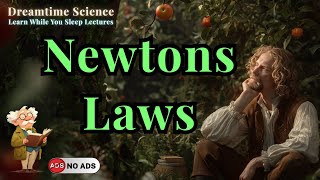
The tale is simple, almost fairytale-like in its brevity: Isaac Newton, a young scholar in the English countryside, sits beneath an apple tree. An apple falls—some say upon his head, others say merely within his view. In that gentle descent, in the arc traced by the falling fruit, Newton glimpses the profound. Gravity, the force that holds the moon in its orbit, that tethers oceans to the planet, that keeps our feet planted on the ground, is suddenly laid bare to human understanding.
If you listen closely to the echoes of history, you will find this moment repeated in countless retellings, embroidered with the aspirations and dreams of each era that has adopted it. The apple, once a simple fruit, becomes an emblem of revelation, a cipher for the instant when the cosmos opened itself to human reason. Whether the story is strictly true matters little now; what matters is how it has seeped into the collective imagination, how it has grown larger and rounder with every telling, until it has become as much myth as it is memory, as much a creation of culture as a record of fact.
Let us linger for a while in that mythic orchard, beneath the spreading boughs of Newton’s legendary tree. The year is 1666. The world is in turmoil: plague sweeps through London, darkening the city’s alleys and markets, and Newton, like many scholars, has retreated to the safety of the countryside. The garden at Woolsthorpe Manor is a place of quiet contemplation. Here, the distractions of city life fall away, and the mind is free to wander as far as the imagination dares to roam.
In the cool shade, Newton sits, perhaps with a book balanced on his knee, his thoughts chasing the mysteries of motion and force. Above him, apples hang heavy, their skins blushed with the promise of autumn. One apple, in this story that has circled the globe, detaches itself from its stem and falls earthward. It is a moment that could belong to any day, to any orchard, to any observer with eyes open to the world’s small wonders. But for Newton—and for all of us who live in the wake of his insight—this is no ordinary moment.
There is a peculiar power in the image of the falling apple. It is humble, immediate, and universal. Who among us has not watched fruit fall, or a stone drop, or leaves flutter groundward in their slow spiral? And yet, in the hands of legend, this everyday occurrence becomes the key to the heavens. From the gentle plummet of the apple, Newton is said to have leapt in mind’s eye to the invisible force that binds all things, from orchard fruit to distant planets.
It is worth pausing to consider just how this story, so simple and so resonant, became attached to Newton and his revelation. The earliest records, penned by Newton’s own contemporaries, do not mention the apple at all. It is only decades later, in the reminiscences of his friend William Stukeley, that the scene crystallizes. Stukeley, in a memoir published after Newton’s death, recounts a conversation in which Newton himself described the inspiration: “Why should that apple always descend perpendicularly to the ground, thought he to himself...”

The details are vague, and yet, that vagueness is the very soil in which legend takes root. The apple becomes a symbol, not just of Newton’s moment of insight, but of all human curiosity. It is the fruit of knowledge, echoing the ancient stories of Eden and the first awakening to the mysteries of the world. It is the prize of the questing mind, the reward for those who sit quietly and allow themselves to wonder.
As the centuries turn, the apple’s descent takes on a life of its own, cascading through art, literature, and popular science. It appears in paintings—Newton, lost in reverie under the apple tree, the fruit frozen mid-fall as if the world itself is pausing for his thoughts. It slips into poems and children’s books, where the laws of gravity are distilled into the simple truth that “what goes up must come down.” It is reimagined in classroom experiments, as teachers drop apples before wide-eyed students, inviting them to recapitulate the long arc from curiosity to comprehension.
Science fiction, too, has found in Newton’s apple a symbol both playful and profound. In the stories spun out across the gleaming corridors of future starships and the windswept plains of distant planets, the apple’s fall becomes a metaphor for the reach of human reason. In some tales, astronauts tether apples to the ceilings of their spacecraft, watching as they float free in microgravity, pondering the universality of Newton’s laws. In others, sentient machines or alien beings debate the nature of the force that binds matter, referencing the ancient Earth myth of the fruit that revealed the secrets of space.
The apple, so ordinary on Earth, becomes a test of home and alienness, a measure of how the universe is both strange and familiar. In the television series and films that explore distant worlds, a character might idly toss an apple, only to see it drift away, heedless of the gravitational pull that shaped Newton’s own musings. The laws of gravity, it seems, are both a bond to our planet and a key to exploring what lies beyond.
Popular culture has further woven the image of Newton and his apple into its own tapestry of meaning. Cartoons and comics riff on the scene, showing Newton beset by a rain of apples, or imagining what might have happened had a pineapple, rather than an apple, landed upon his head. Advertisements invoke the apple as a symbol of ingenuity and “thinking differently”—a nod, perhaps, to the same spirit that animated Newton’s leap of imagination. In classrooms and science fairs, papier-mâché apples dangle from threads, inviting each new generation to reenact the moment of inspiration.
The apple’s journey through our collective consciousness is not merely a matter of repetition; it is a process of continual reinvention. Each telling reshapes the story, adapting it to new contexts and concerns. For some, the apple’s fall is a lesson in humility, a reminder that the universe operates according to laws that we must labor to uncover. For others, it is a celebration of serendipity, the idea that great discoveries can arise from the simplest observations.
And yet, beneath all these layers of meaning, there is a deeper resonance. The story of Newton’s apple is, at its core, a meditation on the nature of understanding itself. Science, it suggests, is not merely a matter of calculation or experiment; it is a way of seeing, of noticing the patterns that underlie even the most mundane events. To watch an apple fall is to be confronted with a mystery: Why does it fall? Why downward, and not sideways or upward? What unseen hand guides its path?
For Newton, and for those who followed, the answer lay in the concept of a universal force, an invisible thread that connects apple and planet, stone and star. The mathematics that would emerge from this insight—published decades later in his monumental *Philosophiæ Naturalis Principia Mathematica*—would provide the scaffolding on which modern physics would be built. But before the equations, before the proofs and diagrams, there was the moment of contemplation, the willingness to wonder at the ordinary and to seek the extraordinary within it.

This willingness is what has made the apple story so enduring. It is not just a tale about Newton, or about gravity, but about the potential that lies within every quiet moment, every unexpected observation. In the hush between heartbeats, the world may reveal itself to those who are patient enough to listen.
The cultural afterlife of Newton’s apple is as rich and varied as the world itself. In some places, the tree itself has become a site of pilgrimage. At Woolsthorpe Manor, a gnarled apple tree—said to be a descendant of the very one that shaded Newton—still stands, its branches heavy with the weight of history. Visitors from around the globe come to stand beneath it, to trace the arc of the falling fruit in their own minds, to imagine themselves on the cusp of discovery.
Museums display apples—real and sculpted, painted and preserved—as relics of the moment when the earthbound and the celestial were joined by the insight of a single mind. In the digital age, the apple has leapt from the orchard to the screen, its image pixelated and stylized, yet no less potent for its transformation. It is a meme, an icon, a shorthand for the moment when the world became comprehensible.
Even as science has advanced, peeling back the layers of gravity to reveal ever deeper mysteries, the apple remains a touchstone, a reminder of where our journey began. For students grappling with the abstractions of force and mass, the story of Newton and his apple offers a foothold, a way to anchor lofty concepts in the soil of everyday experience. For writers and artists, it is a wellspring of metaphor, a symbol of the leap from ignorance to illumination.
In the worlds of speculative fiction, the apple’s fall is replayed on alien worlds, in the low gravity of asteroids, in the simulated environments of virtual reality. The simple act of dropping an object becomes a test of reality itself, a way of distinguishing the familiar from the strange. Characters muse on the universality of gravity, wondering whether somewhere, on some distant planet, another observer might sit beneath a tree and watch as fruit falls, as ideas are born, as the universe once again whispers its secrets.
The apple’s journey is not yet done. With each new generation, the story finds fresh soil in which to grow. Some challenge the legend, pointing out the embellishments and uncertainties, seeking to separate fact from fiction. Others embrace the myth, seeing in it not a distortion, but a celebration of the power of story to inspire curiosity.
And so, as night deepens and the world slows, let your thoughts drift back to that garden in the English countryside, to the rustle of leaves and the hush of contemplation. See the apple, poised for a moment at the edge of its fall, balanced between earth and sky, between the known and the unknown. In that suspended moment, all the possibilities of discovery are contained, waiting for someone to notice, to ask, to wonder.
For the apple’s whisper is not only Newton’s; it is the whisper of curiosity itself, echoing through the centuries, inviting each of us to look again at the world, to see in the ordinary the seeds of the extraordinary. The story, like the apple, continues to fall, drawing us onward toward new questions, new mysteries, and the endless unfolding of wonder. And as this gentle arc continues, another thread waits to be woven—a story not merely of falling, but of forces unseen, of the silent bonds that shape the cosmos, whose secrets linger just beyond our reach, beckoning us to listen a little closer.
Gravity's Intricate Dance: Newton's Laws
This part will delve into the deeper complexities of Newton's laws of motion and universal gravitation. We will debunk misconceptions and highlight the limits of Newton's understanding of gravity.
In the hush of the late seventeenth century, when the world still lay cloaked in mystery and the night sky arched overhead with its riddles unbroken, a remarkably inquisitive mind gazed through the lattice of apple tree branches and into the heart of the cosmos. Isaac Newton, solitary and tireless, pondered the fall of fruit and the wandering course of the moon. In those moments, he glimpsed a thread that tied the heavens to the earth—a force, invisible yet inexorable, that pulled on apples and planets alike.
Newton’s mind was a vessel for both awe and precision. He saw through the veils of myth and legend, seeking the mathematics that might explain why things moved, why they changed course, why they did not fly apart into chaos. His laws of motion and his law of universal gravitation would, for a time, bring clarity to the tangled dance of matter, revealing a clockwork universe of sublime regularity.
Yet, as we settle into the gentle cadence of this exploration, let us not be lulled into thinking these laws were final or flawless. Their beauty lies not just in their elegant simplicity, but in the subtle puzzles and philosophical shadows they cast—puzzles that would haunt generations of thinkers and lead, eventually, to deeper mysteries.
Let us first feel the quiet power of Newton’s First Law, the law of inertia. In essence, it tells us that a body at rest remains at rest, and a body in motion continues in straight-line motion at constant speed, unless acted upon by an external force. At a glance, this seems almost trivial, a mere statement of the obvious. Yet, hidden within is a radical reimagining of how the universe works.
Before Newton, the prevailing wisdom—rooted in Aristotle’s teachings—held that constant motion required constant cause. Objects, it was believed, naturally sought rest unless something kept pushing them. Newton shattered this view. He proposed that motion was not in need of explanation; it was change, deviation from straight-line inertia, that demanded a cause. Thus, friction, air resistance, and the myriad invisible hands that slow carts and arrows became not the rule, but the exception.
Consider, for a moment, a puck gliding across a smooth, frozen pond. In the absence of friction, it would travel forever, unchanging, unless nudged or halted by some external agent. The universe, Newton suggested, does not favor rest over motion. Both are natural states. The world is not a stagnant pond, but a place where movement and stillness share equal dignity.
Yet, Newton’s law of inertia also invokes a subtle, haunting question: what, exactly, is this reference frame in which motion is measured? When we say an object is at rest or in motion, we must always ask—relative to what? For Newton, the answer seemed clear: space itself was an absolute arena, a stage upon which the drama of matter played out. But this notion of absolute space, though comforting in its simplicity, would later be challenged, and with it, the very foundation of what “motion” means.
From inertia, we pass to Newton’s Second Law, the law of acceleration. It is a rule of proportionality, stating with crystalline clarity that the force acting upon an object is equal to the mass of that object multiplied by its acceleration. F = ma. With these three letters, Newton gave the world a universal prescription for predicting motion. Apply a force, and an object’s motion will change in precise measure.
Yet here, too, the law is more nuanced than first appearances suggest. Force and acceleration are both vectors—they possess both magnitude and direction. The world, thus, is not merely about speeds, but about changes, turns, twists, and the subtle negotiations between pushing and yielding. Mass, meanwhile, emerges as a measure of resistance to change—a quality intrinsic to matter itself.
The implications are profound. A feather and a hammer, dropped from the same height in a vacuum, will fall together, their accelerations equal, because the gravitational force upon each is exactly balanced by its mass’s resistance to acceleration. In the absence of air, the difference between stone and straw vanishes.

Newton’s Third Law, often stated as “for every action, there is an equal and opposite reaction,” completes the triad. It is the law of mutuality, of partnership. No force acts alone. When you press your hand against a wall, the wall presses back with equal vigor. When a rocket expels gas out its exhaust, the gas shoves back, propelling the rocket forward. The universe is a web of reciprocal influences, a tapestry of pushes and pulls.
But these laws, majestic as they are, were not conjured in a vacuum. They were shaped by centuries of observation, by the slow accumulation of knowledge and the relentless questioning of assumption. And they are not without their enigmas.
Consider, for a moment, the law of universal gravitation. Newton proposed that every mass in the universe attracts every other mass, with a force that grows weaker with the square of the distance between them. This law, simple in its algebraic form, unlocked the secrets of planetary motion. It explained why the moon orbits the Earth, why the planets trace their elliptical paths around the sun, and even why the tides rise and fall.
And yet, as Newton himself admitted, the law’s mechanism was shrouded in mystery. “I frame no hypotheses,” he famously declared, regarding the cause of gravity. He described the force, calculated its effects, but could not explain how it reached across empty space. How could the Earth pull on the moon, or the sun on the Earth, with nothing connecting them? Was it not, as some critics murmured, a retreat into magic, replacing the crystalline spheres of antiquity with an invisible hand?
Newton’s answer was pragmatic. The mathematics worked; the predictions matched observation. But the nature of gravity itself—the way its influence jumped instantaneously across the void—remained a puzzle. Was it a property of space itself? Was there some unseen medium, an “aether,” that carried gravitational influences? Or was gravity a fundamental law, requiring no further explanation?
These questions lingered, unresolved, even as Newton’s equations guided ships across oceans and astronomers across the gulfs of space. The universe, in Newton’s vision, was like a great machine, its gears set in motion at the dawn of time, its parts governed by rational laws. Yet, beneath the surface, the machinery had its shadows.
One of the most persistent misconceptions about Newton’s laws is the idea that they are universal, unyielding, and complete. For centuries, they seemed to be. The motions of the planets, the flight of cannonballs, the sway of pendulums—all could be explained with Newton’s rules. The universe appeared deterministic: given the initial positions and velocities of all particles, one could, in principle, calculate the future and the past.
But this vision, for all its grandeur, was not without cracks. The first hints came from the edges of the solar system. The orbit of Mercury, the innermost planet, deviated ever so slightly from Newtonian prediction. No matter how carefully astronomers measured, a tiny residue of error remained—a precession of Mercury’s perihelion, a drift unexplained by the gravity of the sun and planets.
Other anomalies whispered at the boundaries of celestial mechanics. Uranus, discovered in the late eighteenth century, did not move exactly as Newton’s laws demanded. The search for missing planets, for undiscovered bodies whose gravity might account for the discrepancies, became a pursuit of the age. Sometimes, as with Neptune, the search succeeded. At other times, the errors persisted, hinting at deeper flaws.
Yet, for most everyday phenomena, Newton’s laws reigned supreme. Their predictive power was unparalleled. They allowed the building of bridges, the charting of orbits, the understanding of tides and eclipses. They became the language of engineering, of astronomy, of physics classrooms everywhere.

Still, lurking within the equations were philosophical tensions. The notion of absolute space and absolute time, central to Newton’s worldview, ran counter to the principle of relativity, quietly articulated by Galileo a generation before. If all motion is relative, what meaning can there be in an “absolute” frame? And if the laws of physics are the same for all observers moving at constant velocity, how can gravity act instantaneously, leaping across the void faster than any signal or messenger?
Newton’s universe is, in a sense, haunted by distance and simultaneity. If the sun were to vanish, Newton’s gravity would predict the Earth’s orbit would change at once, with no delay. But this stands at odds with the finite speed of light, the ultimate speed limit of the cosmos. The contradiction would not be resolved until centuries later, when a new mind—Einstein—would reshape our understanding once more.
Another subtlety lies in the interpretation of force itself. Newton’s laws treat force as a given, a cause that acts upon masses to produce acceleration. But the nature of force, its origin, and its transmission are left unexamined. What is a force, truly? Is it a push or a pull mediated by contact, or can it act from afar? The answer, in Newton’s time, was both: gravity acts at a distance, while friction, tension, and normal forces arise from contact.
This duality leads to another misconception—that forces are always obvious, tangible, or mechanical. In truth, the universe is replete with hidden forces, subtle interactions that elude the senses. The force that holds a magnet to a refrigerator, the tension that keeps water droplets round, the pressure that launches a rocket skyward—each is a manifestation of deeper, sometimes invisible principles.
Even mass, that seemingly straightforward measure of matter, carries mysteries within. Newton’s laws treat mass as both the “quantity of matter” and the measure of resistance to acceleration (inertia). But why should the gravitational mass (the mass that determines the strength of gravitational attraction) and the inertial mass (the mass that determines how much an object resists acceleration) always be exactly equal? Nature, it seems, conspires to keep these two concepts indistinguishable, but Newton’s framework offers no explanation for this coincidence.
As centuries passed, the careful study of Newton’s laws revealed yet more limits. At speeds approaching that of light, as in the case of electrons in atoms or particles in accelerators, Newton’s equations falter. They predict impossible results—masses accelerating without bound, energies growing without limit. Here, the fabric of space and time themselves must be reconsidered, and Newtonian mechanics yields to the strange, beautiful logic of relativity.
On the smallest scales, too, Newton’s world unravels. The precise trajectories of billiard balls and planets dissolve into the probabilistic haze of quantum mechanics. Uncertainty, indeterminacy, and the restless dance of subatomic particles defy the determinism that Newton’s laws seemed to promise.
Yet, despite these limitations, the spirit of Newton’s insights endures. His laws are not relics, but foundations—stepping stones upon which deeper truths are built. They capture, with astonishing fidelity, the workings of the everyday world, the motions of cars and planets, the fall of stones and the arc of cannonballs. They are not the last word, but a profound beginning.
And so, when we look up at the night sky, tracing the paths of the moon and planets, or contemplate the silent fall of an apple, we are seeing with Newton’s eyes—eyes that beheld both the clarity of mathematics and the shadows of mystery. Gravity, in his vision, is an intricate dance, binding all things together in invisible embrace. Its steps are guided by rules both elegant and strange, rules that hint at order yet conceal deeper questions.
In the long hush that follows, you might sense the gentle tug of gravity, not just as a force, but as an invitation—to wonder, to question, to seek what lies beneath the surface of things. For the dance continues, its music echoing in the spaces between stars and in the spaces between thoughts, drawing us ever onward toward new horizons, where the familiar laws of Newton will be tested, stretched, and transformed by the next great leap of imagination.
Unraveling the Cosmic Threads: Tools of Discovery
This part will explore how Newton and later scientists studied and tested the concept of gravity, including the tools used and experiments conducted.
In the faint, flickering candlelit rooms of the seventeenth century, long shadows stretched across paneled walls, and the air was thick with the scent of beeswax and ink. Here, surrounded by stacks of papers and curious brass instruments, Isaac Newton labored into the night. Outside, the world turned on as it always had: apples ripened and fell, the tide ebbed and flowed, the moon traced its arc through clouds. Yet within these quiet chambers, something profound was taking shape—a new way of deciphering the patterns that bound the heavens to the earth.
Newton’s mind, restless and insatiable, was haunted by questions. Why did planets trace perfect ellipses, slow at their farthest, then hasten near the sun? Why did the moon hover in its stately circuit, never falling to earth nor drifting away? Most pressing of all: what invisible hand reached across the cosmos, pulling apples down and keeping the moon aloft? The ancient philosophers had spoken of tendencies and natures, but Newton sought a deeper principle, something measurable, something universal. In the silence of his study, he began to sketch equations, to test ideas with paper, ink, and the sharp edge of reason.
The first tools at Newton’s disposal were abstract: logic, geometry, the rigor of mathematics. Euclid’s elements lay open beside him, their lines and angles providing a language to map the dance of worlds. But Newton’s genius was to see, in these dry symbols, the pulse of living nature. He imagined the earth as a sphere, its radius as a line, its mass as a measure of substance, and he dared to speculate that the same force drawing an apple to the orchard floor also tethered the moon in its orbit. He pondered: if the apple’s fall could be measured, and the moon’s motion charted, could one calculate the strength of this force, and show that it decreased with distance—perhaps, he mused, as the square of the separation?
With trembling hands, Newton worked through the numbers. He calculated the acceleration of falling objects on earth. He compared this with the gentle curvature of the moon’s path, using the best astronomical data available: the moon’s distance, its orbital period. He realized that if gravity diminished with the square of distance, then the force holding the moon was exactly what it should be, given the force that brought apples to earth. This was a moment of revelation—a cosmic thread, drawn tight from orchard to orbit.
Yet mathematics alone could not persuade the world. Newton’s law of universal gravitation, elegantly simple—every mass attracts every other, in proportion to their masses and inversely as the square of their separation—demanded evidence. And so the search began for proof, for tools that could test the invisible.
The first such tools were the minds and hands of Newton’s peers and successors. Edmund Halley, tireless and intrepid, pressed Newton to publish his discoveries, and in 1687, the “Philosophiæ Naturalis Principia Mathematica” appeared, its Latin prose dense but its implications revolutionary. Here, Newton laid out not just the law of gravity, but the method of science itself: that nature’s secrets could be pried loose by experiment, by observation, by the careful comparison of prediction and reality.
Astronomy, that oldest of sciences, became the testing ground. Telescopes—those recent gifts to human vision—had already shown Galileo the moons of Jupiter, the roughness of the lunar surface, the phases of Venus. Now, they became instruments not of wonder alone, but of measurement. Astronomers charted the paths of comets, the wanderings of the planets, the intricate dance of double stars. Every observed motion was a test of Newton’s laws. Halley himself traced the arc of a great comet, predicting its return decades hence—a prophecy fulfilled, a triumph for gravity’s reach.
But observation was not sufficient; the world demanded experiments. How could one measure gravity’s pull, not in the grand sweep of planets, but in the quiet intimacy of a laboratory? Here, the ingenuity of scientists rose to the challenge.

One of the most elegant experiments would not be devised until nearly a century after Newton’s death. In a quiet English village, the natural philosopher Henry Cavendish set about weighing the earth itself. His apparatus was delicate, almost ethereal: a horizontal bar, suspended by a thin wire, with small lead spheres attached at each end. Nearby, larger lead spheres could be positioned, so that their gravitational attraction would twist the bar ever so slightly. Cavendish’s “torsion balance” was exquisitely sensitive. By measuring the tiny angle through which the bar turned, he could calculate the minuscule force between the lead spheres. From this, Cavendish deduced the value of the gravitational constant, and thus the mass and density of the entire earth—a feat that Newton had never attempted.
The torsion balance, although simple in principle, demanded extraordinary care. Air currents, temperature shifts, even footsteps nearby could disturb the apparatus. Cavendish worked in solitude, speaking rarely, his notes meticulous, his patience immense. He watched the bar twist and return, measured the oscillations, and applied Newton’s formula. At last, he arrived at a number: the mean density of the earth is 5.48 times that of water. The world itself, weighed in the balance of gravity, was found to be heavy indeed. Cavendish’s experiment was more than a technical achievement; it was a demonstration that the forces ruling the heavens could be measured in a humble shed, with lead and wire and the quiet persistence of the human mind.
Other tools emerged, each refining the measurement of gravity. The pendulum, that gentle swinger of seconds, became a standard for timekeeping and a probe for gravitational strength. Foucault’s pendulum, in a later century, would swing in vast halls and trace the turning of the earth itself. But even in Newton’s day, the length of a simple pendulum—how swiftly it swung—revealed the local pull of gravity. Surveyors carried pendulums to distant lands and noticed subtle variations: gravity was slightly weaker at the equator than at the poles, hinting at the bulge of the spinning earth.
Geodesists, those skilled in the measurement of earth’s shape, used plumb lines and levels to map the world’s curvature. They found that mountains could deflect a plumb line ever so slightly, the nearby mass of rock tugging at the lead weight, pulling it away from the true vertical. The gravitational influence of mountains and valleys could be mapped, revealing the hidden contours of mass within the earth.
As the centuries turned and instruments grew ever more precise, scientists sought gravity in subtler forms. The invention of the balance—capable of weighing small differences in mass—allowed for experiments on the gravitational force between objects in the laboratory. By carefully isolating their experiments from vibrations and drafts, researchers could measure the faintest attractions, confirming again and again the universality of Newton’s law.
But the quest for understanding was not confined to earth’s surface. Newton’s law made predictions for the heavens as well. The precession of the equinoxes, the changing tilt of the earth’s axis, the perturbations of planetary orbits—all these became tests of gravity’s reach. Astronomers watched, year by year, as the planets traced their intricate paths. When Uranus wandered from its expected course, mathematicians pondered: was Newton’s law at fault, or was there an unseen planet, pulling from the darkness? The calculations led to the discovery of Neptune, a triumph of prediction and observation, and a testament to gravity’s invisible threads.
The tools of discovery were not always material. Sometimes, they were the patterns of thought itself. Mathematicians devised new methods for solving the complex equations of planetary motion. They developed perturbation theory, allowing them to predict the small deviations caused by the mutual attractions of planets. The development of calculus, pioneered by Newton and Leibniz, provided a language for describing change, for tracing curves and accelerations, for mapping forces invisible to the eye.
The scientific community, too, became a tool of discovery. Correspondence crisscrossed Europe: letters between Newton and Hooke, Halley and Flamsteed, Laplace and Lagrange. Observations were shared, results compared. Royal societies and academies flourished, their meetings echoing with debate and demonstration. Instruments were refined, methods standardized, errors discussed and corrected.

As the centuries rolled onward, the laboratory itself became a tool—purpose-built spaces, shielded from wind and noise, equipped with ever more sensitive balances, clocks, and measuring rods. The barometer measured air pressure; the thermometer, temperature; the chronometer, time. Each instrument was a window into nature, opening onto realms previously hidden: the density of air, the mass of the earth, the subtle variations in gravity’s pull.
Gravity, once the province of philosophers and poets, had become the domain of experimenters and engineers. Yet the sense of wonder remained. Even as the formulas became familiar and the instruments routine, there lingered a feeling of awe—a recognition that, through these tools, the mind of humanity was reaching out, tracing the invisible filaments that bound the universe together.
By the dawn of the nineteenth century, new puzzles began to emerge, pushing the tools of discovery to their limits. The orbit of Mercury, closest of the planets to the sun, showed a tiny discrepancy—its point of closest approach shifted slightly more than Newton’s laws predicted. Was there another planet, Vulcan, hiding in the glare of the sun? Or was gravity itself in need of revision? For decades, scientists observed and calculated, their instruments ever more refined, their theories ever more sophisticated.
Elsewhere, engineers harnessed gravity’s power, building canals and aqueducts, designing machines and engines. Surveyors mapped the world with theodolites and chains, measuring angles and distances, plotting the curvature of the earth. Miners weighed ores, architects calculated loads, navigators charted courses—all relying, consciously or not, on the constancy of gravity’s pull.
The age of precision was dawning. Laboratories gleamed with polished brass and glass; observatories rose above the smoke and clamor of cities, their domes turning silently to track the stars. Clocks ticked with unparalleled accuracy, their pendulums swinging in time with the earth’s heartbeat. In far-flung colonies, explorers measured the force of gravity at sea level and atop mountain peaks, confirming the subtle bulge of the earth and the variability of its pull.
Yet, even as the tools grew more refined, the questions deepened. Was gravity truly instantaneous, as Newton supposed, or did it propagate with a finite speed? Could its action be shielded or altered, or was it woven into the very fabric of space and time? The old models began to creak under the weight of new observations, and hints of a deeper theory flickered on the horizon.
But within the quiet laboratories and beneath the rotating domes, the spirit of discovery endured. Each experiment, each measurement, each calculation was a thread, woven into the grand tapestry of understanding. The tools may have changed—growing from pendulums and plumb lines to balances and barometers, from telescopes to chronometers—but the purpose remained: to unravel the cosmic threads, to glimpse the hidden order that binds the apple to the earth, the moon to the sky, and the planets to the sun.
As the nineteenth century waned and the twentieth approached, a new generation of thinkers prepared to ask even deeper questions. They looked at the bending of starlight, at the ticking of clocks in motion, at the very structure of space and time. But in the quiet between their revelations, the tools of Newton and his successors still whispered their secrets, the old experiments still echoed with possibility, and gravity’s ancient pull remained, as ever, both mysterious and profound.
Beyond the laboratory and observatory, another realm beckoned—a place where the very nature of gravity would be reimagined, where the tools of discovery would include not just balances and telescopes, but the subtle mathematics of curved space, the flicker of distant starlight, and the trembling of clocks at the edge of the abyss. The story of gravity was far from over; its deepest mysteries lay just ahead, in the shadowed borderlands where certainty faded into wonder, and the cosmic threads unraveled into something stranger still.
Gravity's Echo: Humanity's Connection to the Cosmos
This final part will reflect on the meaning and mystery of gravity, and its connection to humanity.
There is a hush in the fabric of the universe, a silent thread woven from the very first moments of time, binding all things in an invisible embrace. The ancients gazed upward and felt its tug, the soft pull that keeps feet upon earth and planets dancing their endless waltz around the sun. They called it by many names—force, spirit, order, fate. Today, we call it gravity. Its name rests quietly among the lexicon of science, yet its meaning is as profound as any myth, as mysterious as any riddle posed by the cosmos.
At this late hour, as the world outside your window yields to sleep, let us turn inward and outward both, contemplating not only what gravity is, but what it means—to us, the restless children of Earth who have learned to ask why the apple falls and why the stars burn. For gravity is not only a physical law, but a story written across the ages, a mirror reflecting both our curiosity and our longing for connection.
Gravity’s echo reaches us in subtle ways, its song at once universal and intimate. It is the gentle weight you feel as you lie beneath your blankets, the sense of rootedness that reassures you that home is here, beneath the sweep of the sky. Each cell in your body, each drop of blood, each atom, is bound to the planet by this silent force. And yet, as your body presses softly into the mattress, you are also being pulled, infinitesimally, by the moon, by Jupiter, by the distant sun, and by stars whose light has not yet reached your eyes. This is not poetry alone but physics—a truth that the sum of all things pulls on you, and you on them, across the dark, cold reach of space.
To dwell on gravity is to dwell on unity. For unlike the other forces in nature, gravity cannot be screened or blocked. You cannot shield yourself from its influence. It is the hand that reaches across emptiness, uniting galaxies, guiding comets on their centuries-long orbits, sculpting the delicate arcs of planetary rings, herding the cosmic dust that will someday become new worlds. On Earth, gravity is the sculptor of rivers, the reason mountains crumble and valleys are filled. It is the patient shaper of landscapes and the keeper of tides, drawing the oceans to rise and fall in rhythm with the moon’s silent passage.
But there is another aspect—a paradoxical aspect—to gravity’s story. For all its universality, gravity is the weakest of nature’s fundamental forces. The electromagnetic force that binds electrons to nuclei is some \(10^{36}\) times stronger than gravity. The strong force that glues quarks within protons and neutrons is yet stronger still. And yet, gravity dominates at the largest scales, precisely because it cannot be neutralized, because it always attracts, never repels. The other forces cancel themselves out over distance; gravity, persistent and patient, accumulates, gathering influence over the span of light-years and eons.
This peculiar weakness and omnipresence is not lost on those who seek to understand our place in the universe. It is as if gravity is the great unifier, the thread that ties together the smallest and largest things, whispering that all is connected. In the language of general relativity, gravity is not a force in the traditional sense at all, but a bending of the very fabric of spacetime. Each mass, from pebble to planet to galaxy, dimples this fabric, and all objects follow the gentle curves, as rivers follow the shape of a valley. We walk upon the Earth not because we are pulled by an invisible hand, but because the ground beneath us is following the shortest path in a curved geometry shaped by the Earth’s mass.

To the human mind, this is a revelation bordering on the mystical. The ground we walk on, the sky above our heads, the passage of time itself—all are shaped by gravity’s subtle influence. Time, that most constant of companions, is itself stretched and compressed by gravity’s embrace. High atop a mountain, clocks tick ever so slightly faster than those at sea level, for here, farther from the planet’s heart, gravity’s pull is weaker, and time unwinds a little more freely. Astronauts in orbit, though weightless, are not beyond gravity’s reach; they fall perpetually around the Earth, carried by momentum and bound by gravity’s unending curve.
And yet, for all that science has revealed, gravity remains a source of mystery. We can measure its effects with exquisite precision, but we do not fully understand its origin. We know how it behaves, how to predict its influence, but its essence eludes us. In the great tapestry of physics, gravity stands apart. The quantum world, ruled by uncertainty and probability, resists reconciliation with the smooth, continuous geometry of Einstein’s gravity. Physicists dream of uniting these realms, of finding the elusive “quantum gravity,” perhaps hidden in the depths of black holes or in the faint echoes of the Big Bang. But for now, gravity remains an open question, a cosmic riddle, inviting us to keep searching, keep wondering.
This mystery is not a failing, but a gift. For it is in the unknown that the human spirit finds its greatest inspiration. When we contemplate gravity, we are drawn into a conversation with the universe—a dialogue that stretches from Newton’s apple to Einstein’s equations, from Galileo’s experiments atop the Leaning Tower to the detectors that listen for the faint tremor of colliding black holes. Each generation has added its voice to this chorus, guided by curiosity, humility, and awe.
And awe, perhaps, is the most enduring legacy of gravity. For to experience gravity is to experience belonging. No matter how far we travel, no matter how high we soar, gravity reminds us that we are part of a greater whole. The astronauts who rode Apollo rockets across the void spoke often of this feeling, the sense of profound connection as they gazed back at the blue marble of Earth, floating alone in the black sea of space. From that vantage, the boundaries that divide us—nation from nation, people from people—fade before the reality that we are all held by the same force, spinning together beneath one sun.
There is a quiet poetry in the way gravity shapes our lives. The gentle fall of rain upon thirsty soil, the slow drift of leaves to the earth, the rhythmic beating of hearts in sleeping children—all are orchestrated by gravity’s patient hand. Even love, that most human of mysteries, borrows the language of gravity: we speak of attraction, of falling, of being drawn to another as if by some invisible force. The metaphors are not accidental; they speak to a deep intuition that we, too, are shaped by forces beyond ourselves, that the longing for connection is as fundamental as the pull of the planets.
In the realm of the cosmos, gravity’s reach is even more profound. The swirling arms of galaxies, the gathering of gas into new suns, the slow death of stars collapsing into black holes—all are acts in gravity’s grand narrative. There are places in the universe where gravity grows so strong that not even light can escape, where the known laws of physics shudder and break. These are the black holes, cosmic abysses where time and space themselves are twisted beyond recognition. And yet, even here, in the heart of darkness, gravity links us to the stars. For it is believed that in the collisions of black holes, in the cataclysmic death throes of massive suns, the elements that make up our bodies—carbon, oxygen, iron—were forged and scattered across space, to drift and settle and coalesce into new worlds.
Thus, the story of gravity is also the story of our origins. The atoms in your hands were once stardust, gathered by gravity’s patient pull from the debris of ancient explosions. Over billions of years, these atoms journeyed through space, drawn together by the faintest whisper of attraction, until they became the Earth, the sky, and, for a brief moment, you. In this sense, gravity is not only a physical law, but a cosmic memory, a record of all that has come before and all that will be.

Humanity’s connection to gravity is both literal and metaphorical. We are bound to the Earth, but we are also bound to each other, to the stars, to the vast unfolding of the universe. Every leap, every dream of flight, every voyage into the unknown is a dialogue with gravity’s pull. When we launch satellites into orbit, when we send probes to the farthest planets, when we listen for the faint echo of gravitational waves, we are not escaping gravity, but exploring its reach, its complexity, its beauty.
There is, perhaps, no greater testament to the power of curiosity than the way we have learned to listen for gravity’s echo. In 2015, for the first time, humanity detected the ripples in spacetime from the collision of two black holes—a shudder that began over a billion years ago, traveling across the cosmos to shake the mirrors of delicate instruments on Earth. This was not only a triumph of science, but a moment of profound connection, a reminder that events billions of light-years away can touch us, however faintly, across the gulf of time and space.
Such discoveries do not diminish us; they enlarge us. To sense the echo of gravity is to know that we are part of a universe that is vast, ancient, and ever-changing. It is to recognize that our lives, though fleeting, are woven into the grand tapestry of existence. Gravity, in this sense, is both the stage and the script—the architecture upon which galaxies spin and the melody to which all things dance.
And yet, gravity grounds us, too, in the here and now. It is the reason that seeds fall to earth, that rivers flow to the sea, that our bodies have weight and substance. The simple act of standing, of walking, of breathing, is shaped by gravity’s constant presence. We build our homes, plant our gardens, and raise our children upon a world molded by gravity’s hand. Our bones, our muscles, our very sense of balance are tuned to this force; take it away, and our bodies change, adapting to the strangeness of weightlessness as astronauts do in orbit.
In this way, gravity is both the anchor and the invitation. It holds us close, yet it also draws our gaze upward, outward, beyond the familiar horizon. The urge to explore, to reach for the stars, is itself a kind of gravitational longing—a desire to know, to understand, to connect with something greater than ourselves. Each question we ask, each experiment we perform, each theory we build, is a step along this endless journey.
The mystery remains. Gravity, the patient architect of the cosmos, still holds secrets. We do not know if it is carried by a particle, the elusive graviton, or if it is woven into the very geometry of the universe in ways we have yet to imagine. There are hints, whispers of new physics in the way galaxies spin, in the expansion of the universe, in the shadowy presence of dark matter and dark energy. Perhaps gravity is not what we think it is at all; perhaps it is only the surface of a deeper reality, waiting to be revealed.
So, as you settle into the softness of the night, held gently by gravity’s embrace, let your thoughts drift outward, into the silence between the stars. Feel the connection that binds you not only to the earth beneath your feet, but to the distant galaxies, to the birth and death of suns, to the unfolding story of the universe itself. In the hush that follows, listen for gravity’s echo—a reminder that you are, and always have been, a part of something vast, mysterious, and beautiful. And as you listen, consider the questions that remain, the mysteries yet unsolved, the wonders yet to be discovered. For in that longing, in that curiosity, you will find both the weight and the wonder of being human.