
The Heat of a Chilli Pepper
This part will introduce the sensation of heat from eating spicy food and the role of capsaicin in this process.
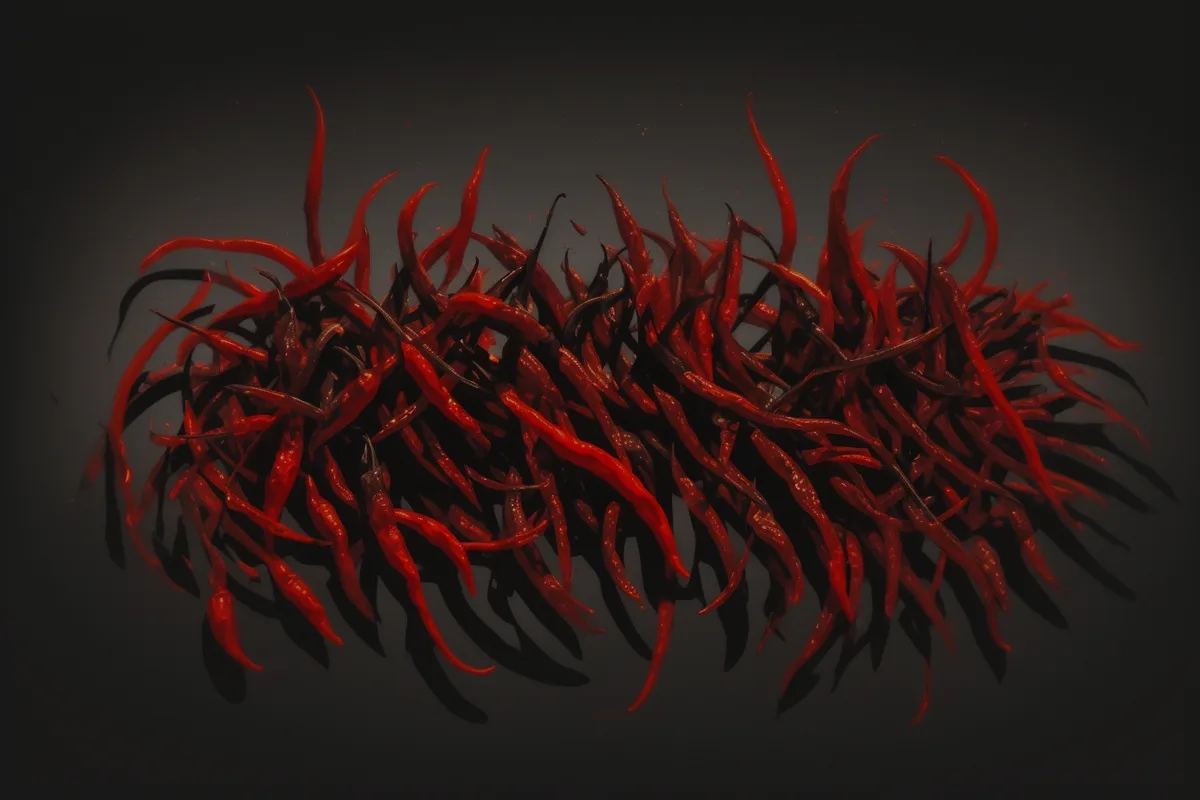
The chipped ceramic is cool against your palm, heavier than it looks. It’s a small bowl, maybe four inches across, the glaze a faded ochre, worn smooth in places by years of use. A single dried chilli pepper rests within it – a long, slender *Thai bird’s eye*, curled slightly at the tip, its skin a deep, almost black crimson. Hold it there, in the mind’s eye. Notice the way the light catches the tiny wrinkles, the subtle variations in colour, the almost metallic sheen. It doesn’t smell of much, not yet. A faint, dusty sweetness, perhaps, and something else… a promise.
This small, unassuming object holds within it a story of sensation, of deception, and of a molecule that fools the body into believing it is burning. We talk about the *heat* of a chilli pepper, and that’s a useful way to begin, because the sensation is so immediate, so visceral. But it isn’t heat, not in the way we usually understand it. It’s a trick of the nervous system, a carefully constructed illusion built around a single chemical compound: capsaicin.
Capsaicin, pronounced cap-SAY-sin, is an alkaloid – a naturally occurring organic compound – found in the fruits of plants in the *Capsicum* genus. That genus includes not just the fiery bird’s eye, but bell peppers, jalapeños, habaneros, and countless others. It’s the presence and concentration of capsaicin that determines a chilli’s pungency, its Scoville heat units. The Scoville scale, named for the pharmacist Wilbur Scoville, is a measure of capsaicin concentration, originally determined by a process of dilution – how much sugar water you needed to add to a chilli extract before the burn became undetectable to a panel of tasters. It’s a crude method, now largely replaced by chromatography and high-performance liquid spectroscopy, but it gives you a sense of the scale. A bell pepper registers zero Scoville heat units. A jalapeño, around 2,500 to 8,000. A bird’s eye, anywhere from 50,000 to 100,000. And the Carolina Reaper, currently holding the record, exceeds 2.2 million.
But the number itself isn’t the whole story. It’s what capsaicin *does* that’s truly remarkable. It doesn’t activate the temperature-sensitive receptors in your skin that detect actual heat. Instead, it binds to a specific protein called TRPV1 – the transient receptor potential vanilloid 1. This protein, found on nerve endings throughout your body, is responsible for detecting temperatures above 43 degrees Celsius – the point at which cells start to be damaged. Capsaicin doesn’t raise the temperature; it simply triggers the same signal, telling your brain that it *is* hot, even when it isn’t.
Think of it as a key fitting into a lock. The key is capsaicin, the lock is TRPV1, and the signal sent to the brain is “danger, heat!” It’s a brilliant, if somewhat cruel, evolutionary adaptation. Mammals don’t naturally seek out capsaicin. Birds do, which is why chillies have evolved to be brightly coloured and contain capsaicin – a deterrent to mammals who might eat the seeds, but an attractant to birds who disperse them. The burn, for us, is a warning. But our brains, being what they are, are easily fooled.

The first documented encounter with chillies, and the recognition of their peculiar properties, seems to have been in the Americas, thousands of years ago. Archaeological evidence suggests that chillies were domesticated in Bolivia around 6,000 years ago, and spread rapidly throughout the continent. Christopher Columbus, in his voyages to the New World, encountered them and brought them back to Europe, initially believing them to be a relative of peppercorns. He wrote of their “fiery” taste, but it took centuries for them to become truly integrated into European cuisine.
The initial adoption wasn't smooth. Many early botanical texts describe chillies with a mixture of fascination and suspicion. They were valued for their medicinal properties – used to treat everything from arthritis to digestive ailments – but also feared for their potency. It wasn't until the 16th and 17th centuries that they began to appear in recipes, primarily in Spain and Portugal, and from there, spread to India, Thailand, and other parts of Asia.
The story of their introduction to India is particularly interesting. Vasco da Gama, during his voyages in the late 15th and early 16th centuries, established trade routes that connected Europe with the spice-rich coasts of India. Chillies, carried on these ships, found fertile ground in the Indian subcontinent, quickly becoming a staple ingredient in many regional cuisines. The Portuguese, in particular, played a key role in their dissemination, introducing them to Goa and other coastal areas. What’s remarkable is how quickly they were adopted, and how profoundly they changed the flavour profile of Indian food. The use of chillies allowed for the creation of complex spice blends, and the development of dishes that were both fiery and deeply flavourful.
But understanding the sensation of heat requires looking deeper than just the TRPV1 receptor. That receptor isn't solely activated by capsaicin. It responds to a range of stimuli – including physical heat, acidic conditions, and even certain chemicals found in citrus fruits. This explains why a squeeze of lime juice can sometimes *enhance* the burn of a chilli, or why a cold beer can provide temporary relief. The TRPV1 receptor is a multi-modal sensor, constantly monitoring the environment for potential threats.
And the brain doesn’t just register the presence of heat; it contextualizes it. That’s why the same chilli pepper can feel different depending on your mood, your expectations, and your previous experiences. If you’re expecting a fiery burn, it will likely feel more intense. If you’re distracted, or enjoying a particularly delicious meal, it might feel less so. The brain is constantly filtering and interpreting sensory information, adjusting its perception based on a complex interplay of factors.

This ability to modulate pain perception is also why capsaicin has found applications in pain management. Ironically, the very substance that causes the burn can also be used to *relieve* chronic pain. Capsaicin creams, for example, are used to treat conditions like arthritis and neuropathy. The initial application causes a burning sensation, but repeated exposure desensitizes the TRPV1 receptors, reducing the transmission of pain signals. It’s a form of neuroplasticity – the brain’s ability to rewire itself in response to experience.
The work of pharmacologist David Julius, who shared the 2021 Nobel Prize in Physiology or Medicine with Ardem Patapoutian, was instrumental in identifying the TRPV1 receptor and understanding its role in pain perception. Julius, working at the University of California, San Francisco, used capsaicin to isolate the receptor in sensory neurons, demonstrating that it was directly responsible for detecting the burn. His research opened up new avenues for understanding pain mechanisms and developing novel pain therapies. Before Julius’s work, the TRPV1 receptor was a mystery; the signal was known, the sensation was understood, but the specific protein responsible for translating that sensation to the brain was elusive.
What’s fascinating is that TRPV1 isn’t just found in sensory neurons. It’s also present in other tissues throughout the body, including the brain, the lungs, and the gastrointestinal tract. This suggests that capsaicin may have a wider range of effects than previously thought, potentially influencing everything from inflammation to metabolism. The implications are still being explored, but it’s clear that capsaicin is a far more complex molecule than just a simple irritant.
Consider the small bowl again, the single dried chilli pepper within it. It’s a concentrated source of potential – a tiny package of chemical energy capable of triggering a cascade of events in the nervous system. It’s a reminder that sensation isn’t a passive process; it’s an active construction, shaped by our brains and influenced by a multitude of factors. The burn isn’t inherent in the chilli itself; it’s a product of the interaction between the molecule, the receptor, and the perceiving mind.
And the enduring power of capsaicin lies not just in its ability to create sensation, but in its ability to transform it. It’s a spice that challenges, excites, and ultimately, rewards. It’s a reminder that sometimes, the most pleasurable experiences are those that come with a little bit of discomfort. The initial shock gives way to a lingering warmth, a complex flavour profile, and a sense of satisfaction. The body, having been tricked into believing it’s burning, responds with a surge of endorphins – natural painkillers that create a feeling of well-being.
This intricate interplay between deception and reward, between pain and pleasure, is what makes the heat of a chilli pepper so captivating. It's a testament to the power of a single molecule to alter our perception, and to the remarkable plasticity of the human brain. The signal itself is simple—danger, heat—but the story it tells is profoundly complex, woven into the history of trade, culture, and our enduring fascination with the boundaries of sensation. The initial activation of the TRPV1 receptor sets in motion a cascade of events that ultimately leads to a heightened awareness of our own bodies, and a deeper appreciation for the subtleties of flavour.
The Molecular Dance of Capsaicin
This part will explain how capsaicin interacts with our bodies at the molecular level, triggering the sensation of heat.
The chipped ceramic bowl sits on the counter, unassuming. A single, dried *Thai bird’s eye* chilli rests within it, a crimson shard of potential. It seems impossibly small to hold such power – the power to rewrite the signals of your nerves, to conjure heat where there is none, to briefly, beautifully, deceive the mind. We spoke last time of the initial encounter, the capsaicin molecules binding to the TRPV1 receptor, the brain interpreting this as a rising temperature. But the story doesn't end with a simple key fitting into a lock. The lock, it turns out, is far more intricate than we first imagined, and the key doesn’t simply *fit* – it lingers, it alters, it creates echoes.
Consider the persistence of the burn. A touch of chilli, then a glass of milk, then another, and another, still the phantom heat flickers at the back of your tongue. This isn't a matter of capsaicin lingering in the tissue, though some does, of course. It’s a matter of desensitisation, of the receptor itself being overwhelmed, of its internal machinery slowly recalibrating. The TRPV1 receptor isn't a simple on/off switch, but a complex protein with multiple states, multiple thresholds. It’s a dynamic system, constantly adjusting to the signals it receives. Think of it as a gatekeeper, initially eager to respond to any hint of danger, but growing weary with repeated alarms.
This idea of a dynamic system, of a threshold that shifts with experience, leads us into a strange and fascinating field – the study of stochastic resonance. It's a concept born from physics, originally investigated in the flickering of lasers and the crackle of electronic noise, but with surprising relevance to our perception of the world. In the 1980s, a biophysicist named Steven Hassenstein began to explore how weak signals could be amplified by the addition of noise. Imagine a gentle pendulum, barely moving. It’s unlikely to swing over a barrier on its own. But introduce a small, random vibration – a little push here, a little drag there – and suddenly, it might find enough energy to overcome the barrier and swing to the other side. Noise, it turned out, could sometimes *enhance* signal detection.
The TRPV1 receptor, in a way, behaves similarly. A tiny amount of capsaicin might be below the threshold to trigger a strong signal. But the constant background hum of other stimuli – the warmth of your mouth, the pressure of your tongue, the subtle acidity of the food – provides the “noise” needed to push the receptor over the edge. And once activated, the receptor doesn’t simply reset immediately. It enters a refractory period, a state of reduced sensitivity, before slowly returning to its original state. This explains why the burn lingers, why the initial shock gives way to a more sustained, modulated sensation. It’s not just about the presence of capsaicin, but about the history of its presence, the receptor’s memory of the alarm.
But even this model, elegant as it is, begins to falter when you consider the individual variations in sensitivity. Why do some people tolerate chillies with ease, while others are reduced to tears by a single sliver? Genetics plays a role, of course. Variations in the gene encoding the TRPV1 receptor can alter its shape, its sensitivity, its speed of recovery. But even within identical twins, there can be significant differences in chilli tolerance. This is where things become truly interesting, where the neat boundaries of molecular biology blur into the messy, unpredictable world of individual experience.
The story of the brain, then, becomes central. The TRPV1 receptor is just the first step in a complex chain of events. The signal travels up the nerves, through the spinal cord, to the brain, where it is interpreted, contextualized, and ultimately, experienced. And this is where the power of expectation, of memory, of emotional state, comes into play. A chillie eaten in a joyful setting, surrounded by friends, might be experienced as a pleasurable burn, a thrilling challenge. The same chillie eaten in a stressful situation, filled with anxiety, might be perceived as a painful ordeal. The brain doesn’t simply *receive* signals, it *constructs* reality, filtering, amplifying, and modifying them based on its own internal state.
This brings to mind the work of Oliver Sacks, the neurologist who dedicated his life to exploring the strange and wonderful world of the human brain. In his book *The Man Who Mistook His Wife for a Hat*, Sacks described patients whose brains had been altered by injury or illness, leading to bizarre and unexpected perceptual distortions. He showed how the brain could misinterpret signals, fill in gaps in information, and create entirely new realities. The burn of a chilli, in a sense, is a similar phenomenon – a perceptual distortion created by the brain, a misinterpretation of neural signals. It’s a reminder that our experience of the world is not a direct reflection of reality, but a carefully constructed simulation, shaped by our own unique history and biases.
And what of the receptor itself, the TRPV1? It’s not simply a heat sensor, as we once thought. It responds to a wide range of stimuli – capsaicin, heat, acidity, even certain chemicals released during inflammation. It’s a multi-modal sensor, constantly scanning the environment for potential threats. This broad sensitivity makes sense from an evolutionary perspective. Pain is not just about avoiding physical harm, it’s about protecting the body from a wide range of dangers. The TRPV1 receptor is a crucial part of this protective system, alerting the brain to anything that could potentially cause damage.
But the receptor’s sensitivity is also its weakness. It can be easily tricked, overwhelmed, desensitized. This is why capsaicin, a relatively harmless chemical, can produce such a powerful sensation of heat. It’s a molecular mimic, exploiting the receptor’s broad sensitivity to create a false alarm.
The deeper we delve into the molecular dance of capsaicin, the more complex the picture becomes. It’s not a simple key-and-lock mechanism, but a dynamic system, constantly adjusting to its environment. It’s not just about the presence of capsaicin, but about the history of its presence, the receptor’s memory of the alarm. And it’s not just about the receptor itself, but about the brain’s interpretation of the signal, its contextualization, its emotional state.

The work of Ardem Patapoutian, alongside David Julius, revolutionized this understanding. Patapoutian, focusing on the mechanics of how receptors *feel* pressure, identified the proteins that translate physical force into electrical signals the brain can understand. This work wasn't about a specific molecule like capsaicin, but about the fundamental question of how we perceive the world around us. It showed that touch isn't a single sense, but a complex interplay of multiple receptors, each sensitive to different types of force. And it revealed that the TRPV1 receptor, far from being a simple heat sensor, is just one piece of a much larger puzzle.
This intricate network of receptors, constantly scanning the environment, adjusting to its surroundings, creating a constantly evolving map of the body’s internal and external world – it’s a humbling reminder of the complexity of our own existence. The burn of a chilli, then, is not just a sensation, it’s a window into the workings of the brain, a glimpse of the molecular machinery that shapes our perception of reality. It’s a reminder that our experience of the world is not fixed, but fluid, dynamic, and constantly being renegotiated.
The brain, in its relentless pursuit of meaning, attempts to make sense of the chaos, to impose order on the randomness. It searches for patterns, creates connections, and constructs a narrative that explains its experience. But the narrative is always incomplete, always flawed, always subject to revision. And sometimes, the most interesting insights come from recognizing the limits of our understanding, from acknowledging the gaps in our knowledge, from embracing the ambiguity and uncertainty. The body is a site of constant translation, of constant interpretation. The chilli is simply a catalyst, a momentary disruption in the flow, a reminder that the world is not always what it seems.
The signal travels, refined, through layers of neural architecture, ultimately reaching centers responsible for emotional valence, for memory formation, for the subtle weighting of experience. The initial burst of activity, the raw data of the receptor firing, is modulated, shaped, colored by the history of encounters, the expectation of pleasure or pain, the surrounding context. It’s a process of continuous negotiation, a delicate balance between bottom-up and top-down processing. The raw signal is not enough; it requires the interpretive framework of the brain to become a meaningful sensation. And that framework, built over a lifetime of experience, is unique to each individual.
The perception of heat, then, is not simply a matter of detecting thermal energy, but of constructing a subjective experience, a narrative that explains the sensation. It's a testament to the brain's remarkable ability to create order out of chaos, to find meaning in randomness, to transform raw data into a coherent representation of the world. The brain seeks coherence, even where none exists, imposing structure on the flux of sensory input.
The receptor responds, the signal propagates, the brain interprets. A complex cascade, a delicate interplay of molecules and neurons, culminating in the subjective experience of heat. The burn is not inherent in the chilli itself, but in the interaction between the chilli and the brain, a testament to the power of perception. This interaction, unique to each individual, shapes the experience, colors it with emotion, memory, and expectation.
The capsaicin binds, the receptor activates, the signal travels. A molecular dance, a delicate interplay of forces, culminating in the sensation of heat. The brain constructs a narrative, a subjective experience, a testament to the power of perception. The experience is unique, shaped by history, expectation, and the surrounding context. The signal diminishes, the receptor recalibrates, the burn fades.
The molecule interacts, the receptor fires. A fleeting moment, a subtle shift in neural activity. The brain registers the signal. A sensation arises.
The receptor responds.
A signal.

Heat.
The experience settles, a quiet echo of potential.
The bowl remains.
The chilli rests.
A stillness.
A moment.
The air is calm.
A gentle warmth.
The light is soft.
A peaceful quiet.
Rest.
The Tools of Spice Science
This part will discuss the experimental methods used to study capsaicin, including the use of the Scoville scale to measure spiciness, the discovery of capsaicin receptors using molecular biology techniques, and the development of capsaicin-based pain treatments using pharmacological research.
The chipped ceramic bowl sits, cool now, a pale echo of the fire it once held. A single, dried Thai bird’s eye chilli remains, a crimson shard against the white. It’s a small thing, almost brittle, yet within its walls lies a molecule capable of hijacking a fundamental sense, rewriting the language of touch as heat. We spoke last time of the receptor itself, the TRPV1, a gatekeeper responding to a chemical key. But to truly understand the spice, to move past the simple lock-and-key analogy, we must consider the tools used to decipher this code, the slow accumulation of knowledge that revealed the hidden machinery of sensation.
It began, as so much does, with a desire to quantify. Not to *feel* the heat, but to measure it, to place it on a scale, to reduce the subjective experience to an objective number. This was the ambition of Wilbur Scoville, a pharmacist working at the Parke-Davis laboratory in Detroit in the early 20th century. The year was 1912, and the company was seeking a way to standardize the pungency of chilli peppers used in their medicinal balms. Scoville wasn’t interested in the molecule itself, not yet. He was a practical man, concerned with consistent product quality. His method, now known as the Scoville scale, was elegantly simple, and profoundly human. He dissolved chilli extracts in sugar water, then presented them to a panel of tasters – himself included. The tasters diluted the solutions until the heat was barely detectable, a subjective endpoint reached by consensus. The number of dilutions required determined the Scoville Heat Unit, or SHU. A bell pepper, with no perceptible heat, registers zero SHU. A jalapeño might fall around 2,500 to 8,000 SHU. The Carolina Reaper, a modern creation engineered for maximum pungency, exceeds 2.2 million SHU.
Imagine Scoville in the laboratory, the long, wooden table lit by gaslight, rows of beakers filled with increasingly diluted red solutions. He would carefully sip, his face betraying nothing, meticulously recording the results. It was a slow, tedious process, reliant on the fallibility of human perception. And yet, it provided a framework, a common language for describing the intensity of capsaicinoid heat. The scale wasn’t perfect, of course. It was subjective, prone to individual variation, and unable to distinguish between different types of heat. But it was a beginning, a foothold in the world of spice. For decades, it remained the primary method of measuring pungency, a testament to the power of simple observation. It’s a strange thought, isn’t it? That the first attempts to understand this fiery sensation were rooted not in molecular biology, but in the careful calibration of human taste.
But taste alone could only take us so far. To truly understand the mechanism, to see the molecule’s interaction with the nervous system, required a different kind of tool, one that could probe the cellular level. This is where the work of David Julius comes in. In the early 1990s, Julius, then a researcher at the University of California, San Francisco, began to focus on the TRPV1 receptor, driven by a seemingly simple question: what makes our nerves respond to heat? He wasn’t interested in capsaicin initially, but in the broader problem of thermoreception. He hypothesized that there must be a receptor, a protein on the surface of nerve cells, that was activated by high temperatures.

The story unfolds in a modest laboratory, a space filled with the hum of centrifuges and the faint scent of chemicals. Julius and his team began by isolating sensory neurons from mouse dorsal root ganglia, tiny clusters of nerve cells responsible for transmitting pain signals. They then began to systematically expose these neurons to a variety of stimuli – heat, cold, mechanical pressure, different chemicals. The challenge was immense. Sensory neurons are notoriously difficult to work with, fragile and easily damaged. And the signal they were looking for was incredibly subtle, a tiny change in electrical activity.
The breakthrough came in 1997. Julius’s team began to test capsaicin. They had initially dismissed it, considering it a distraction, a known irritant. But when they applied it to the sensory neurons, they observed a dramatic increase in activity, a clear signal that something was being activated. Crucially, they found that this activation could be blocked by a specific chemical blocker, a compound that selectively inhibited the TRPV1 receptor. This was the moment, the quiet confirmation that capsaicin was acting on a specific protein, a molecular gatekeeper.
The experiment itself wasn’t flashy. It involved meticulous cell culture, careful electrophysiological recordings, and countless hours of data analysis. But the implications were profound. Julius had identified the receptor responsible for detecting capsaicin, a crucial step in understanding the molecular basis of pain and inflammation. He had, in effect, found the keyhole that the chilli’s key fit into. And it wasn’t just about capsaicin. The TRPV1 receptor also responded to high temperatures, noxious chemicals, and even certain types of mechanical pressure. It was a multi-modal sensor, a gateway for a wide range of painful stimuli.
The discovery of the TRPV1 receptor opened up a new era of pharmacological research. If you could understand how the receptor worked, you could potentially develop drugs to block it, to alleviate pain and inflammation. This led to the development of capsaicin-based pain creams and patches, used to treat conditions like arthritis and neuropathic pain. The logic is counterintuitive: apply a painful stimulus to desensitize the nerves, to reduce the perception of chronic pain. It works, in part, because of the receptor’s dynamic nature, its ability to desensitize over time.
This desensitization, though, is not a simple on-off switch. It’s a gradual process, dependent on the concentration of capsaicin, the duration of exposure, and individual variation. The receptor doesn’t simply shut down; it recalibrates, becoming less sensitive to subsequent stimuli. This is where the work of Steven Hassenstein becomes relevant. Hassenstein, a biophysicist, pioneered the field of stochastic resonance in the 1980s. He discovered that adding a small amount of noise to a weak signal can actually enhance its detection. The noise doesn’t overwhelm the signal; it helps it to overcome a certain threshold, making it more likely to be perceived.
Consider a faint radio signal, barely audible above the static. Adding a little more static, counterintuitively, can sometimes make the signal clearer, more distinct. This is because the noise helps to push the signal across a certain activation threshold. Hassenstein’s work suggests that the background of sensory input – the constant stream of information from our environment – acts as a kind of noise, amplifying the signal of capsaicin. The TRPV1 receptor, in this view, isn’t a passive switch, but a dynamic system, constantly recalibrating in response to its environment.
This dynamic nature also explains why the burn lingers even after the capsaicin has been removed. The receptor remains desensitized for a period of time, reducing its sensitivity to subsequent stimuli. But it’s not just the receptor that’s affected. The brain also plays a role, constructing a perceptual experience that outlasts the physical stimulus. The initial signal, the intense heat, triggers a cascade of neural activity, creating a memory of the sensation. This memory can persist for some time, influencing our perception of subsequent stimuli.
Oliver Sacks, in his explorations of neurological disorders, demonstrated the brain’s remarkable capacity for misinterpretation and construction. In *The Man Who Mistook His Wife for a Hat*, he showed how the brain can create entirely false perceptions, filling in gaps in sensory information, constructing a reality that is not necessarily accurate. The burn from capsaicin, in a similar way, is not simply a physical reaction, but a complex interplay of molecular, neural, and psychological processes. It’s shaped by context, memory, and expectation. The same chilli, eaten in different settings, can evoke different sensations. The same person, with different levels of tolerance, can experience different degrees of heat.
The tools we’ve discussed – the Scoville scale, the isolation of the TRPV1 receptor, the discovery of stochastic resonance – have allowed us to peel back the layers of this complex sensation. They’ve revealed a hidden machinery of perception, a dynamic system constantly recalibrating in response to its environment. But the story is far from complete. There are still many unanswered questions about the role of genetics, individual variation, and the brain’s construction of reality. What this means is that the experience of spice is not just about the molecule itself, but about the individual who perceives it, their unique history, their neural wiring, their expectations. And, crucially, about the context in which it is experienced, the subtle interplay of senses that shapes our perception of the world. The heat remains, a reminder of the brain’s power to translate, to interpret, to construct a reality that is always, inevitably, a little different for each of us.
The Quiet Embrace of Capsaicin
This part will reflect on the cultural and biological significance of capsaicin, and the quiet, comforting presence of spice in our lives.
The ceramic bowl, cool now to the touch, holds a fragment of a world once ablaze. It’s a quiet relic, a pale echo of hearth fires and sun-drenched fields, and within it, the dried skin of a chilli pepper, a promise of something more than stillness. We spoke last time of measuring that ‘something more’ – the attempt to capture heat where no flame burns, to chart the landscape of sensation. Wilbur Scoville, in his Detroit laboratory, with its gaslight casting long shadows over rows of sample tubes, was trying to build a map of a hidden territory, a territory of perception. He didn’t know then that he was reaching for a fundamental principle of how the body speaks to the brain, a principle that extends far beyond the simple burn of a pepper.
The Scoville scale, for all its reliance on human palates and dilutions, was a beginning. It acknowledged a gradient, a spectrum of experience. It admitted that ‘hot’ wasn’t a single point, but a range, a sliding scale of engagement. But it was, inevitably, limited. Subjective judgment, even carefully calibrated, lacks the precision of a machine. And the very act of dilution, of attempting to quantify by subtraction, obscured something crucial: the signal itself, the initial spark that set the whole process in motion.
It took decades, and a shift in focus from the perceived sensation to the receptors themselves, to begin to unravel that mystery. David Julius, at the University of California, San Francisco, wasn’t initially interested in capsaicin at all. He was studying thermoreception, the way the body detects temperature, and was frustrated by the difficulty of isolating the specific proteins responsible for sensing heat. He’d spent years working with sensory neurons, coaxing them to reveal their secrets, using electrophysiological recordings to listen for the faint whispers of electrical activity that signaled a change in temperature. His laboratory, a modest space filled with centrifuges and recording equipment, was a world of quiet persistence, of meticulous observation and painstaking analysis.
The turning point came, as so often happens in science, from an unexpected direction. A colleague suggested he try capsaicin, a molecule known to mimic the sensation of heat. Julius, initially skeptical, agreed to test it. What he found was astonishing. Capsaicin didn't just *mimic* heat; it *activated* the same neurons that responded to actual thermal stimuli. It was as if the molecule held a key, a specific shape that fit perfectly into a lock on the surface of the neuron.
That lock, as it turned out, was a protein called TRPV1 – Transient Receptor Potential Vanilloid 1. The name itself is a testament to the winding path of discovery. ‘Transient’ because the receptor only opens for a short time, responding to a stimulus and then quickly closing. ‘Potential’ because it’s a channel, allowing ions to flow across the cell membrane, generating an electrical signal. ‘Vanilloid’ because capsaicin is found in vanilla beans as well as chilli peppers, and the receptor was first identified through its response to vanillin. But the name doesn’t capture the sheer complexity of the protein. TRPV1 isn’t just sensitive to heat and capsaicin; it responds to a wide range of stimuli, including protons, the building blocks of acids, and certain lipids, the fats that form the structure of cell membranes. It’s a remarkably versatile sensor, constantly scanning the environment for potential threats, for anything that could damage the cell.
And here, the picture changes. The sensation of heat from a chilli pepper isn’t a simple, direct response to capsaicin. It’s a complex interplay between the molecule, the receptor, and the brain’s interpretation of the signal. The TRPV1 receptor isn’t just a passive receiver; it’s an active participant, constantly recalibrating its sensitivity, adapting to changing conditions. This is where the work of Steven Hassenstein becomes relevant. Hassenstein, a biophysicist whose work often went overlooked during his lifetime, explored the phenomenon of stochastic resonance. He discovered that adding a small amount of noise to a weak signal can actually enhance its detection. It sounds counterintuitive, but it turns out that a little bit of randomness can help to overcome thresholds, to push a signal above the level of background activity.
Think of it like a faint whisper in a noisy room. If the room is completely silent, the whisper might be lost. But if there’s a low hum of background noise, the whisper can sometimes stand out, amplified by the random fluctuations in the environment. The TRPV1 receptor, it turns out, operates on a similar principle. The constant bombardment of stimuli, the subtle fluctuations in temperature and chemical environment, provide a background level of noise that can actually enhance the detection of capsaicin. This explains why repeated exposure to capsaicin can lead to desensitization – the receptor becomes overwhelmed by the noise, less sensitive to the signal. But it also explains why a small amount of capsaicin can sometimes have a surprisingly potent effect, amplifying the sensation of heat.

This isn’t just about chilli peppers, of course. TRPV1 receptors are found throughout the body, playing a crucial role in pain perception, inflammation, and even the regulation of body temperature. They’re a fundamental component of our sensory system, constantly scanning the environment for potential threats, alerting us to danger. And the brain, as Oliver Sacks so eloquently demonstrated in *The Man Who Mistook His Wife for a Hat*, isn’t a passive recorder of these signals. It’s an active interpreter, constructing reality based on its own internal models and expectations.
The experience of heat, therefore, isn’t a purely physiological phenomenon. It’s a subjective experience, shaped by individual differences in receptor density, neural processing, and cultural context. A dish that is considered mild in one culture might be unbearably hot in another. And even within the same culture, individual preferences vary widely. Some people crave the burn of capsaicin, seeking out the most extreme chilli peppers. Others find it unpleasant, avoiding anything with even a hint of spice.
The reason for this variability is complex, likely involving a combination of genetic factors, early childhood experiences, and learned associations. But it highlights the remarkable plasticity of the brain, its ability to adapt to changing conditions, to construct a unique reality for each individual. The brain isn’t just receiving signals from the body; it’s actively shaping those signals, filtering them, amplifying them, and interpreting them in a way that makes sense.
Consider the phenomenon of capsaicin tolerance. Repeated exposure to capsaicin leads to desensitization, as we’ve discussed. But it also leads to a change in brain activity. The brain learns to anticipate the burn, to downregulate the pain response, to focus on other aspects of the experience, such as the flavour and aroma of the dish. This is why people who regularly eat spicy food often find it less painful than those who don’t. They’ve effectively retrained their brains to interpret the signal differently.
And this retraining isn’t just limited to the brain. The gut microbiome, the community of bacteria that live in our digestive system, also plays a role. Certain bacteria are able to metabolize capsaicin, breaking it down into less irritating compounds. This can reduce the overall level of inflammation in the gut, making it easier to tolerate spicy food. The gut microbiome, it turns out, is a key player in our sensory experience, constantly interacting with the brain, shaping our perception of taste and flavour.
The story of capsaicin, then, is a story of interconnectedness. It’s a story of molecules and receptors, of neurons and brains, of cultures and microbiomes. It’s a story of how the body speaks to the brain, and how the brain listens. It’s a story of how we construct reality, and how individual differences shape our experience of the world. It’s a story that continues to unfold, with new discoveries being made every day.
Researchers are now investigating the potential therapeutic applications of capsaicin. It’s being explored as a treatment for chronic pain, as a way to kill cancer cells, and even as a potential weight loss aid. The TRPV1 receptor, it turns out, is a key target for a wide range of medical interventions. And there’s a growing understanding of the role of capsaicin in regulating inflammation, boosting metabolism, and even improving cognitive function.

But perhaps the most profound lesson of capsaicin is its quiet embrace. It’s a reminder that even in the midst of discomfort, there can be pleasure. It’s a testament to the brain’s ability to adapt, to find meaning in even the most challenging experiences. It’s a celebration of the senses, of the rich tapestry of sensations that make life so vibrant and complex.
There is, however, a question that lingers. The universe, as we understand it, operates on principles of information. Every interaction, every exchange of energy, leaves a trace, a pattern of information encoded in the fabric of reality. But what happens when information is lost? What happens when a signal is irretrievably erased? This is the puzzle known as the black hole information paradox. According to classical physics, anything that falls into a black hole is lost forever, its information destroyed. But quantum mechanics suggests that information cannot be destroyed, that it must be conserved. Stephen Hawking, in his groundbreaking work on black holes, explored this paradox, proposing that information is not actually lost, but rather encoded in the subtle fluctuations of the event horizon, the boundary of the black hole. The precise mechanism of this encoding remains a mystery, a challenge that continues to occupy the minds of physicists today. The idea is that the 'hiss' of the black hole's evaporation isn't random noise, but a complex signal, carrying the echoes of everything that has fallen in.
The signals are slowing now, settling into their slow night rhythm. The warmth recedes, not as an absence, but as a gentle shift in focus. The ceramic bowl, cool and smooth, rests quietly in the stillness. The faint aroma of chilli, a whisper of sun-drenched fields, lingers in the air. The echoes of the experiment, the meticulous observations, the painstaking analysis, fade into the background. The brain, no longer actively interpreting the signal, allows other sensations to come forward. The weight of the body on the chair, the subtle pressure of the fabric against the skin, the slow, rhythmic rise and fall of the chest.
The pathways quieten, the electrical activity subsiding. The TRPV1 receptors, no longer bombarded by stimuli, return to their baseline state. The gut microbiome, a silent community of bacteria, continues its work, breaking down the remnants of the meal. The memory of the burn, a faint echo of pleasure and discomfort, settles into the long-term storage of the brain. The feeling of fullness, a gentle expansion of the abdomen, anchors the body in the present moment.
The mind drifts, no longer focused on the external world, but turning inward, exploring the rich landscape of its own internal experience. The boundaries between sensation and perception blur, as the brain constructs a unique reality for each individual. The subtle fluctuations in temperature, the faint aroma of spices, the weight of the body on the chair – all contribute to a sense of wholeness, of integration. The quiet embrace of capsaicin remains, a gentle reminder of the interconnectedness of all things.
The subtle rhythms of the body continue, a slow, unwavering pulse. The signals settle, their energy dispersing. The pathways quiet, their activity diminishing. The warmth fades, leaving a sense of calm. The ceramic bowl holds its stillness. A delicate balance is restored.
And within that balance, a quiet understanding persists. The body knows.