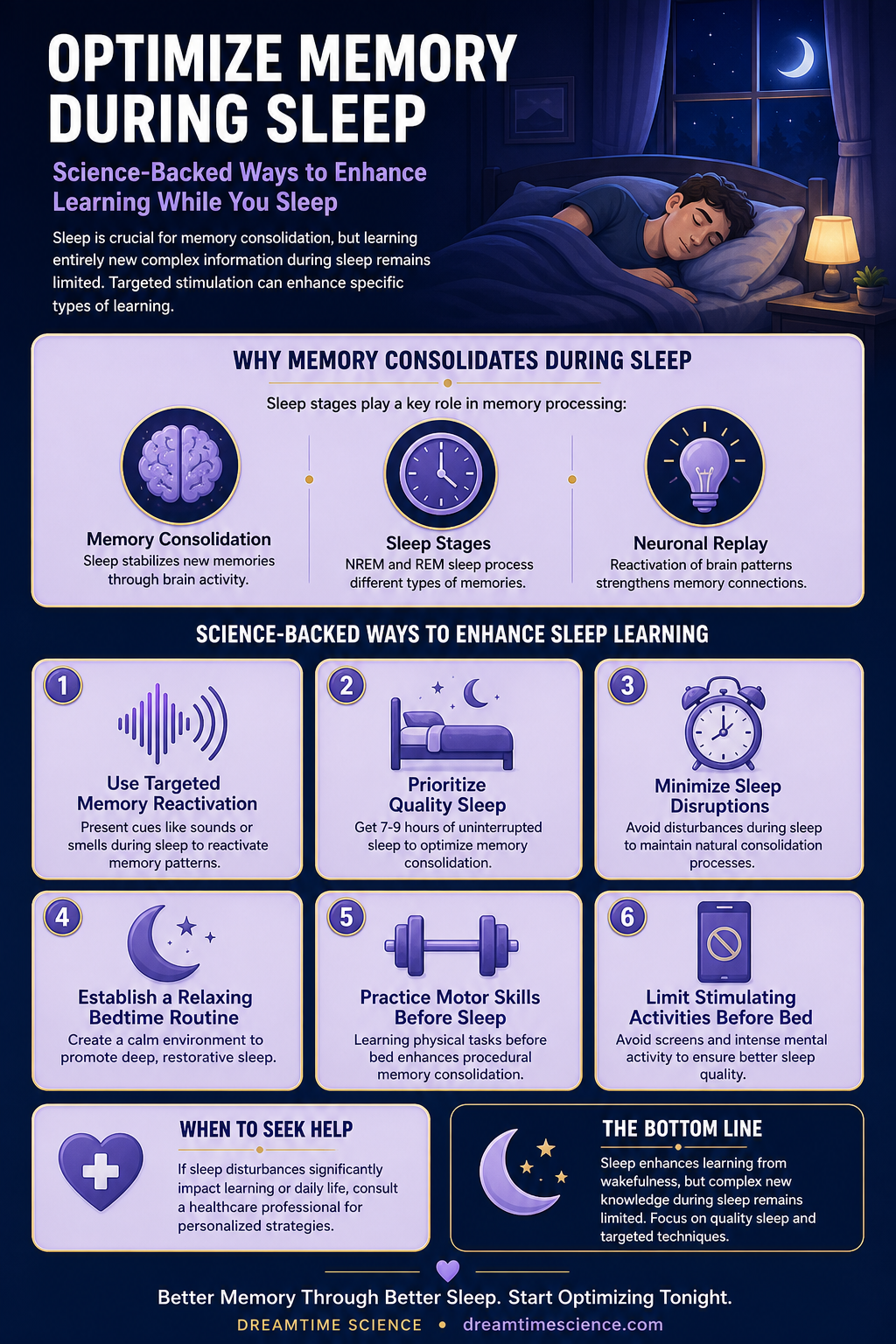
The short answer: Sleep learning aims to strengthen existing memories or facilitate the consolidation of recently learned information while asleep, rather than acquiring entirely new complex skills. Techniques like targeted memory reactivation (TMR) and olfactory stimulation can modestly enhance motor skill learning and declarative memory consolidation, particularly when cues are timed to specific sleep stages like slow-wave sleep (SWS) or REM sleep. However, current research focuses on reinforcing previously established knowledge and interfering with natural consolidation can even impair subsequent awake learning.
Sleep plays a critical role in consolidating and optimizing memories formed during waking hours, though acquiring entirely new complex information during sleep remains limited [1, 2]. Targeted stimulation during specific sleep stages can modulate certain types of learning, particularly motor and associative skills, but the effects are typically modest and depend on several factors.
What is Sleep Learning?
Sleep learning refers to the attempt to facilitate the acquisition of new information or the strengthening of existing memories while in a sleep state. The rationale for this field stems from the demonstrable fact that sleep is an active state characterized by significant brain activity, essential for memory consolidation—the process of stabilizing new memories [1]. This is distinct from simply retaining naturally consolidated memories, and the extent of achievable learning is an ongoing focus of research.
Can You Learn in Your Sleep? The Role of Sleep Stages
The brain cycles through distinct stages—Non-Rapid Eye Movement (NREM) sleep and Rapid Eye Movement (REM) sleep—and each stage contributes differently to memory processing [2]. NREM sleep, specifically slow-wave sleep (SWS), is heavily implicated in consolidating declarative memories, which encompass facts and episodic events [1]. REM sleep is crucial for procedural memory consolidation—the learning of skills and habits—and emotional processing [1].
A foundational process in sleep-dependent memory is “replay,” referring to the reactivation of neuronal patterns that were active during waking experience. This reactivation strengthens the synaptic connections underlying those memories, increasing their durability. Researchers hypothesize that external cues delivered during sleep can tap into this replay process, potentially modifying existing memories or facilitating the integration of new information, though this is constrained by the brain’s overall activity level.
Learning in Your Sleep: Targeted Stimulation Techniques
Several methods have been investigated to induce or enhance sleep learning, including auditory cues, olfactory stimulation, and targeted memory reactivation (TMR) [3].
- Auditory cues: Presenting sounds or words associated with previously learned material during sleep has shown limited efficacy, with some studies reporting small improvements in recall [3]. Effectiveness is variable, influenced by factors like cue timing and individual sleep architecture.
- Olfactory stimulation: Exposure to scents linked to learning tasks can subtly reinforce memory consolidation during sleep. Associating a specific odor with a new task and then re-presenting that odor during sleep has been shown to modestly enhance performance on the task [3].
- Targeted memory reactivation (TMR): This technique involves presenting cues—sounds, smells, or weak electrical stimulation—to reactivate specific neuronal patterns during sleep. TMR shows some promise in enhancing motor skill learning and declarative memory consolidation [4].
Is Sleep Learning Real? Evidence and Constraints
While the notion of acquiring complex, entirely new skills or knowledge during sleep remains largely unsupported, sleep significantly enhances learning that occurred prior to sleep. Ample evidence demonstrates that sleep deprivation impairs cognitive performance and memory consolidation [8]. Conversely, sufficient sleep following learning improves retention, recall, and skill transfer [2].
Current research primarily focuses on bolstering previously established knowledge rather than creating it from scratch. The impact of TMR is often small and requires precise control of sleep stages and individual brain activity [4]. Furthermore, the brain’s capacity to form new connections is substantially reduced during sleep compared to wakefulness. Ruch et al. (2022) found that sleep-learning can even impair subsequent awake learning, indicating that interfering with natural consolidation processes can be detrimental [5].
Types of Learning Primarily Enhanced by Sleep
Not all types of learning benefit equally from sleep-dependent consolidation.
- Motor learning: Sleep is particularly effective for consolidating procedural memories, such as skills involving muscle movements. Practicing a motor task—playing an instrument, learning a sport—followed by sleep demonstrably improves performance [7].
- Associative learning: Sleep facilitates the strengthening of associations between stimuli and responses. This includes enhanced recall of paired word lists or associating faces with names [1].
- Declarative learning: Sleep also contributes to consolidating factual and episodic memories, though the effect is generally less pronounced than for motor skills [1].
Wake-Sleep Consolidated Learning vs. Pure Sleep Learning
A growing area of research centers on “wake-sleep consolidated learning”—a paradigm where initial learning occurs during wakefulness, followed by targeted cues or stimulation during sleep to strengthen consolidation [6]. Combining learning across both states often yields more robust results than attempts to induce pure sleep learning. Sorrenti et al. (2025) demonstrated significant improvements on a complex tactile discrimination task when learning was reinforced during sleep after initial awake training [6], suggesting a synergistic effect between conscious processing and subconscious reinforcement.
Factors Influencing Sleep Learning Potential
Several factors influence the potential for sleep learning efficiency.
- Sleep Stage: The timing of stimulation relative to specific sleep stages is critical. TMR is most effective when cues are delivered during SWS for declarative memories and REM sleep for procedural memories [4].
- Individual Differences: Brain activity patterns, sleep architecture, and prior learning experiences vary between individuals and can significantly impact the efficacy of sleep learning techniques.
- Type of Information: Simpler information—associating sounds with established facts—is more amenable to sleep consolidation than complex, abstract concepts.
- Stimulus Intensity: Stimulus intensity must be carefully calibrated to enhance, not disrupt, sleep. Excessive stimulation can provoke arousal and interfere with consolidation processes [3].
Frequently Asked Questions
What does “sleep learning” actually involve?
Sleep learning attempts to acquire knowledge or skills while asleep, primarily through exposure to cues or stimuli linked to previously learned information. However, current evidence suggests it better describes the enhancement of consolidation of learning that initially took place during wakefulness.
Is it possible to learn a new language in your sleep?
Currently, there is no scientific evidence to support learning a new language in your sleep. While sleep assists in memory consolidation, the complexity of language demands active cognitive processing that is unattainable during sleep.
What is targeted memory reactivation (TMR)?
Targeted memory reactivation (TMR) involves presenting cues associated with a specific memory during sleep to re-activate the neuronal patterns linked to that memory, potentially strengthening it. Though promising, its effectiveness is limited and requires precision in timing and individual assessment of sleep stages.
How much sleep do I need to optimize learning?
Generally, 7-9 hours of quality sleep per night is recommended to optimize memory consolidation and learning [2]. Maintaining a consistent sleep schedule and a conducive sleep environment are also important for effective learning.
Can I improve sleep learning without specialized equipment?
You can improve sleep learning by prioritizing sufficient sleep after learning, Establishing a relaxed bedtime routine, and minimizing disruptions during sleep. While some commercial products claim to facilitate sleep learning, their scientific validity is often limited.
How does sleep deprivation affect learning?
Sleep deprivation significantly impairs both the acquisition of new information and the consolidation of existing memories [8]. Prioritizing adequate sleep is crucial for optimal cognitive function and effective learning.
Fall Asleep to a Science Lecture
Put tonight's reading into practice — pick a gentle, softly-narrated episode and let the Professor talk you to sleep.
 Tonight's episodeUnveiling the Mind's Labyrinth