← Back to Articles
Sleep Hygiene

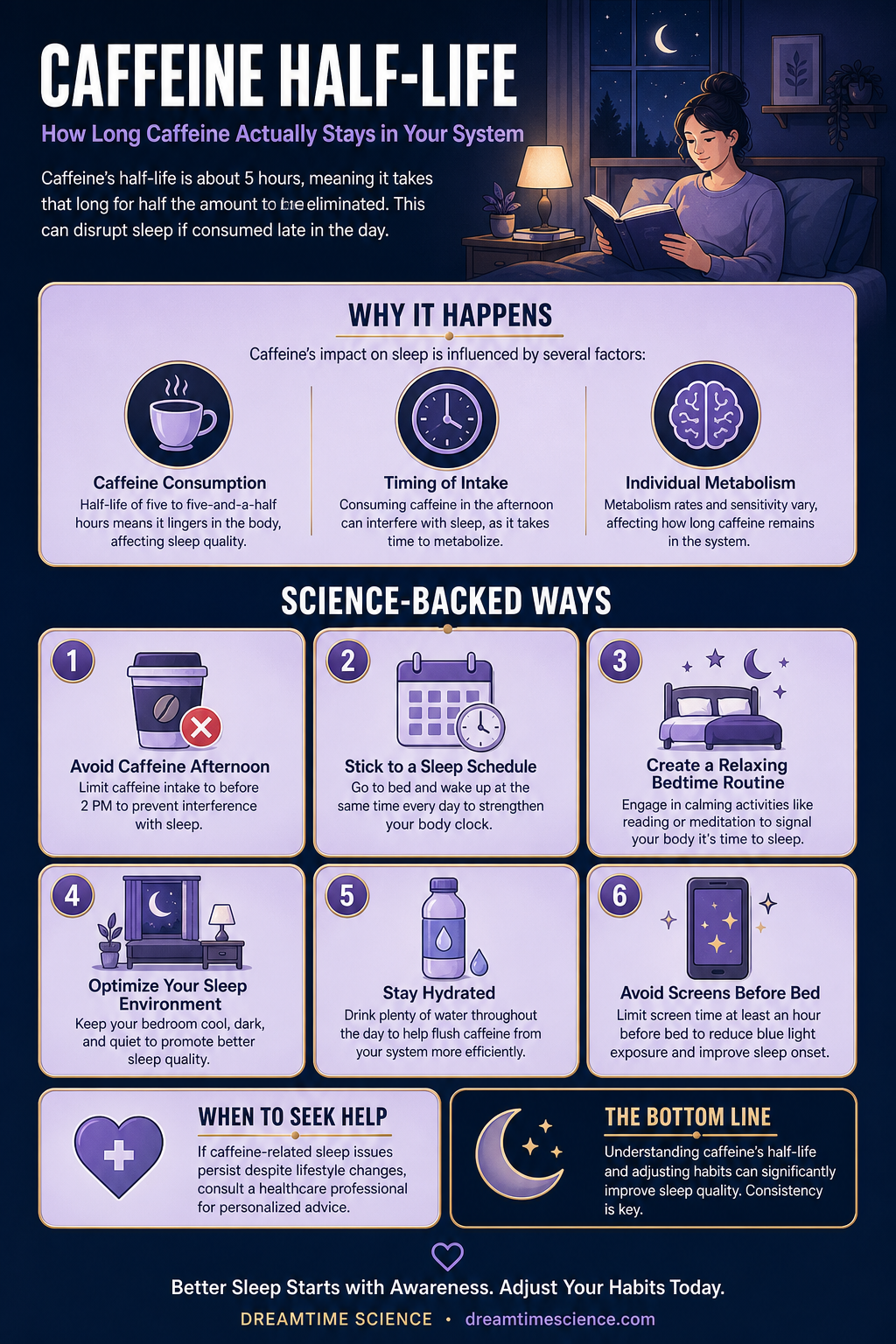
The short answer: Caffeine’s half-life is approximately five to five-and-a-half hours, meaning it takes that long for half of the ingested amount to be eliminated. This means caffeine consumed in the afternoon can negatively impact sleep quality, and even small amounts remaining late at night can disrupt sleep architecture. If you consume 200mg of caffeine at 2 PM, roughly 100mg will still be in your system by 7 PM.
Caffeine’s half-life is approximately five hours, meaning it takes that long for half of the ingested caffeine to be eliminated from the body. As a result, caffeine consumed in the afternoon can demonstrably interfere with sleep quality and duration [1]. Individual metabolism rates and sensitivity influence the extent and duration of these effects.
Can You Learn in Your Sleep?
The potential for learning during sleep—sleep-dependent memory consolidation—is a complex area of neuroscience. While the idea of passively absorbing information while asleep remains largely unsupported, research indicates sleep plays a crucial role in consolidating memories formed before sleep [4]. Specifically, sleep facilitates the transfer of information from temporary storage in the hippocampus to more permanent storage in the neocortex. Studies employing targeted memory reactivation—presenting cues associated with learned information during sleep—have demonstrated improvements in performance on tasks subsequently completed while awake [4]. However, acquiring new complex information during sleep typically does not occur. The brain's processing capacity is significantly reduced during sleep, and it lacks the attentional resources required for initial encoding of new memories.
Learning in Your Sleep
Sleep enhances several distinct types of memory. Declarative memory, which encompasses facts and events, benefits significantly from sleep consolidation [2]. Similarly, procedural memory—skills and habits—is also enhanced by sleep [2]. These benefits are thought to arise from specific brainwave patterns generated during various sleep stages. Slow-wave sleep (SWS), for instance, is particularly important for consolidating declarative memories, while rapid eye movement (REM) sleep contributes to procedural memory consolidation and emotional processing. Attempts to facilitate learning during sleep through auditory stimulation or olfactory cues have yielded mixed results. While some studies show modest improvements in performance, the effects are often small and require precise timing and cueing protocols [4]. These studies often utilise magnetoencephalography to gain a better understanding of the brainwave patterns present during these trials [4].
How Long Does Caffeine Stay in Your System?
Caffeine is readily absorbed by the gastrointestinal tract and distributes throughout the body [1]. The average half-life of caffeine is 5.0 to 5.5 hours, though this varies significantly [1]. Factors influencing caffeine clearance include genetics, liver function, age, pregnancy [1], and smoking status. Smokers metabolize caffeine faster due to enzyme induction. To illustrate, if an individual consumes 200mg of caffeine at 2 PM, approximately 100mg will remain in their system by 7 PM, and 50mg by midnight. While 50mg may seem like a small amount, it can still be sufficient to disrupt sleep architecture and reduce sleep efficiency in sensitive individuals.
Factors Affecting Caffeine Metabolism
Genetic variations within the CYP1A2 gene significantly impact caffeine metabolism [1]. Individuals with faster metabolizing variants process caffeine more efficiently, experiencing shorter-lasting effects. Conversely, those with slower metabolizing variants may experience prolonged effects and increased sensitivity. Liver health is also critical, as the liver is responsible for breaking down caffeine via the CYP1A2 enzyme. Conditions that impair liver function, such as cirrhosis, will slow caffeine metabolism. Age also plays a role, with younger individuals typically metabolizing caffeine more rapidly than older adults. Hormonal fluctuations, like those experienced during pregnancy, can also affect caffeine metabolism rates.
Caffeine Sensitivity: Individual Differences
Caffeine sensitivity is a spectrum influenced by numerous factors. Regular caffeine consumers develop a degree of tolerance, requiring higher doses to achieve the same effects [1]. However, the degree of tolerance varies significantly between individuals. Some people are inherently more sensitive to caffeine due to variations in adenosine receptor density—the brain targets affected by caffeine [1]. Other factors, such as anxiety levels and body weight, can also influence caffeine sensitivity. Individuals with anxiety disorders, for example, may experience increased nervousness and jitteriness from caffeine consumption.
Key Takeaways: Managing Caffeine for Better Sleep
Understanding each component – caffeine metabolism, sensitivity, and the impact of timing – is critical toward establishing healthy caffeine consumption habits. Limit caffeine intake to the morning hours to minimize sleep disruption. Be mindful of hidden sources of caffeine, such as chocolate, tea, and certain medications. Consider experimenting with reducing or eliminating caffeine to assess your individual sensitivity. A consistent sleep schedule and a relaxing bedtime routine can further mitigate the negative effects of caffeine. Ultimately, optimizing sleep hygiene involves tailoring caffeine consumption to your specific needs and metabolic profile.
Frequently Asked Questions
What is caffeine half-life and why is it important?
Caffeine half-life refers to the time it takes for the concentration of caffeine in your bloodstream to reduce by half. Knowing this (approximately five hours) helps individuals time their caffeine intake to avoid disrupting sleep. Consuming caffeine too close to bedtime can lead to reduced total sleep time and impaired sleep quality.
Can drinking coffee help you learn better?
While drinking coffee before learning can improve alertness and focus, leading to better initial encoding of information, it doesn’t directly aid in learning during sleep. Sleep itself is the critical phase for memory consolidation – strengthening and storing memories formed earlier in the day.
Does caffeine affect everyone’s sleep the same way?
No, caffeine affects individuals differently due to variations in genetics, age, liver function, and habitual consumption. Some people are fast metabolizers, while others are slow, leading to significant discrepancies in the duration of caffeine’s effects.
Is it okay to drink decaf coffee in the evening?
Decaf coffee still contains a small amount of caffeine, typically around 25-100mg per cup [1]. While less potent than regular coffee, this residual caffeine can still disrupt sleep in sensitive individuals. Opting for herbal teas or other non-caffeinated beverages is a safer choice closer to bedtime.
What can I do to counteract the effects of caffeine if I’ve already had too much?
Drinking plenty of water can help dilute the caffeine concentration in your system. Engaging in physical activity can accelerate metabolism, but avoid strenuous exercise close to bedtime. Creating a relaxing bedtime routine can help counteract the stimulating effects of caffeine and promote sleep.
Tonight's Listening
 Tonight's episodeDNA's Silent Blueprint: Uncovering Life’s Deepest Secrets
Fall Asleep to a Science Lecture
Put tonight's reading into practice — pick a gentle, softly-narrated episode and let the Professor talk you to sleep.
Tonight's episodeDNA's Silent Blueprint: Uncovering Life’s Deepest Secrets
Related articles

Food, Body & Health
Caffeine Sensitivity: Why Some People Are More Affected Than Others
Caffeine affects people differently due to variations in genes like CYP1A2 and ADORA2A. Individuals with a slow CYP1A2 variant metabolize caffeine 1.5 times slower…

Food, Body & Health
How Caffeine Affects Your Sleep and When to Stop Drinking It
Caffeine's half-life averages 5 to 6 hours, meaning that consumption even six hours before bedtime can significantly disrupt sleep.

Sleep, Mind & Mood
Sleep Deprivation's Impact on Memory, Learning, and Your Immune System
After 24 hours without sleep, cognitive impairment equals a blood alcohol level of 0.10%, beyond the legal driving limit. Reaction times slow by 300%, emotional…