
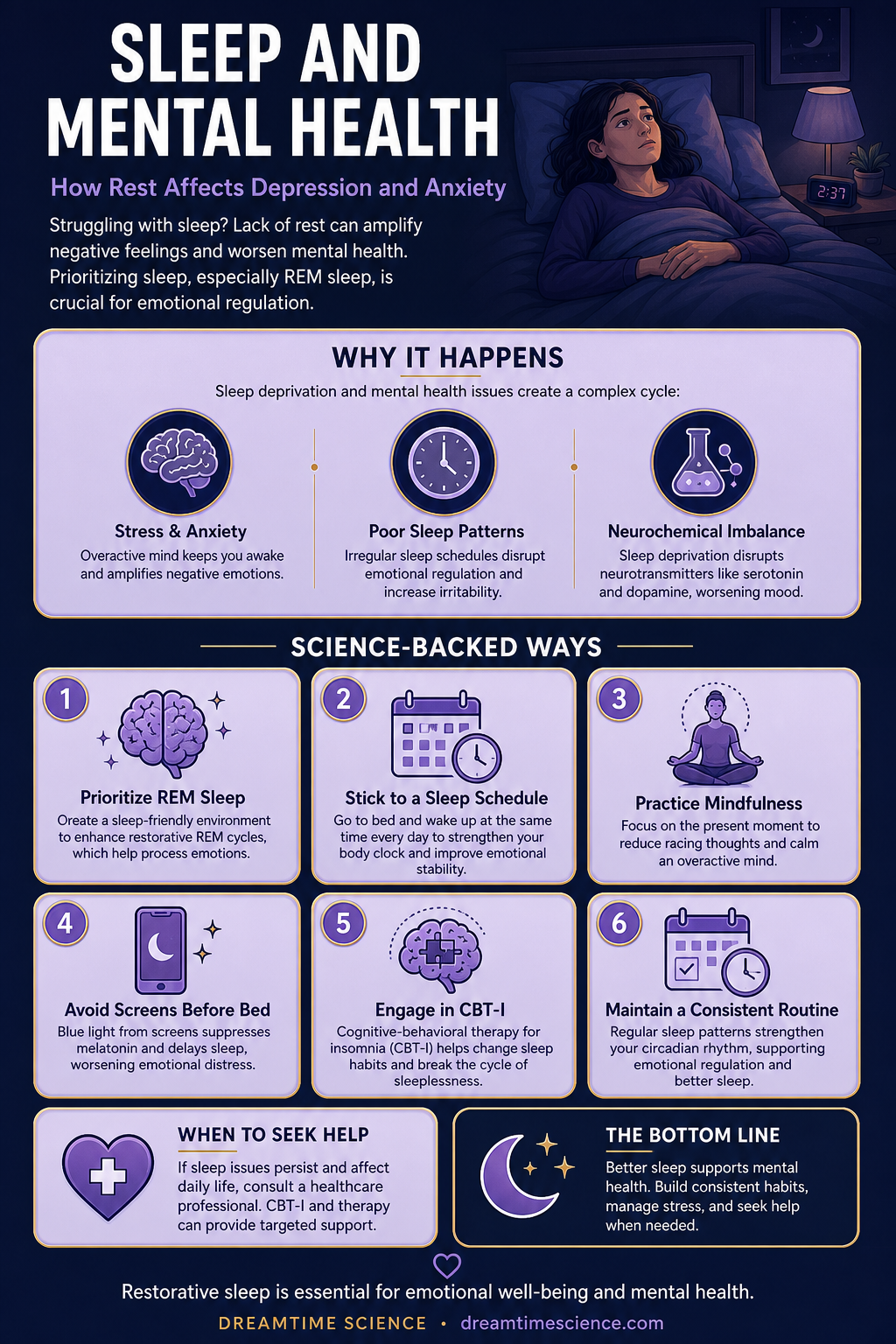
The short answer: Sleep significantly impacts mental health, with a lack of sleep amplifying negative feelings. A 2007 study found sleep deprivation can increase the brain's reaction to negative stimuli by up to 60%, while a 2009 study showed REM sleep disruption heightened emotional distress by 35%. Prioritizing sleep, particularly REM sleep, is crucial for emotional regulation and overall mental well-being.
You're lying awake, staring at the ceiling. Thoughts circling like restless birds. Maybe you're replaying the day, or the week, or your entire life. It's late, and sleep feels a million miles away. Ever wonder why your mind races faster as your body tires?
Here's a hint: It's not just you. It's the intricate dance between sleep and mental health.
Key takeaways
- Prioritizing sleep can significantly improve your mental well-being and emotional stability.
- Lack of sleep amplifies the brain’s reaction to negative experiences, making them feel more intense.
- Consistent sleep routines can anchor mental health by strengthening the body’s internal clock.
- Disruptions to sleep can cause neurotransmitter imbalances, affecting mood and overall mental health.
- Emotional processing and stress reduction occur during REM sleep, requiring adequate sleep duration.
The Night-Time Tug-of-War
Sleep and mental health have a relationship more complicated than a soap opera love triangle. When sleep is elusive, depression and anxiety often sneak in, making themselves comfortable. But why?
Your brain isn't just a passenger in your life’s ride—it’s the driver, and sleep is the fuel. During those precious hours, the brain tidies up, reinforces memories, and resets emotional circuits. Lack of sleep? Well, it's like trying to run a marathon on fumes.
Ever felt more irritable after a bad night's sleep? You’re not imagining it. A 2007 study in Sleep found that sleep deprivation amplifies the brain’s reaction to negative stimuli by up to 60%. In other words, everything feels a bit more... intense.
A Vicious Cycle
Here's the kicker: poor sleep can lead to anxiety and depression, but anxiety and depression can also lead to poor sleep. It's a loop that feels impossible to break.
Insomnia often joins the table of anxiety. Racing thoughts and worry chase away the Sandman. Depression has its own way of disrupting sleep, luring you into excessive slumber or keeping you awake with uneasy energy.
Understanding this cycle is the first step to breaking it. As explored in The Science of Why You Can't Sleep, insomnia isn't just a nighttime problem; it's deeply intertwined with mental health.
What This Means for You
So what can you do? Recognizing the signs and acknowledging the cycle is crucial. Identifying whether your sleep issues stem from stress, anxiety, or depression can help tailor solutions. In upcoming sections, we'll explore practical strategies to help you regain control.
The Brain's Reset Button
Sleep is a reset button for your emotional brain. During rapid eye movement (REM) sleep, your brain processes emotions, untangling complex feelings and soothing daily stresses.
It's akin to a mental spa treatment, except when you don't get enough of it. REM sleep deprivation can leave emotional wounds raw and unhealed, increasing susceptibility to mood disorders. A 2009 study in the Journal of Sleep Research showed that REM sleep disruption heightened emotional distress by 35%.
Think of sleep as a support beam. Without it, your emotional building might sway dangerously.
What This Means for You
To support your mental health, prioritizing REM sleep is essential. Creating a sleep-friendly environment, as outlined in Temperature, Darkness, and Sound: The Ideal Sleep Environment, can enhance your chances of achieving restorative REM cycles.
Chemistry in Motion
Neurotransmitters are the unsung heroes in this story. They're the brain’s messengers, bouncing between neurons, regulating mood and sleep.
- Serotonin: Often dubbed the "feel-good" neurotransmitter, it stabilizes mood and promotes relaxation.
- Dopamine: Influences pleasure and reward, affecting motivation and mood.
- Norepinephrine: Increases alertness and focus, playing a role in the body's stress response.
When sleep falters, these chemicals can go a little haywire, affecting how you feel and think. Imagine trying to communicate underwater—messages get lost, meanings distorted. That's your brain on disrupted sleep.
The Role of Routine
Routine is your secret weapon. Consistent sleep patterns can anchor your mental health, providing stability in a chaotic world.
Your circadian rhythm—the internal clock that governs sleep—craves regularity. When you align with its natural ebb and flow, sleep can become less of a struggle and more of a sanctuary. As detailed in Circadian Rhythms 101: How Your Body's Internal Clock Controls Sleep, maintaining a consistent sleep schedule strengthens this internal clock.
Think of it as setting a bedtime appointment with your brain. Show up for it. Your mental health will thank you.
Finding Balance in the Dark
No magic potion exists to cure insomnia or its impact on mental health. But small steps can lead to significant changes. Cognitive-behavioral therapy for insomnia (CBT-I) offers strategies to change sleep habits and break the cycle of sleeplessness. Cognitive Behavioral Therapy for Insomnia (CBT-I): Evidence-Based Sleep Fixes dives deeper into these techniques.
And then there's mindfulness—a gentle reminder to be present, even when your thoughts race. It’s a practice of noticing, without judgment, which can help soothe the anxious mind. Imagine your mind as a wild horse. Mindfulness is the gentle hand that tames it.
Historical Context: Sleep and Mental Health
The connection between sleep and mental health isn't a modern discovery. Historical texts reveal that ancient civilizations, such as the Greeks and Romans, recognized the importance of sleep for emotional well-being. Hippocrates, the father of medicine, emphasized rest as a critical component of health. In the Middle Ages, sleep disturbances were often attributed to spiritual or supernatural causes, reflecting the limited understanding of the brain's role at the time. It wasn't until the advent of modern psychology and neuroscience that the intricate links between sleep and mental health began to be scientifically explored.
Recent Research Insights
Recent studies continue to unravel the complex relationship between sleep and mental health. A 2021 study published in Nature Reviews Neuroscience highlighted how sleep disruptions can alter brain connectivity, impacting emotional regulation and increasing vulnerability to psychiatric disorders. Additionally, research from the American Journal of Psychiatry in 2022 indicated that improving sleep quality can significantly reduce anxiety and depressive symptoms, underscoring the therapeutic potential of sleep interventions.
Conclusion
Sleep and mental health are intertwined in a delicate balance. It’s a relationship that requires care, patience, and understanding. Tonight, as you lie in bed, remember: your brain is trying its best. It's not an enemy. It's just a little overwhelmed. Treat it with kindness, and who knows? Sleep might just become your ally in the battle against anxiety and depression.
Want to experience these sleep science concepts with our soothing narration and ambient soundscapes? Check out our latest video on YouTube @dreamtimescience.
Frequently Asked Questions
What’s the connection between sleep and mental health?
Sleep and mental health are intimately connected. Poor sleep can exacerbate symptoms of depression and anxiety, while these conditions can also disrupt sleep patterns, creating a feedback loop. This connection is supported by numerous studies, including a comprehensive review in The Lancet Psychiatry in 2020, which detailed how sleep disturbances are both a symptom and a precursor of mental health disorders.
How does lack of sleep affect neurotransmitters?
Lack of sleep disrupts neurotransmitter balance, particularly serotonin, dopamine, and norepinephrine, which are crucial for mood regulation. This imbalance can lead to heightened emotional responses and mood swings. According to a 2018 study in Neuropsychopharmacology, sleep deprivation alters the availability of these neurotransmitters, affecting cognitive functions and emotional stability.
Can improving sleep help with depression?
Yes, improving sleep can alleviate some symptoms of depression. A 2015 study in JAMA Psychiatry found that treating insomnia in people with depression significantly improved their depressive symptoms. Furthermore, a 2019 meta-analysis in Sleep Medicine Reviews confirmed that sleep interventions can effectively reduce depressive symptoms, highlighting the importance of addressing sleep issues in mental health treatment plans.
What is REM sleep's role in mental health?
REM sleep is vital for emotional processing and memory consolidation. Disrupted REM sleep can lead to increased emotional distress and heightened risk of mood disorders. A 2020 study in Frontiers in Psychology emphasized that REM sleep facilitates the integration of emotional experiences, which is crucial for maintaining emotional resilience.
How can I improve my sleep routine?
Establishing a consistent sleep schedule, creating a relaxing bedtime environment, and practicing mindfulness can improve your sleep routine. These small changes can have a significant impact on mental health. For more tips, see 7 Science-Backed Ways to Beat Insomnia Tonight.
Fall Asleep to a Science Lecture
Put tonight's reading into practice — pick a gentle, softly-narrated episode and let the Professor talk you to sleep.
 Tonight's episodeDNA's Silent Blueprint: Uncovering Life’s Deepest Secrets
Related articles

Sleep Anxiety: When Fear of Not Sleeping Keeps You Awake
Sleep anxiety, or somniphobia, turns bedtime into a struggle fueled by the fear of not sleeping and the potential consequences of exhaustion. A 2018 study in the…

Sleep and Blood Sugar: How Rest Affects Your Glucose Levels
Insufficient sleep significantly impacts blood sugar regulation. Studies show individuals sleeping less than six hours a night face a 32% higher risk of type 2…

Breathing Techniques for Sleep: How Your Breath Affects Rest
Breathing techniques like the 4-7-8 method and deep breathing exercises can significantly improve sleep quality by activating the parasympathetic nervous system. A…