← Back to Articles
Sleep Science

The short answer: Your circadian rhythm is a 24-hour internal clock controlled by the suprachiasmatic nucleus in the hypothalamus. It regulates sleep-wake cycles, hormone release, body temperature, and metabolism. Light is the primary synchroniser, which is why morning sunlight exposure and evening darkness are the most powerful tools for healthy sleep timing.
If sleep feels unpredictable, here's something grounding to consider: Your body runs on timing. At the heart of it all are circadian rhythms—24-hour biological cycles that regulate vital functions such as sleep and wakefulness, hormone release, body temperature, metabolism, and alertness. Circadian rhythms 101 begins with a simple truth: You don’t fall asleep just because you’re tired. You fall asleep because your internal clock says it’s time.
Key takeaways
- Your body has an internal clock, called the suprachiasmatic nucleus, that regulates sleep.
- Light, especially morning light, helps set your body’s internal clock and influences sleep timing.
- Sleep pressure and your circadian rhythm work together to determine when you feel sleepy.
- Chronotype, or your natural sleep preference, is partly determined by genetics.
- Consistent daily routines, like wake times and meal times, strengthen your circadian rhythm.
The Master Clock in Your Brain
At the center of your circadian rhythm is a tiny yet mighty structure called the suprachiasmatic nucleus (SCN), located in the hypothalamus. This cluster of approximately 20,000 neurons acts as the body’s master clock, responding primarily to light signals from your eyes. A 2019 study published in Nature Reviews Neuroscience described the SCN as crucial in coordinating daily rhythms throughout the body, synchronizing the release of melatonin, timing cortisol peaks, and regulating body temperature fluctuations. Think of it as your internal conductor, orchestrating a symphony of biological processes.
Light: The Primary Time Cue
Light plays a pivotal role in setting your circadian rhythm. Morning light advances the clock, nudging you to wakefulness, while evening light delays it, pushing sleep onset later. Blue-enriched light, in particular, is a powerful influencer, as discussed in Blue Light Before Bed: Myth or Reality? What Research Actually Shows. In darkness, melatonin levels rise, signaling it’s time to sleep; in light, they fall. This light-dark cycle remains the strongest regulator of sleep timing, a fact well-supported by numerous studies, including those by the Harvard Medical School.
Sleep Pressure vs. Circadian Rhythm
Two systems govern sleep: sleep pressure and the circadian rhythm. Sleep pressure builds with the accumulation of adenosine, a neurotransmitter that increases with every waking hour. Meanwhile, your circadian rhythm dictates when you’re most likely to feel alert or sleepy. You might feel tired at 3 PM due to high sleep pressure, but if your circadian rhythm promotes alertness at that hour, falling asleep won’t be easy.
Sleep occurs when high sleep pressure and the circadian "sleep window" align. When these two systems are misaligned, insomnia can occur—a topic explored in The Science of Why You Can't Sleep: Understanding the Insomnia Cycle.
Chronotypes: Night Owls and Morning Larks
Not everyone’s internal clock ticks the same way. Chronotype reflects your natural timing preference: morning types, or "larks," peak earlier in the day, while evening types, or "owls," peak later. Genetics play a significant role in determining chronotype. Forcing a night owl into a 5 AM routine can create "social jet lag," disrupting their natural rhythm. This internal clock resists abrupt changes, a phenomenon supported by a 2017 study in the Journal of Biological Rhythms.
What Disrupts Circadian Rhythms?
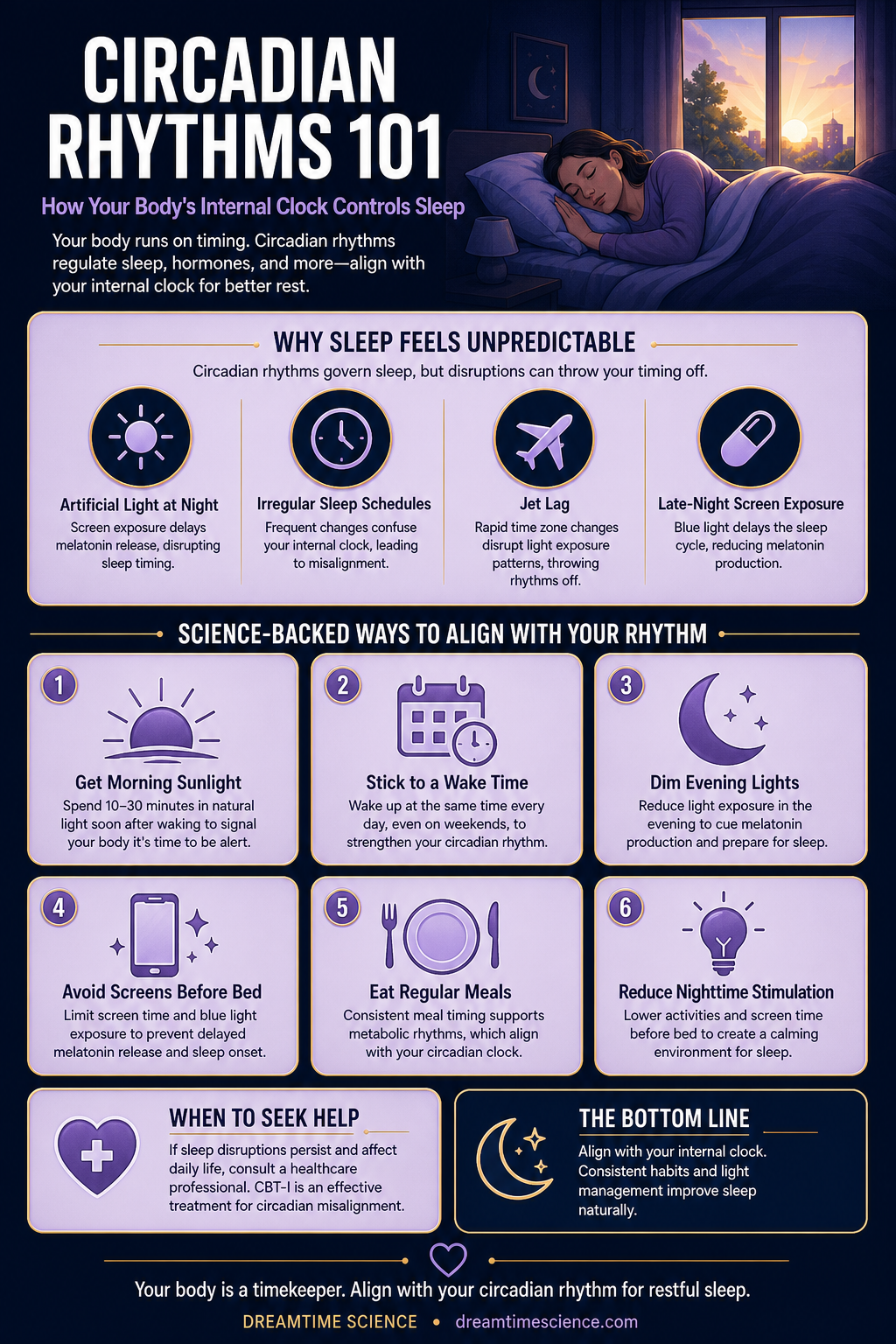
Several factors can disrupt the delicate balance of your circadian rhythms:
- Artificial light at night: Exposure to screens and artificial lighting can delay melatonin production.
- Irregular sleep schedules: Frequent changes in sleep timing can confuse your internal clock.
- Shift work: Working nights or rotating shifts can lead to chronic misalignment.
- Jet lag: Crossing time zones rapidly alters light exposure patterns.
- Late-night screen exposure: Blue light from screens can delay the sleep cycle.
Disruption leads to delayed melatonin release, fragmented sleep, and reduced REM sleep in late cycles, all of which connect back to Sleep Cycles Explained: Why 8 Hours Isn't Always Enough.
Strengthening Your Internal Clock
Here are some gentle strategies to reinforce your circadian rhythm:
- Morning sunlight exposure: Spend 10–30 minutes in natural light soon after waking.
- Consistent wake times: Try to wake up at the same time every day, even on weekends.
- Dim lights in the evening: Reduce light exposure to cue melatonin production.
- Regular meal timing: Eating at consistent times supports metabolic rhythms.
- Reduced nighttime stimulation: Lower activities and screen time before bed.
Circadian rhythm thrives on consistency. It is a pattern-seeking system that, when aligned, naturally enhances sleep quality.
What This Means for You
Understanding your circadian rhythm empowers you to align with it rather than fight against it. By adopting regular sleep and wake times, reducing evening light exposure, and getting morning sunlight, you can improve your sleep quality and overall well-being. This alignment can reduce the risk of insomnia and other sleep disorders, making rest feel like less of an effort and more of a natural rhythm.
Conclusion: Your Body Is a Timekeeper
Circadian rhythms 101 reveals something calming: Your sleep is not random; it is orchestrated. Light cues, hormone pulses, temperature shifts, and neural timing all work in harmony. When you align with your internal clock instead of fighting it, sleep becomes less effortful and more rhythmic. And rhythm, once restored, feels natural.
Want to experience these sleep science concepts with our soothing narration and ambient soundscapes? Check out our latest video on YouTube @dreamtimescience.
Frequently Asked Questions
Can I reset my circadian rhythm?
Yes, you can gradually reset your circadian rhythm through timed light exposure and consistent scheduling. Morning sunlight and avoiding screens before bed are effective methods. This process often takes several days to a few weeks, depending on the degree of adjustment needed.
How long does adjustment take?
Adjusting your circadian rhythm can take several days to a few weeks. The speed depends on how significant the shift in your schedule is and how consistently you expose yourself to natural light at key times.
Is melatonin helpful?
Melatonin supplements can aid in timing shifts, especially for night owls or those experiencing jet lag. They are most effective when timed correctly, as discussed in Does Melatonin Actually Work? What Science Says About This Popular Supplement.
Why do I get a second wind at night?
A second wind in the evening can occur due to a spike in cortisol and alertness signals, particularly in evening chronotypes. This natural rise in energy levels can make it challenging to settle into sleep if bedtime is too early.
Does age affect circadian rhythm?
Yes, circadian rhythms often shift earlier as you age. This shift can lead to earlier sleep and wake times, making older adults more likely to rise early and feel sleepy in the early evening.
Tonight's Listening
 Tonight's episodeHow Gravity Can Bend Time: The Cosmic Clock Puzzle
Fall Asleep to a Science Lecture
Put tonight's reading into practice — pick a gentle, softly-narrated episode and let the Professor talk you to sleep.
Tonight's episodeHow Gravity Can Bend Time: The Cosmic Clock Puzzle
Related articles

How Sleep Works
The Sleep Pressure Curve: Why You Get Tired at Specific Times
Sleep pressure is driven by adenosine, a byproduct of neuronal activity that accumulates in the brain throughout waking hours. The longer you stay awake, the more…

Body Clock & Timing
Shift Work and Sleep: Strategies for Night Shift Workers
Night shift work significantly disrupts the body's natural circadian rhythm, leading to challenges with sleep and alertness. A 2017 study found shift workers are 1.5…

Body Clock & Timing
Jet Lag Explained: How to Recover From Time Zone Changes
Jet lag occurs when your body's internal clock, the circadian rhythm, doesn't align with the new time zone after travel. This disruption, impacting sleep, mood, and…