← Back to Articles
Sleep Hygiene

The short answer: Progressive muscle relaxation (PMR) reduces sleep onset time by systematically tensing and releasing muscle groups from toes to head. This activates the parasympathetic nervous system, lowering heart rate, blood pressure, and cortisol. Clinical studies show PMR reduces time to fall asleep by 15-20 minutes and improves subjective sleep quality. It takes just 10-15 minutes and requires no equipment.
If your body feels tense at night—jaw tight, shoulders lifted, breath shallow—sleep becomes harder. Because tension signals vigilance, your body is on high alert, like a sentry guarding a fortress. This state of hyperarousal can make slumber feel as elusive as a distant star.
Progressive Muscle Relaxation (PMR) is a simple, neuroscience-backed technique that helps shift your nervous system from alertness to a state of safety. It doesn’t require supplements. It doesn’t force sleep. Instead, it gently trains your body to release, like a leaf floating downstream, carried effortlessly by the current.
And its effectiveness is supported by decades of research, offering a bridge from tension to tranquility.
Key takeaways
- Progressive Muscle Relaxation involves tensing and releasing muscle groups systematically.
- Practicing PMR regularly can help reduce chronic stress and improve sleep quality over time.
- PMR activates the parasympathetic nervous system, promoting relaxation and recovery.
- Insomnia often involves hyperarousal, which PMR can interrupt by lowering muscle tension.
- Combining PMR with natural sleep pressure enhances the body’s ability to transition into restful sleep.
What Is Progressive Muscle Relaxation?
Developed in the 1920s by physician Edmund Jacobson, PMR involves systematically engaging specific muscle groups in a cycle of tension and release. The method is as follows:
- Tensing specific muscle groups: You start by deliberately tensing a particular muscle group, such as your hands or feet.
- Holding tension briefly: Maintain this tension for a few seconds, allowing the sensation to fully register.
- Releasing and noticing the contrast: Release the tension and pay attention to the feeling of relaxation that follows.
This contrast teaches the brain the difference between tension and relaxation. Over time, awareness improves, and baseline tension decreases, much like a river smoothing over sharp stones.
The Neuroscience Behind PMR
Our bodies are equipped with a sophisticated response system, finely tuned to detect stressors. When muscles are tense, sensory feedback signals the brain that the body is activated, a state known as sympathetic nervous system activity, or the fight-or-flight response. This response is vital in emergencies but can be a hindrance when trying to sleep.
PMR, however, activates the parasympathetic system—your rest-and-digest mode—which encourages relaxation and recovery. A 2017 study published in the journal Frontiers in Psychology found that PMR significantly reduced physiological markers of stress, such as heart rate and muscle tension. This shift from activation to relaxation is akin to easing off the accelerator and coasting to a gentle stop.
According to the American Academy of Sleep Medicine, relaxation training, including PMR, is a validated behavioral treatment option for insomnia. Relaxation isn’t vague; it’s measurable and impactful, much like the calming effect of a lullaby.
What This Means for You
By regularly practicing PMR, you empower your nervous system to recognize and adopt a state of calm. This practice can help reduce chronic stress levels and improve sleep quality over time. It's a gentle, accessible tool for anyone seeking to soothe the body and mind, offering a pathway to deeper rest.
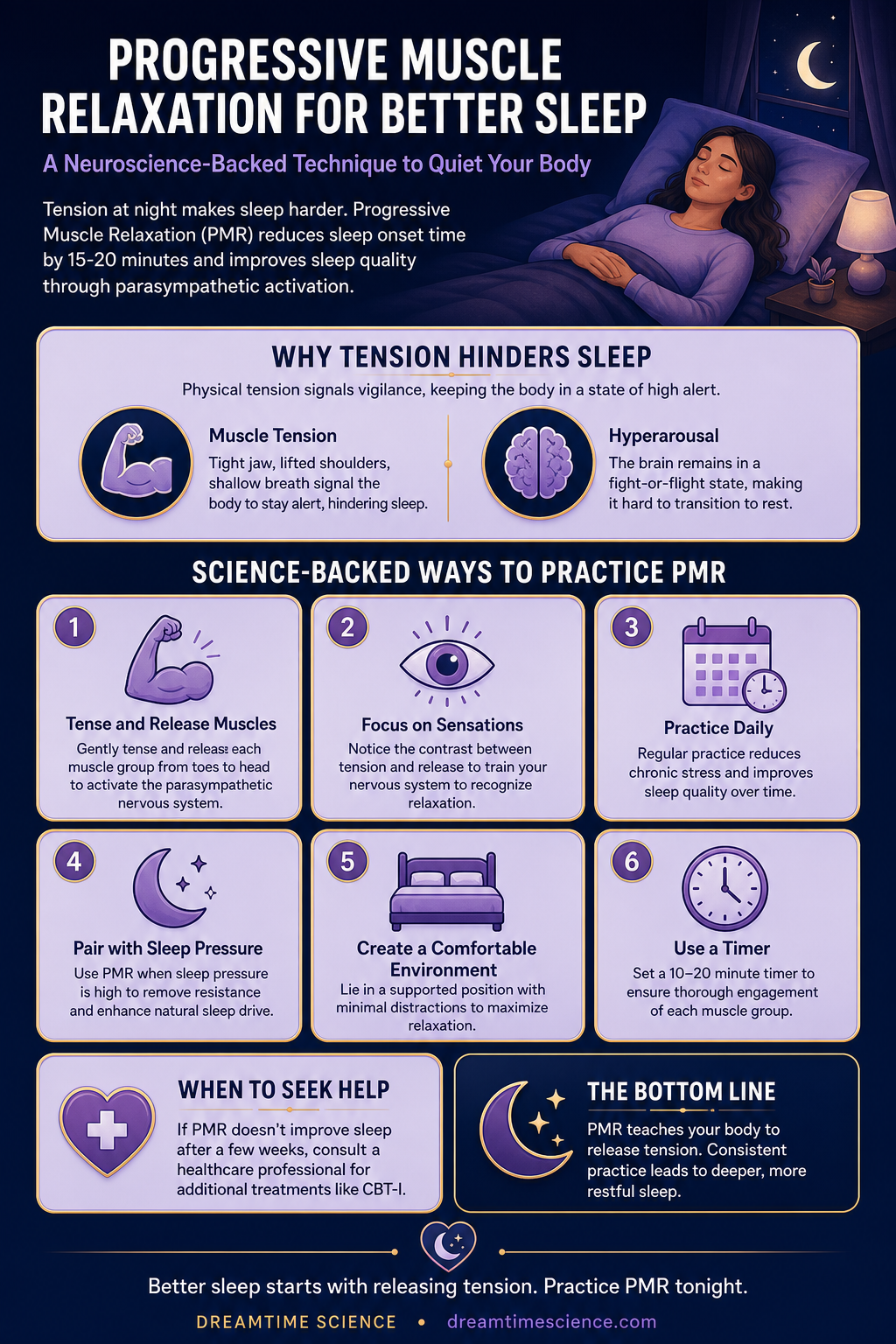
How to Practice Progressive Muscle Relaxation
You can try this tonight in the comfort of your own bed:
- Lie comfortably. Find a position that supports your entire body.
- Start at your feet. Gently tense the muscles in your feet for about 5 seconds.
- Release for 10–15 seconds. Notice the sensation of letting go.
- Move upward: Progressively work through your calves, thighs, abdomen, hands, arms, shoulders, and face.
The key isn’t force; it’s awareness. By tuning into the sensations of tension and release, you teach your nervous system what “off” feels like, recalibrating your baseline state from alert to at ease.
Why PMR Helps Insomnia
As we explored in The Science of Why You Can't Sleep: Understanding the Insomnia Cycle, insomnia often involves hyperarousal—a state where the mind races and the body remains on edge. PMR interrupts that loop by:
- Lowering muscle tension: Reducing the physical signs of stress.
- Reducing heart rate: Slowing the pulse to a more restful rhythm.
- Anchoring attention in the body: Focusing the mind away from racing thoughts.
- Decreasing cognitive rumination: Allowing mental chatter to quieten.
It gives the brain a competing signal: safe, not threatened, allowed to rest. This approach can be a powerful complement to other methods for managing insomnia, such as Cognitive Behavioral Therapy for Insomnia (CBT-I).
Pairing PMR with Sleep Pressure
As explained in The Sleep Pressure Curve: Why You Get Tired at Specific Times, PMR works best when sleep pressure is already present. Relaxation does not create sleep pressure; it removes resistance to it. Think of it as opening a gate—the biological drive to sleep does the rest.
By pairing PMR with natural sleep pressure, you enhance your body's ability to transition into restful sleep, much like a gentle breeze helping a sailboat glide across calm waters.
Conclusion: Teaching the Body to Let Go
Progressive Muscle Relaxation is simple. Tense, release, notice. But beneath that simplicity lies powerful neurobiology. By teaching your body to let go, you allow your nervous system to recalibrate. Sleep becomes less of a battle and more of a transition—a gentle slide into restfulness.
And sometimes, the smallest releases create the deepest rest.
Want to experience these sleep science concepts with our soothing narration and ambient soundscapes? Check out our latest video on YouTube @dreamtimescience.
Frequently Asked Questions
How long does PMR take?
A full session takes about 10–20 minutes, allowing you to thoroughly engage each muscle group. This brief investment of time can yield significant benefits for your overall relaxation and sleep quality.
Should I practice daily?
Yes, consistency improves effectiveness. Regular practice helps reinforce the relaxation response, making it easier for your body to enter a state of calm when needed.
What if I fall asleep mid-practice?
That’s perfectly fine. Falling asleep during PMR indicates that your body is responding positively to the relaxation process, which is ultimately the goal.
Can PMR replace sleep medication?
While PMR is a valuable tool, it is often used alongside other treatments, including medication. Always consult a healthcare provider before making changes to your medication regimen.
Does it work immediately?
Some individuals experience relief quickly, while others notice improvements with repetition. Like learning a new skill, the benefits of PMR deepen with practice.
Tonight's Listening
 Tonight's episodeHow Gravity Can Bend Time: The Cosmic Clock Puzzle
Fall Asleep to a Science Lecture
Put tonight's reading into practice — pick a gentle, softly-narrated episode and let the Professor talk you to sleep.
Tonight's episodeHow Gravity Can Bend Time: The Cosmic Clock Puzzle
Related articles

Remedies & Relaxation
Breathing Techniques for Sleep: How Your Breath Affects Rest
Breathing techniques like the 4-7-8 method and deep breathing exercises can significantly improve sleep quality by activating the parasympathetic nervous system. A…

Insomnia & Sleep Problems
Beat Insomnia Tonight
Insomnia can be beaten tonight using seven evidence-based techniques: the 4-7-8 breathing method, progressive muscle relaxation, stimulus control, cognitive…

How Sleep Works
Sleep and Athletic Performance: How Rest Builds Muscle and Speed
You’ve pushed through another grueling workout, sweat pouring, muscles aching.