
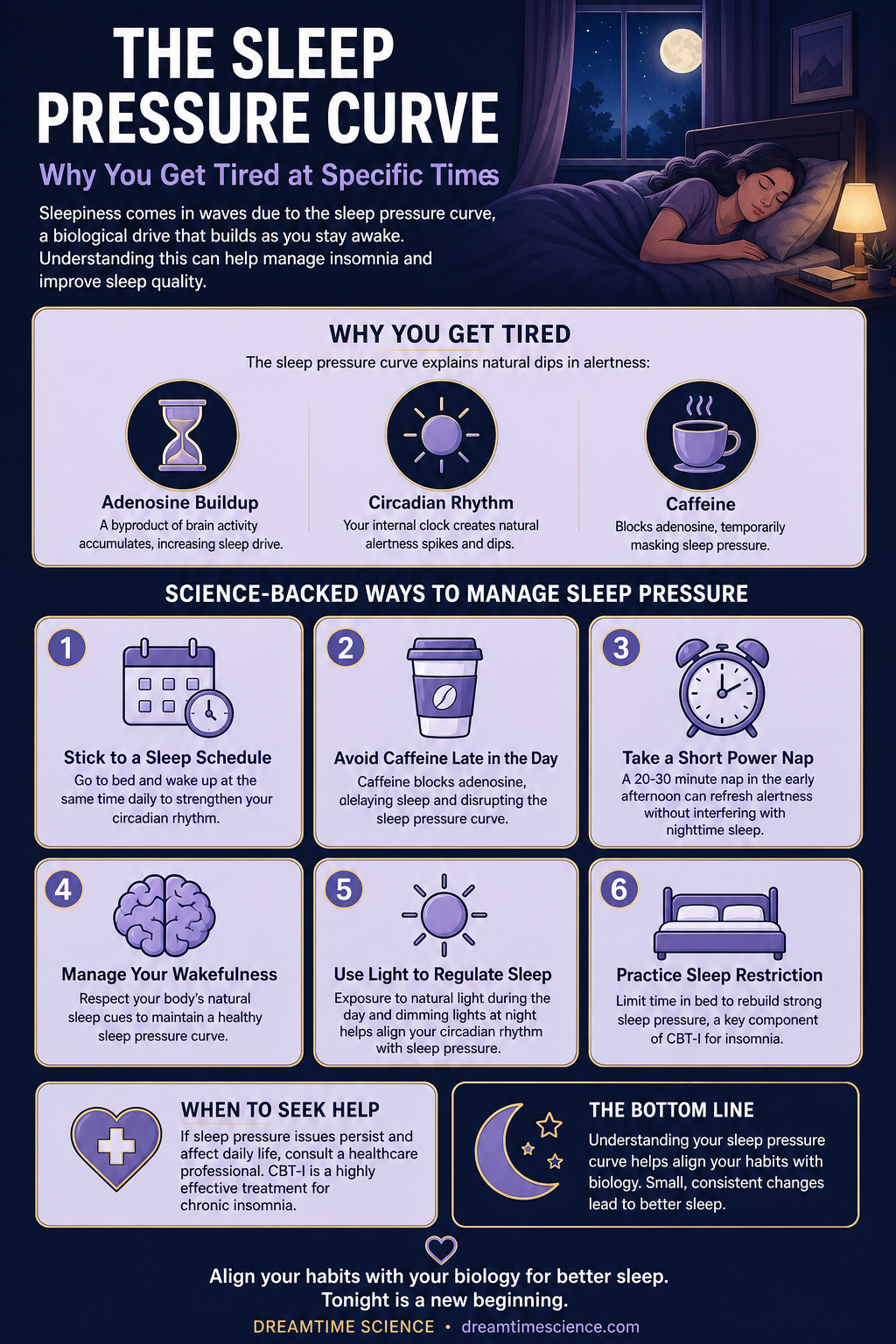
The short answer: Sleep pressure is driven by adenosine, a byproduct of neuronal activity that accumulates in the brain throughout waking hours. The longer you stay awake, the more adenosine builds up, creating an increasing urge to sleep. This homeostatic drive interacts with your circadian rhythm to produce two natural dips in alertness: a major one around 2-4am and a smaller one around 1-3pm.
Have you ever noticed how sleepiness comes in waves? You might feel alert at 10 PM, only to be suddenly exhausted by 10:45 PM. Or perhaps you experience a sluggish lull at 3 PM, but find yourself strangely energized by 9 PM. Maybe you're completely wired when you finally lie down to sleep. This isn’t random; rather, it's driven by something called the sleep pressure curve — one of the two major systems controlling when you feel tired.
If your circadian rhythm is your internal clock (explored in Circadian Rhythms 101: How Your Body’s Internal Clock Controls Sleep), then sleep pressure is your internal hourglass. Understanding this curve can transform how you relate to insomnia, naps, and those late-night “second winds.”
Key takeaways
- Understanding sleep pressure involves recognizing your body’s increasing need for sleep as you stay awake.
- Adenosine builds up in your brain throughout the day, creating a biological drive to sleep.
- Naps can be helpful for reducing sleep pressure, but short naps earlier in the day are best.
- Caffeine blocks adenosine receptors, masking sleep pressure rather than eliminating it.
- Sleep restriction, a CBT-I technique, can strengthen sleep pressure and improve sleep quality.
What Is Sleep Pressure?
Sleep pressure is your body’s increasing drive to sleep the longer you stay awake. Biologically, it's linked to a molecule called adenosine. Throughout the day, adenosine builds up in your brain as a byproduct of cellular activity. The longer you’re awake, the more adenosine accumulates, and the stronger the urge to sleep becomes.
A 2019 study published in Sleep revealed that adenosine plays a central role in sleep regulation, acting like sand filling an hourglass. When the glass fills high enough, sleep becomes nearly irresistible unless something interferes. This buildup of adenosine creates a natural biological pressure that nudges you toward slumber.
What This Means for You
Understanding sleep pressure means recognizing the importance of managing your wakefulness. By respecting your body's natural cues, you can enhance your overall sleep quality. For instance, avoiding caffeine late in the day can help keep the sleep pressure curve on track, making it easier to fall asleep when bedtime arrives.
The Two-Process Model of Sleep
Sleep scientists describe regulation using the Two-Process Model, developed by Alexander Borbély. This model includes two components: Process S (sleep pressure or homeostatic drive) and Process C (circadian rhythm or internal clock timing). Sleep happens most easily when high sleep pressure and the circadian “sleep window” align.
If either one is off, sleep becomes harder. For example, high sleep pressure coupled with a circadian alertness spike can make you feel wired but tired. Conversely, low sleep pressure during a circadian sleep window might leave you lying awake at bedtime. This interplay is often at the heart of insomnia, as we explore in The Science of Why You Can't Sleep: Understanding the Insomnia Cycle.
Why You Get a “Second Wind” at Night
Have you ever felt exhausted at 8 PM, then strangely awake by 10 PM? That’s your circadian rhythm briefly boosting alertness. In the evening, your brain releases a small pulse of alerting signals to prevent you from falling asleep too early, known as the “wake maintenance zone.”
Pushing past your initial sleepiness window allows this second wind to override sleep pressure temporarily. However, the adenosine doesn’t disappear; it continues to rise quietly in the background. This is why staying up “just one more hour” can backfire, leading to fragmented sleep or difficulty falling asleep.
Naps and the Sleep Pressure Reset
Naps reduce sleep pressure by lowering adenosine levels, which can be helpful unless you nap too long or too late. A long afternoon nap can drain sleep pressure, delay nighttime sleep onset, and weaken your natural curve. Short naps (20–30 minutes) earlier in the day tend to refresh without significantly flattening the nighttime pressure buildup. We delve into this balance further in Why Naps Backfire (And When They Actually Help).
Practical Nap Tips
To harness the benefits of napping without disrupting your sleep pressure, aim for a power nap of 20-30 minutes in the early afternoon. This can provide a boost in alertness and mood without significantly interfering with your nighttime sleep.
Caffeine and the Sleep Pressure Curve
Caffeine works by blocking adenosine receptors, masking rather than removing adenosine. When caffeine wears off, the accumulated sleep pressure can feel intense, often referred to as a caffeine “crash.” Your hourglass was filling the whole time, you just couldn’t see the sand.
What This Means for You
Timing your caffeine intake strategically can help manage sleep pressure. Consuming caffeine in the morning allows its effects to wear off by bedtime, minimizing its impact on your sleep pressure curve.
Sleep Restriction and Rebuilding Pressure
One of the most effective treatments for chronic insomnia, Cognitive Behavioral Therapy for Insomnia (CBT-I), uses controlled sleep restriction to rebuild strong sleep pressure. By temporarily reducing time in bed, sleep pressure intensifies, and the curve steepens. Over time, this strengthens the bed = sleep association, which is discussed in detail in Cognitive Behavioral Therapy for Insomnia (CBT-I): Evidence-Based Sleep Fixes.
Conclusion: Sleepiness Is Rhythmic, Not Random
The sleep pressure curve explains why tiredness rises in waves. It builds quietly throughout the day, interacting with your internal clock. It can be strengthened or weakened by habits, and understanding this curve makes insomnia feel less mysterious. You’re not broken; your biology is simply out of alignment, and alignment can be restored.
Want to experience these sleep science concepts with our soothing narration and ambient soundscapes? Check out our latest video on YouTube @dreamtimescience.
Frequently Asked Questions
Why do I feel sleepy at 3 PM?
This often reflects a natural dip in circadian alertness combined with moderate sleep pressure buildup, creating that familiar afternoon slump. It’s your body signaling that a brief rest could help restore energy levels.
Can I increase sleep pressure naturally?
Yes, consistent wake times, limiting naps, and reducing late caffeine consumption can help increase sleep pressure naturally. Regular physical activity also contributes to adenosine buildup, enhancing your sleep drive.
Why am I tired but not sleepy?
You may be mentally fatigued but not at peak biological sleep pressure. This discrepancy often occurs when your brain is still active or stimulated, even if your body feels rundown, highlighting the importance of winding down before bed.
Does exercise affect sleep pressure?
Yes, physical activity increases adenosine buildup, strengthening nighttime sleep drive. Regular exercise can help align your sleep pressure with your circadian rhythm, promoting more restful sleep.
How long does sleep pressure take to build?
For most adults, 14–18 hours of wakefulness creates strong sleep pressure. This timeframe varies slightly depending on individual factors such as age, lifestyle, and overall health.
Fall Asleep to a Science Lecture
Put tonight's reading into practice — pick a gentle, softly-narrated episode and let the Professor talk you to sleep.
 Tonight's episodeHow Gravity Can Bend Time: The Cosmic Clock Puzzle
Related articles

The Science of Why You Can't Sleep: Understanding the Insomnia Cycle
Insomnia becomes self-perpetuating because worrying about sleep triggers a stress response that makes sleep impossible. This creates a conditioned arousal where the…

Drowsy Driving: Why Tired at the Wheel Rivals Drunk at the Wheel
Ever found yourself squinting at the road ahead, eyelids growing heavier with each stretch of asphalt?

Weighted Blankets: The Science of Deep Pressure and Sleep
Tossing and turning, tangled in sheets, the clock's relentless march toward morning.