You’ve pushed through another grueling workout, sweat pouring, muscles aching. You’ve fueled your body with the right nutrients, ticking off every box in your training plan. But as the night creeps in, there’s one crucial element left on your checklist — sleep. It’s the secret weapon in every athlete's arsenal, the unsung hero in muscle recovery and speed enhancement.
Sleep isn’t just a passive state of rest.
It’s active, dynamic, and brimming with potential.
Your body knows this.
While you dream, it rebuilds.
The Night Shift: Muscle Recovery During Sleep
When your head hits the pillow, your body begins its night shift. It’s the time your muscles have been waiting for — the moment they start to heal and grow. This is when sleep muscle recovery takes center stage, transforming fatigue into strength.
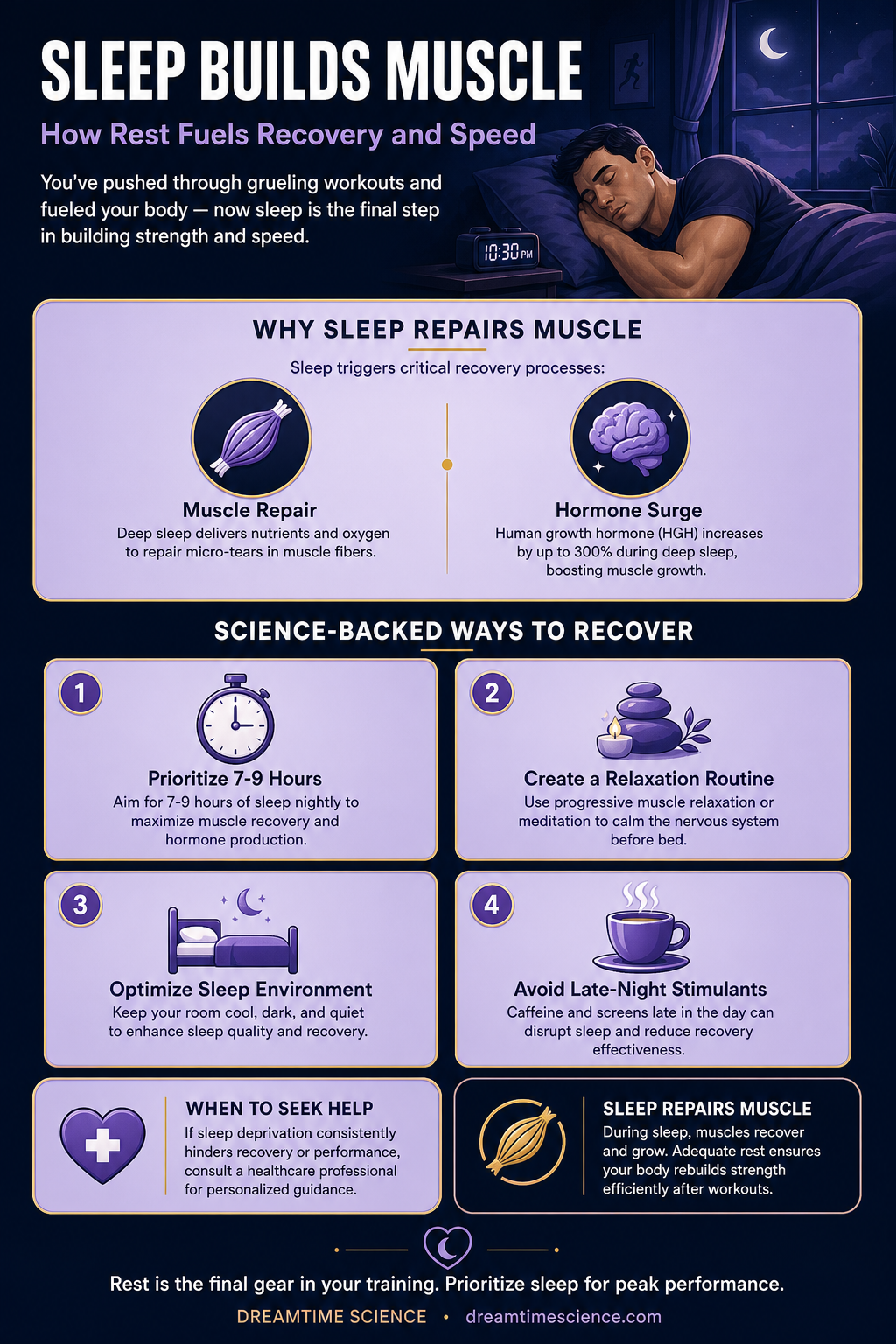
During deep sleep, blood flow to your muscles increases, delivering essential nutrients and oxygen. It’s like a construction site that comes alive after hours, with workers pouring in to repair the day’s wear and tear. The damage from tiny tears in muscle fibers, inflicted by intense workouts, gets fixed here.
But it’s not just about mending what's broken.
It’s about building something better.
Human growth hormone (HGH) surges in the bloodstream during sleep, peaking particularly in the early hours of deep sleep. According to a study published in The Journal of Clinical Investigation in 1994, this hormone can increase by up to 300% during sleep compared to waking hours. HGH doesn’t just fix; it fortifies, stimulating growth and athletic prowess. Every night, your potential for speed and strength gets a fresh coat of paint.
What This Means for You
To maximize muscle recovery, aim for 7-9 hours of sleep each night. Consider incorporating a relaxation routine before bed to enhance sleep quality. Techniques such as progressive muscle relaxation can calm the nervous system and prepare your body for rest, as explored in our article on Progressive Muscle Relaxation.
Hormones: The Silent Engineers
While you rest, a team of hormones quietly works behind the scenes, orchestrating the repair processes. Among them, testosterone stands out, a critical agent in muscle growth and recovery.
Athletes sleep deeply, knowing that testosterone isn’t built in the gym — it’s crafted in the confines of a good night’s sleep. This hormone helps synthesize protein, the building block of muscle, carving out the physique you've worked for in daylight hours. A 2007 study in The Journal of Clinical Endocrinology & Metabolism found that testosterone levels may decrease by 10-15% after a week of sleep restriction, illustrating the crucial connection between rest and hormone production.
Not enough rest?
The balance tilts, and your body's ability to produce testosterone dips. Less testosterone means slower recovery, fewer gains. Sleep is the linchpin, the stabilizer in this delicate hormonal dance.
The Circadian Rhythm: Nature's Personal Trainer
Your body runs on an internal clock, a circadian rhythm that dictates when you should sleep and when you should wake. This rhythm isn’t just a biological quirk — it’s your personal trainer, pushing you toward optimal performance.
Syncing your sleep with your circadian rhythm can enhance athletic performance. Like a well-timed metronome, it ensures that every function of your body ticks in harmony. This natural cycle dictates when cortisol, the wake-up hormone, spikes and when melatonin, the sleep-inducing hormone, takes over.
Ignoring this rhythm is like running a race with untied shoelaces.
You might still finish, but not at your best.
What This Means for You
To harness your circadian rhythm, try to maintain a consistent sleep schedule, even on weekends. Exposure to natural light during the day and minimizing artificial light at night can help regulate this internal clock, as detailed in our article on Circadian Rhythms 101.
Training Recovery: The Sleep Connection
Sleep is the final frontier in training recovery, a sanctuary where your muscles find solace. It’s where the magic happens — where yesterday’s struggles transform into tomorrow’s victories. Athletes who prioritize sleep often find that their training recovery sleep leads to enhanced performance and fewer injuries.
Consider it your recovery drink, without the calories. Every REM cycle, every moment of deep sleep, acts like a balm for sore muscles and tired minds. It’s a reset button, a chance for your body to recharge and optimize its functions for the next challenge.
Chasing speed or strength?
It starts in the bedroom.
Speed and Agility: The Dream Team
Speed is a blend of physical prowess and mental acuity — a partnership that sleep strengthens. During sleep, the brain consolidates memories, including motor skills learned during the day. This process translates training into intrinsic knowledge, turning practice into instinct.
It’s not just about faster reflexes.
It’s about smarter, more efficient movement.
Agility improves as the brain refines pathways, making each movement smoother and quicker. A 2016 study in Nature Neuroscience found that sleep-enhanced motor skill learning can improve performance by 20% compared to wakefulness alone. When dreams fade and eyes open, the effects linger, a testament to the power of restful nights.
Historical Context: Sleep in Ancient Athletic Practices
In ancient times, athletes were well aware of the importance of rest. Greek Olympians, for instance, would incorporate rest days into their training regimens, understanding that recovery was as crucial as the training itself. This practice was not just about physical rest but also mental preparation, allowing athletes to visualize their performance and mentally rehearse their skills. The concept of rest as a performance enhancer is deeply rooted in history, illustrating that even without modern science, the benefits of sleep were intuitively recognized.
Conclusion
Sleep is an athlete’s silent partner, one whose contributions often go unnoticed yet remain undeniably crucial. It stitches together the gains from your workouts, fuels your recovery, and propels you into your next feat. As you prepare for bed, remember: it’s not just rest. It’s preparation. It’s potential. It’s the promise of what you can achieve tomorrow.
Want to experience these sleep science concepts with our soothing narration and ambient soundscapes? Check out our latest video on YouTube @dreamtimescience.
Frequently Asked Questions
How does lack of sleep affect athletic performance?
Lack of sleep can impair cognitive functions, slow reaction times, and reduce endurance. According to a 2011 study in the European Journal of Applied Physiology, sleep deprivation can decrease time to exhaustion by up to 10%, highlighting its impact on stamina and performance. Additionally, sleep deprivation affects the body's ability to metabolize glucose, which is crucial for endurance sports. This metabolic disruption can lead to decreased energy availability during prolonged physical activity.
Is it better to sleep more before a big event?
Yes, ensuring adequate sleep before a major athletic event can enhance performance. Sleep acts as a foundation for physical and mental readiness, allowing the body to repair and the mind to focus. A well-rested athlete is more likely to experience improved reaction times, better decision-making, and enhanced mood, all of which are critical on the day of competition.
How does sleep improve muscle recovery?
Sleep promotes muscle recovery by increasing blood flow and releasing growth hormones like HGH, which are essential for tissue repair and growth. This facilitates the healing of microtears in muscle fibers caused by intense exercise. Moreover, sleep reduces inflammation and supports the immune system, both of which are vital for recovery and preventing injuries.
Can naps benefit athletic performance?
Short naps of 20-30 minutes can boost alertness and improve cognitive performance without causing sleep inertia. A study published in Sports Medicine in 2019 suggests that strategic napping can enhance aspects of physical performance like reaction time and accuracy. Naps can also help in reducing muscle fatigue and improving mood, making them a useful tool in an athlete's recovery arsenal.
Why are REM cycles important for athletes?
REM sleep is crucial for cognitive functions, including memory consolidation and learning. This stage of sleep helps athletes integrate new skills and strategies, effectively translating practice into improved performance. REM sleep also plays a role in emotional regulation, which can be beneficial for maintaining focus and motivation in high-pressure situations.
Fall Asleep to a Science Lecture
Put tonight's reading into practice — pick a gentle, softly-narrated episode and let the Professor talk you to sleep.
 Tonight's episodeUnveiling the Mind's Labyrinth