← Back to Articles
Sleep Science
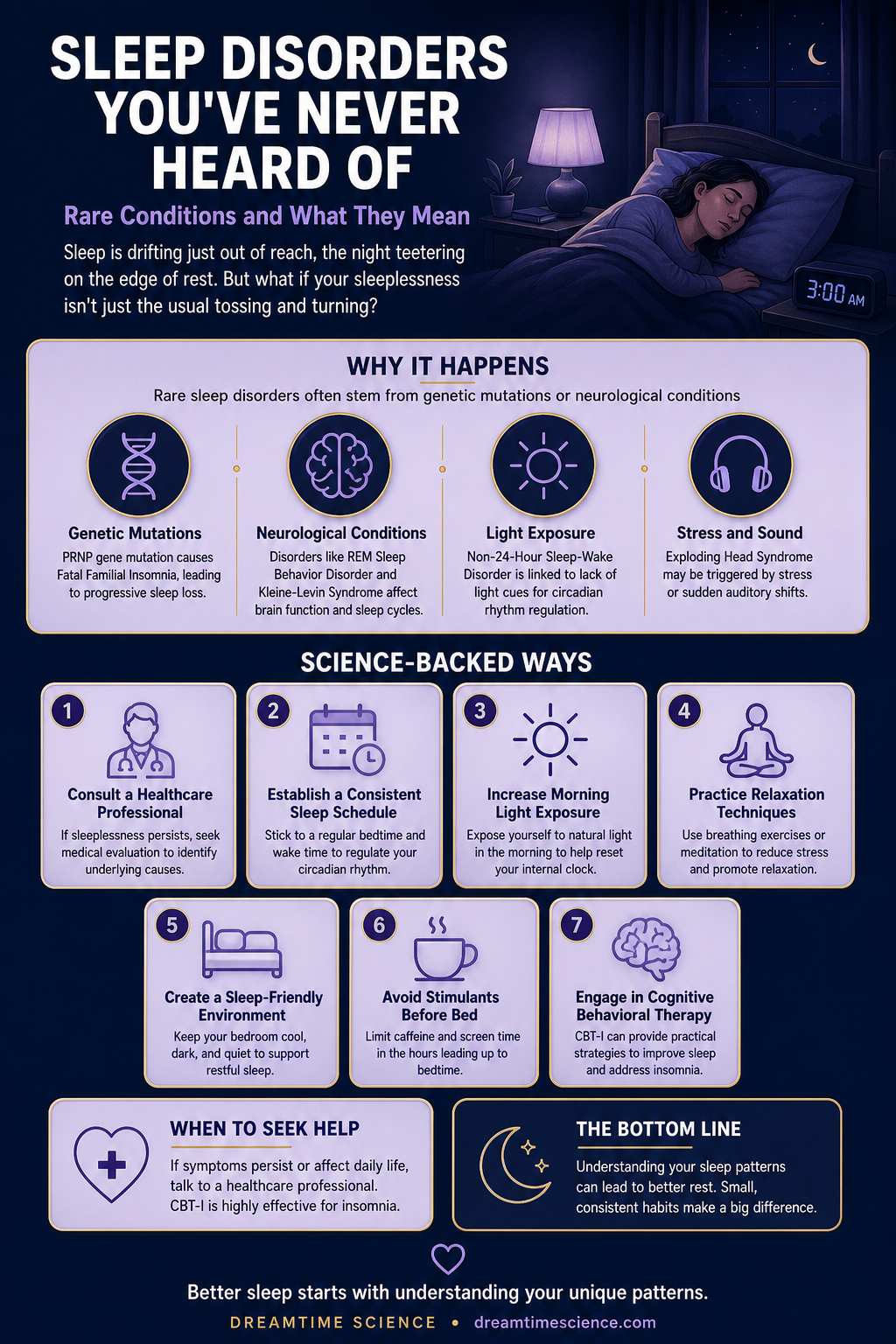
The short answer: Several rare sleep disorders exist beyond common insomnia, each with unique and often unsettling manifestations. Fatal Familial Insomnia, linked to a genetic mutation, progresses to death within 12 to 18 months, while Non-24-Hour Sleep-Wake Disorder causes sleep times to shift progressively later, affecting up to 70% of blind individuals. Kleine-Levin Syndrome can involve up to 20 hours of daily sleep and affects roughly 68% of males, and Exploding Head Syndrome presents with startling auditory sensations during sleep transitions.
You've been there before.
Sleep is drifting just out of reach, the night teetering on the edge of rest. But what if your sleeplessness isn't just the usual tossing and turning? Maybe your nights hold secrets you’ve never imagined.
In the vast world of sleep science, not all disorders are household names. Some lurk quietly, rare and peculiar, affecting just a few. Yet, to those few, they are anything but obscure.
The Enigma of Fatal Familial Insomnia
Imagine a life without sleep. Not by choice, but by relentless compulsion. Fatal Familial Insomnia (FFI) is a rare genetic disorder that strips sleep away entirely, leading to a cascade of symptoms that blur day and night, reality and illusion.
As FFI progresses, the sleepless nights are marred by hallucinations and panic attacks. The body, denied rest, begins to unravel. This isn't just restlessness; it's an insidious thief of peace. A 2018 study in Nature Reviews Neurology reported that FFI typically manifests in middle age and progresses to death within 12 to 18 months. The condition is linked to a mutation in the PRNP gene, a cruel twist of fate that whispers through generations, its full manifestation as inevitable as the ticking of a clock. For those who inherit it, sleep becomes a distant memory.
What This Means for You
If sleeplessness haunts you, it’s essential to distinguish between common insomnia and something more sinister. Engaging with a healthcare professional can be your first step to discovering the underlying cause and finding peace in the night. Exploring therapies like Cognitive Behavioral Therapy for Insomnia (CBT-I) can provide practical strategies to improve sleep.
Exploring Non-24-Hour Sleep-Wake Disorder
Time moves differently for some.
Non-24-Hour Sleep-Wake Disorder defies the typical circadian rhythm, disrupting the natural 24-hour cycle most of us rely on. Those with this condition find their internal clocks ticking to a different beat, often extending beyond the 24-hour cycle. The result? Sleep times shift progressively later each day, leading to a life in constant flux.
The disorder is most commonly observed in individuals who are completely blind, as their bodies lack the light cues necessary to reset the circadian clock. But occasionally, it appears in those with sight, casting them adrift in a sea of shifting hours. A 2016 study in Chronobiology International found that up to 70% of blind individuals experience this disorder, highlighting the pivotal role of light in regulating our internal clocks.
What This Means for You
If your sleep schedule feels perpetually out of sync, assessing your exposure to natural light might be crucial. Increasing morning light exposure can help regulate your circadian rhythm, as discussed in Circadian Rhythms 101. Consistent light-dark cycles can anchor your body’s clock, even when it seems to drift.
The Perplexity of Kleine-Levin Syndrome
Imagine waking up one day only to find the world speeding past, your own body in slow motion.
Kleine-Levin Syndrome (KLS), often dubbed the “Sleeping Beauty syndrome,” is marked by episodes of excessive sleep, sometimes lasting days or even weeks. Those affected might sleep for up to 20 hours a day, rousing only to eat and use the bathroom. But don’t mistake this for a fairy tale nap. Episodes bring confusion and altered perceptions, a fog that clouds the mind. Reality becomes a dreamscape, distant and disjointed.
KLS strikes predominantly in adolescents, often vanishing in adulthood. A 2015 study in Sleep Medicine Reviews revealed that 68% of KLS sufferers are male, and the condition usually resolves after a decade. Yet, during its tenure, it transforms life into a series of prolonged absences from the waking world.
When Sleep Turns Violent: REM Sleep Behavior Disorder
Your dreams may feel vivid, but for some, they spill over into reality.
REM Sleep Behavior Disorder (RBD) causes sleepers to physically act out their dreams, sometimes violently. It's a stark contrast to the usual paralysis that keeps our dream actions confined to the mind. This disorder often foreshadows neurodegenerative diseases like Parkinson’s. A 2017 study in The Lancet Neurology indicated that over 80% of individuals with RBD developed neurodegenerative diseases within 15 years.
Partners bear the brunt, becoming unwilling participants in nighttime narratives. RBD transforms the bed into a battleground, where dreams and reality wage their weary war.
The Mystery of Exploding Head Syndrome
Imagine drifting towards slumber and being jolted awake by an explosive sound within your own skull.
Exploding Head Syndrome (EHS) is as dramatic as it sounds. Those afflicted hear loud noises—explosions, gunshots, cymbals clanging—just as they fall asleep or wake up. It's startling, disorienting, yet entirely harmless. The cause is a mystery, theories ranging from minor seizures to sudden shifts in the brain's auditory circuits. Though unsettling, EHS doesn't signal any deeper danger lurking beneath the surface.
What This Means for You
Understanding the benign nature of EHS can be reassuring. It’s not a sign of something more ominous, but rather an odd quirk in the brain’s transition from wakefulness to sleep. Relaxation techniques, like those found in Breathing Techniques for Sleep, can reduce stress and potentially lessen episodes.
Navigating Sleep Paralysis
You wake up, eyes open, but your body refuses to move.
Sleep paralysis is a common phenomenon but rarely understood in its full, eerie detail. It's when the mind awakens before the body does, leaving you conscious yet immobilized, often with a sense of an unseen presence in the room. For centuries, sleep paralysis has inspired myths of demons and dark spirits, but the truth is simpler—it's a momentary glitch in the transition between sleep stages.
The paralysis lifts. It always does.
What This Means for You
If sleep paralysis visits you, remember that it’s temporary and harmless. Building a calming bedtime routine, as suggested in Sleep Hygiene 101, can create a more peaceful transition between sleep and wakefulness.
Conclusion
Sleep disorders are as diverse as dreams themselves, each a unique window into the complex workings of our resting minds. While some conditions remain in the shadows, they remind us of the intricacies of human biology. If you find yourself resonating with these stories, know that understanding is the first step towards peace. Sleep science, with all its mysteries, aims to bring clarity to the night.
Want to experience these sleep science concepts with our soothing narration and ambient soundscapes? Check out our latest video on YouTube @dreamtimescience.
Frequently Asked Questions
What causes Fatal Familial Insomnia?
Fatal Familial Insomnia is caused by a genetic mutation in the PRNP gene. This mutation leads to the progressive degeneration of the thalamus, which is crucial for regulating sleep.
How does Non-24-Hour Sleep-Wake Disorder affect daily life?
Non-24-Hour Sleep-Wake Disorder can lead to chronic sleep deprivation and difficulty maintaining a consistent daily routine. According to a 2016 study in Chronobiology International, this disorder significantly affects social and occupational functioning.
Is Kleine-Levin Syndrome permanent?
Kleine-Levin Syndrome often resolves on its own, typically as the individual reaches adulthood. A 2015 study noted that the average duration of the disorder is around 14 years.
Can REM Sleep Behavior Disorder be treated?
Yes, medications like melatonin and certain antidepressants can help manage symptoms of RBD. Behavioral strategies, such as ensuring a safe sleep environment, are also effective.
Does Exploding Head Syndrome require medical treatment?
Exploding Head Syndrome is generally harmless and doesn’t require treatment. However, if episodes are frequent and distressing, consulting a sleep specialist may help identify triggers and solutions.
Tonight's Listening
 Tonight's episodeUnveiling the Mind's Labyrinth
Fall Asleep to a Science Lecture
Put tonight's reading into practice — pick a gentle, softly-narrated episode and let the Professor talk you to sleep.
Tonight's episodeUnveiling the Mind's Labyrinth