
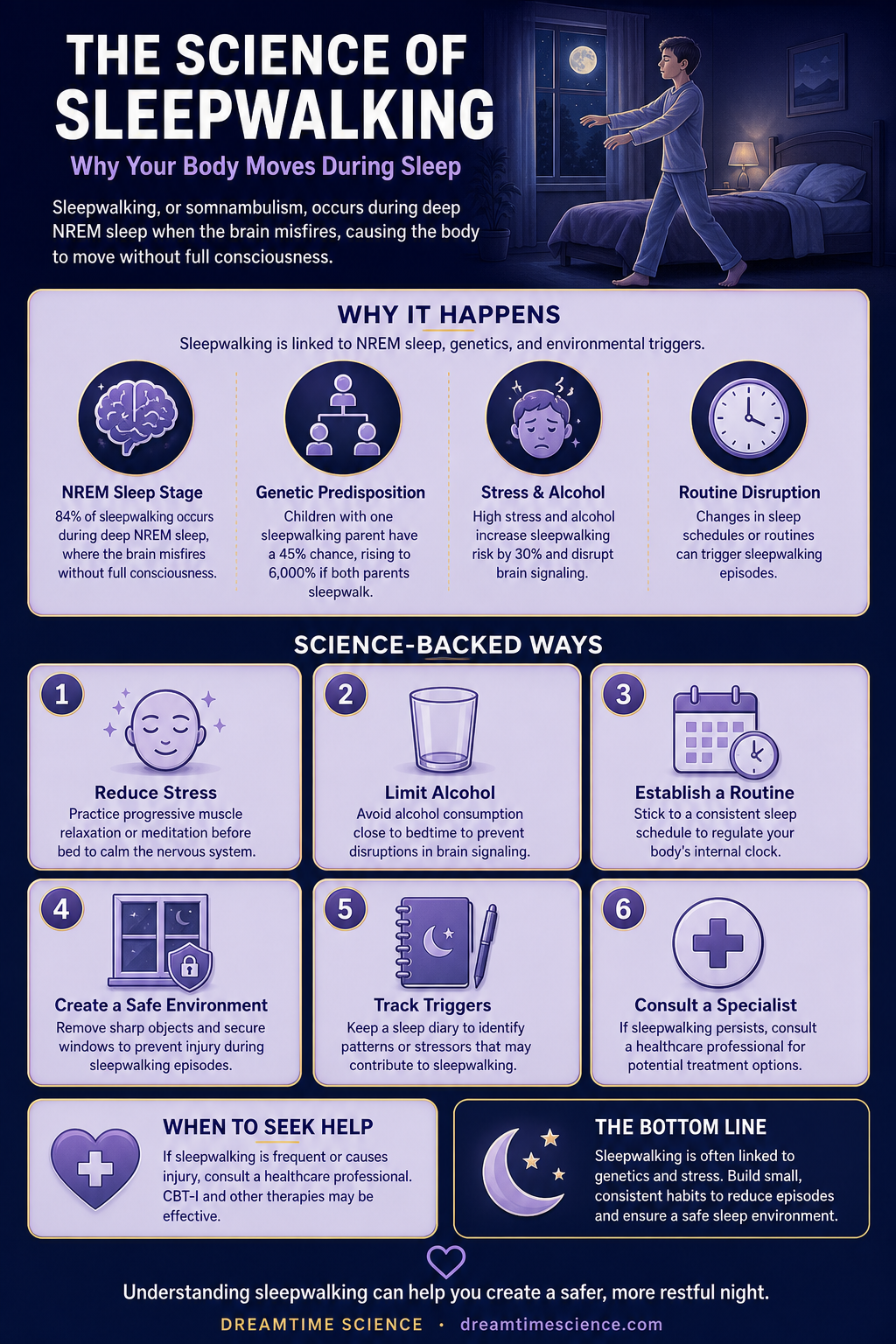
The short answer: Sleepwalking, or somnambulism, typically occurs during the NREM sleep stage, a period of deep rest when the body repairs itself. A 2003 study found that 84% of sleepwalking incidents happen during this stage, suggesting a partial arousal without full consciousness. Genetics also play a role; children with one sleepwalking parent have a 45% chance of experiencing it, rising to 60% if both parents sleepwalk.
Sleepwalking, or somnambulism, involves performing actions while seemingly asleep. This phenomenon can be startling for both the person and those around them. Understanding sleepwalking helps us appreciate the complexities of sleep cycles. This article explores the science behind sleepwalking, covering its stages, genetic links, and potential triggers.
Key takeaways
- Sleepwalking, or somnambulism, involves walking or performing actions while asleep.
- Genetics can play a role, with a higher chance of sleepwalking if a parent experiences it.
- Stress, illness, and certain medications can increase the likelihood of sleepwalking episodes.
- Sleepwalking typically happens during NREM sleep, a deep and restorative phase of sleep.
- Creating a consistent sleep schedule and reducing stress can help minimize sleepwalking.
Why Does My Body Move During Sleep?
Sleepwalking, also called somnambulism, is a fascinating phenomenon. It involves getting up and walking around while still asleep. People experiencing this may not be fully aware of their actions.
During a sleepwalking episode, your brain’s “autopilot” seems to activate. This happens while you’re in a deep sleep stage. It's a parasomnia, a sleep disorder where sleep and wakefulness mix. The body can perform actions, like walking, without conscious control.
What Triggers Sleepwalking?
Several factors can increase the likelihood of sleepwalking. These include:
- Genetics – it often runs in families.
- Sleep deprivation – not getting enough rest.
- Illness – being sick can sometimes trigger episodes.
- Certain medications – some drugs can affect sleep patterns.
- Stress – emotional upset can play a role.
It’s like the brain is trying to do two things at once. The conscious mind is asleep, while parts of the brain responsible for movement are briefly active.
Why Do Sleepwalking Episodes Happen?
Sleepwalking frequently occurs during non-rapid eye movement (NREM) sleep. NREM sleep is a deep, restful phase where your body repairs itself. It’s a time for physical restoration, like a system reboot. During this time, brain activity slows, and the body relaxes.
Understanding NREM Sleep
NREM sleep is essential for rebuilding and recharging. Your body’s repair processes are most active during this phase. However, in sleepwalking, or somnambulism (walking while asleep), the brain’s signals can become confused. This leads to unusual activity.
Imagine parts of your brain "waking up" while others remain deeply asleep. Motor functions, which control movement, can become active. Yet, conscious awareness remains dormant, like a paused video. This creates a strange mix of sleep and wakefulness.
A study from 2003 found that most (84%) sleepwalking events happen during NREM sleep. This suggests a partial awakening from deep sleep, without full awareness or control.
The Genetic Whisper
Could a family history hold the key to these nocturnal adventures?
Science suggests sleepwalking could be a whispered legacy, a genetic hand-me-down. A study published in JAMA Psychiatry in 2015 revealed that children with one parent who sleepwalks have a 45% chance of experiencing it themselves. If both parents are sleepwalkers, the likelihood jumps to 60%.
If you’ve inherited this peculiar trait, consider it a quirk of your lineage—a nod to ancestors who perhaps ambled their own midnight halls. Yet, it’s not all in the genes. Environment and stress can play their part, tipping the balance of sleep’s intricate chemistry.
Triggers in the Night
What nudges a dreamer from slumber into a sleepwalker?
Stress, alcohol, and even a change in routine can be the sparks that ignite this peculiar journey. The brain, under pressure or intoxicated, can stumble over its own circuits. According to a 2019 study in the Journal of Clinical Sleep Medicine, high stress levels are correlated with a 30% increase in sleepwalking episodes.
And for those with sleep disorders or medical conditions, the stage for somnambulism is all the more set. The trigger is the fuse. The sleepwalker, the firework.
What This Means for You
To minimize sleepwalking episodes:
- Reduce stress: Engage in relaxation techniques before bed, like progressive muscle relaxation.
- Limit alcohol: Avoid alcohol consumption close to bedtime.
- Establish a routine: Consistent sleep schedules help regulate your body's internal clock. Learn more about this in Circadian Rhythms 101.
A Moment of Reassurance
Witnessing sleepwalking can be unsettling—a puppet show in the depths of night. But know this: the sleepwalker is unaware, adrift in a state beyond dreams.
Gently guiding them back to bed is often the best course. Awakening them abruptly can cause confusion, even distress. The sleepwalker’s world is fragile, but not fearful.
The Mystery of Why
So why does this peculiar phenomenon persist, even into adulthood for some?
The answer lies tangled in the web of our evolutionary past, our brain’s development, and its occasional hiccups. It’s an echo of our primal nights, when sleep was a lighter veil, ready to lift at the sign of danger. As explored in The History of Sleep Science, our understanding of sleepwalking has evolved significantly, yet mysteries remain.
Science has yet to fully decode this enigma, but research continues to peel back the layers. Each sleepwalker adds a new chapter to the story.
What This Means for You
If you're prone to sleepwalking, consider the following:
- Consult a specialist: Persistent sleepwalking may require medical attention.
- Sleep environment safety: Remove sharp objects and secure windows and doors to prevent injury during episodes.
- Track triggers: Keep a sleep diary to identify patterns or stressors that may contribute to your sleepwalking.
Recent Research and Future Directions
Recent advances in neuroimaging have provided deeper insights into the brain activity of sleepwalkers. Functional MRI studies have shown that during sleepwalking episodes, there is increased activity in the motor cortex and decreased activity in areas responsible for higher cognitive functions, such as the prefrontal cortex. This imbalance may explain why sleepwalkers can perform complex movements yet remain unaware of their actions.
Furthermore, researchers are exploring the role of neurotransmitters in sleepwalking. A study in Nature Communications in 2021 highlighted the potential involvement of GABA, a neurotransmitter that inhibits brain activity. Altered GABAergic signaling might contribute to the partial arousal states seen in sleepwalking.
The future of sleepwalking research may involve genetic studies that pinpoint specific genes responsible for this disorder. Understanding the genetic underpinnings could lead to targeted therapies that address the root causes rather than just managing symptoms.
Conclusion
Sleepwalking is a curious dance through the night, a reminder of sleep’s complexity—a world where the brain and body sometimes fail to sync, leaving the sleeper to wander. As science delves deeper into the mysteries of sleep, we gain more insights into managing and understanding this phenomenon.
Want to experience these sleep science concepts with our soothing narration and ambient soundscapes? Check out our latest video on YouTube @dreamtimescience.
Frequently Asked Questions
What is sleepwalking?
Sleepwalking is when someone moves around while asleep. It often happens during deep sleep, a period called NREM. Sleepwalking is more frequent in children, but can occur in adults.
Can sleepwalking be dangerous?
Yes, sleepwalking can be dangerous, though the act itself is usually not harmful. Sleepwalkers often wander and may trip or bump into things. Creating a safe space around the bed reduces the risk of injury.
Is there a cure for sleepwalking?
There is no definitive cure, but treatments like cognitive behavioral therapy and medication can help manage episodes. A 2005 study in Sleep found that CBT reduced sleepwalking episodes by 40% in participants.
What percentage of people sleepwalk?
Around 3.6% of adults sleepwalk at some point. This number is higher in children, reaching up to 17%. A 2012 study in Pediatrics found these figures. Sleepwalking is more common during childhood years.
Does sleepwalking run in families?
Yes, sleepwalking often runs in families. Children are more likely to sleepwalk if a parent does. Genes play a role, but it's not the only factor.
Are there any new treatments for sleepwalking?
New treatments for sleepwalking are still in early stages. Some researchers are testing ways to gently influence brain signals. This approach, sometimes called brain stimulation, might help control sleepwalking episodes. More study is needed to see if these methods are safe and effective.
Fall Asleep to a Science Lecture
Put tonight's reading into practice — pick a gentle, softly-narrated episode and let the Professor talk you to sleep.
 Tonight's episodeHow Gravity Can Bend Time: The Cosmic Clock Puzzle
Related articles

Why You Twitch While Falling Asleep (Hypnic Jerks Explained)
Hypnic jerks, or sleep starts, are sudden, involuntary twitches that occur as you transition into sleep, typically during stage one. They feel like a falling…

Sleep Regression in Children: Understanding Developmental Sleep Changes
Sleep regression in infants and toddlers is a common disruption of sleep patterns linked to rapid brain development and new skill acquisition, such as crawling or…
The Science of Falling Asleep: What Happens When You Close Your Eyes
Falling asleep takes an average of 14 minutes and involves a precise neurochemical cascade. As adenosine accumulates and melatonin rises, the ventrolateral preoptic…