
The short answer: Each sleep cycle lasts approximately 90 minutes and progresses through four stages: light NREM (N1 and N2), deep slow-wave sleep (N3), and REM sleep. You complete 4-6 cycles per night. Earlier cycles contain more deep sleep for physical restoration, while later cycles are REM-heavy for memory consolidation. Waking at the end of a cycle rather than mid-cycle is why timing matters more than total hours.
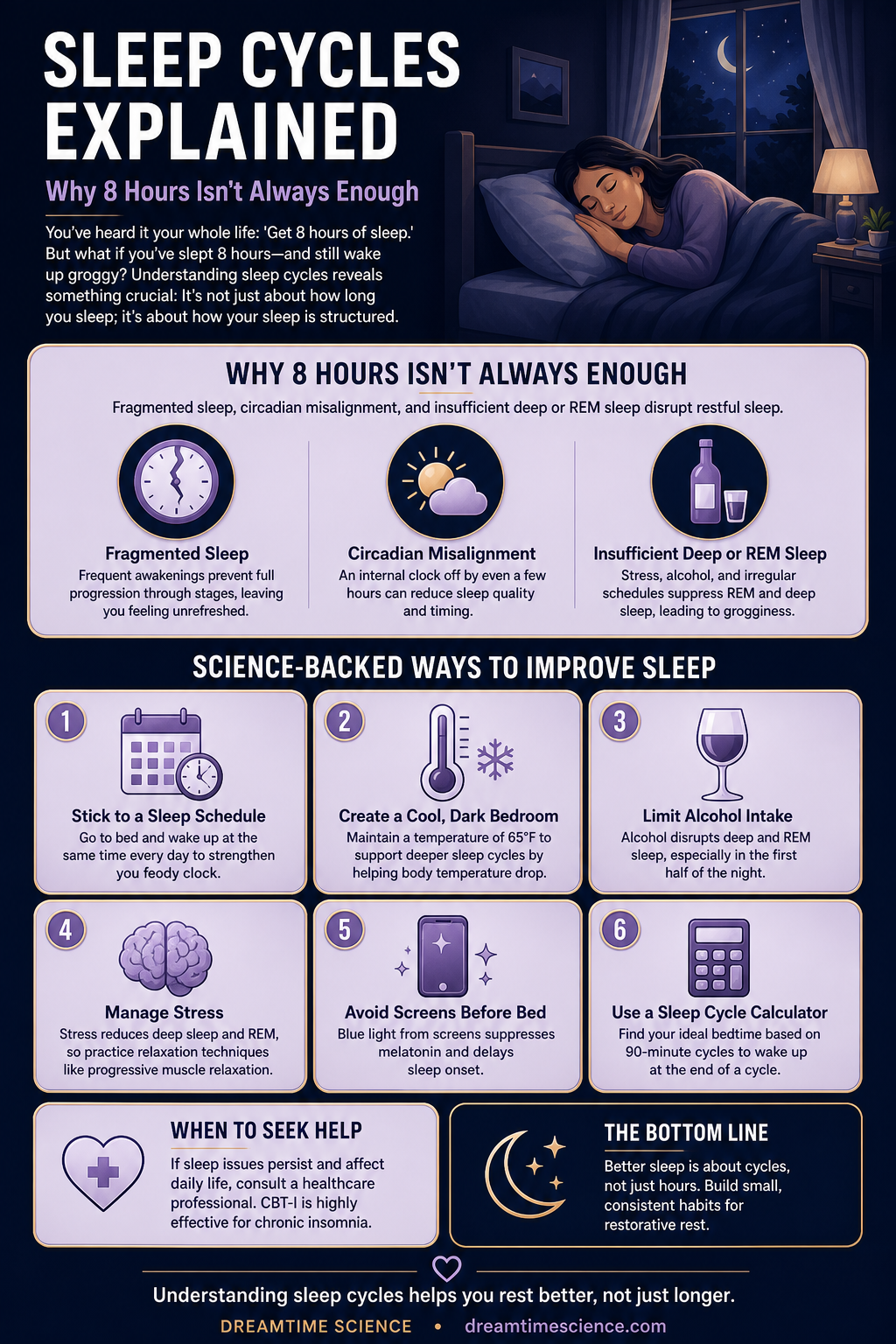
You’ve heard it your whole life:
“Get 8 hours of sleep.”
But what if you’ve slept 8 hours — and still wake up groggy?
Understanding sleep cycles reveals something crucial: It’s not just about how long you sleep; it’s about how your sleep is structured. Your night isn’t one continuous state but a repeating pattern — like waves rolling onto shore.
Let’s explore why 8 hours isn’t always enough, and why timing matters just as much as duration.
Key takeaways
- A typical sleep cycle lasts around 90 minutes and involves four distinct stages.
- Complete sleep cycles, rather than just total hours, are important for feeling rested.
- Deep sleep, prominent early in the night, supports physical restoration and growth.
- REM sleep, lengthening later, is crucial for memory consolidation and emotional processing.
- Waking at the end of a sleep cycle can minimize grogginess and improve morning alertness.
What Is a Sleep Cycle?
A typical sleep cycle lasts about 90 minutes and includes four stages:
- Light Sleep (N1)
- Deeper Light Sleep (N2)
- Slow-wave Deep Sleep (N3)
- REM Sleep
You cycle through these stages 4–6 times per night. According to a 2017 report by the National Sleep Foundation, healthy sleep involves multiple complete cycles — not just total hours. Imagine sleep like washing clothes: deep sleep is the heavy wash, REM is the spin cycle, and light sleep transitions between them. If you interrupt the machine mid-cycle, the process feels incomplete.
Stage by Stage: What Each Phase Does
Light Sleep (N1 & N2)
- Body Relaxes: Your muscles begin to release tension.
- Brain Waves Slow: Transitioning from wakefulness, brain activity decreases.
- Easy to Wake: This stage is brief and prepares you for deeper restoration.
Deep Sleep (N3)
- Tissue Repair: Cells undergo repair and growth.
- Growth Hormone Release: Essential for growth and development.
- Immune Strengthening: Bolsters the immune system.
Deep sleep is especially prominent in the first half of the night. It's your body's physical reset.
REM Sleep
- Dreaming Intensifies: Most vivid dreams occur.
- Memory Consolidates: Important for learning and memory retention.
- Emotional Processing: Helps process emotions and experiences.
REM periods lengthen in the second half of the night. This is your brain's creative and emotional reset. For a deeper dive, see REM Sleep Explained: Why This Stage Matters Most.
Why 8 Hours Isn’t Always Enough
Here’s where it gets interesting.
1. Fragmented Sleep Breaks Cycles
Frequent awakenings prevent full progression through stages. You may log 8 hours in bed — but only complete 3–4 full cycles. According to a 2019 study in the journal Sleep, disturbances can lead to incomplete cycles, leaving you feeling unrefreshed.
2. Circadian Misalignment
If your internal clock is off (as discussed in Circadian Rhythms 101: How Your Body's Internal Clock Controls Sleep), you may sleep at the wrong biological time, reducing sleep quality.
3. Insufficient Deep or REM Sleep
Stress, alcohol, and irregular schedules suppress REM and deep sleep. A study in Sleep Medicine Reviews shows alcohol reduces REM in the first half of the night and fragments sleep later, so you wake feeling unrefreshed.
Why Waking Mid-Cycle Feels So Awful
If your alarm goes off during:
- Deep Sleep → Grogginess (Sleep Inertia): Your brain needs time to reconfigure.
- REM Sleep → Disorientation, Dream Residue: You might feel dreamy or confused.
Sleep inertia can last 30–60 minutes. It’s not laziness; it’s neurochemistry at play.
The Ideal Night: Think Cycles, Not Hours
Instead of fixating on 8 hours, consider:
- 5 Cycles ≈ 7.5 hours
- 4 Cycles ≈ 6 hours
- 6 Cycles ≈ 9 hours
Waking at the end of a cycle often feels smoother. Isn’t it fascinating that your body moves in predictable waves — even in sleep?
What This Means for You
Understanding sleep cycles allows you to tailor your sleep schedule to your needs. By aiming to wake up at the end of a cycle, you can reduce sleep inertia and start your day feeling refreshed. Additionally, maintaining a consistent sleep schedule and creating an optimal sleep environment, as detailed in Temperature, Darkness, and Sound: The Ideal Sleep Environment (By the Numbers), can support more restorative sleep.
Conclusion: Sleep Is Rhythmic, Not Rigid
Sleep cycles explained clearly show that rest isn’t just a number. It’s an architecture, a choreography, a repeating neural symphony. When you understand this, you stop chasing 8 hours — and start respecting rhythm. And rhythm, once honored, tends to return the favor.
Want to experience these sleep science concepts with our soothing narration and ambient soundscapes? Check out our latest video on YouTube @dreamtimescience.
Frequently Asked Questions
How long is one sleep cycle?
A typical sleep cycle lasts about 90 minutes, although this can vary slightly from person to person. Variations depend on age, lifestyle, and individual sleep needs.
Is deep sleep more important than REM?
Both are essential. Deep sleep restores the body by repairing tissues and strengthening the immune system, while REM sleep is crucial for emotional processing and memory consolidation. Each stage plays a unique role in overall health.
Can I increase deep sleep?
Yes, you can. Consistent sleep schedules, a cool, dark bedroom, and limiting alcohol intake before bed can enhance deep sleep. Engaging in relaxing pre-sleep routines, such as those found in The Perfect Bedtime Routine According to Sleep Scientists, can also be beneficial.
Why do I wake up at 3 AM?
Waking up at 3 AM often aligns with a cycle transition or is due to stress-related cortisol shifts. Managing stress through techniques like Progressive Muscle Relaxation: A Neuroscience-Backed Technique for Better Sleep can help.
Do naps include full cycles?
Usually, shorter naps only include light sleep unless extended beyond 90 minutes. For more on effective napping, see Why Naps Backfire (And When They Actually Help).
Fall Asleep to a Science Lecture
Put tonight's reading into practice — pick a gentle, softly-narrated episode and let the Professor talk you to sleep.
 Tonight's episodeHow Gravity Can Bend Time: The Cosmic Clock Puzzle
Related articles

Oversleeping: Can You Really Get Too Much Sleep?
You've felt it, haven't you? That groggy haze after a marathon sleep session.

Deep Sleep vs Light Sleep: Which Matters More?
Both deep and light sleep are essential components of a complete sleep cycle, contributing uniquely to physical and cognitive restoration.

REM Sleep Explained: Why This Stage Matters Most
REM sleep is the brain's nightly maintenance cycle for emotional processing and memory consolidation. During REM, your brain is nearly as active as when awake,…