← Back to Articles
Insomnia

The short answer: CBT-I is the gold-standard treatment for chronic insomnia, recommended as first-line therapy over sleeping pills by every major medical body. It combines sleep restriction, stimulus control, cognitive restructuring, and sleep hygiene education. Clinical trials show 70-80% of patients improve, with benefits lasting years after treatment ends.
If you struggle with insomnia, you’ve likely encountered well-meaning but misguided advice:
“Just relax.” “Try harder to sleep.” “Take something.”
But insomnia isn’t a failure of effort. It's a complex dance between mind and body, often choreographed into a stubborn pattern over time. A pattern that can, thankfully, be unlearned.
Enter Cognitive Behavioral Therapy for Insomnia (CBT-I), the most evidence-based treatment for chronic insomnia. Unlike quick fixes that rely on medication, CBT-I focuses on healing from within.
Key takeaways
- CBT-I is a structured therapy program that aims to address the root causes of insomnia.
- Stimulus control therapy involves reassociating the bed with sleep alone, not wakefulness.
- Sleep restriction temporarily limits time in bed to improve sleep efficiency and consolidate sleep.
- Cognitive restructuring helps people challenge unhelpful beliefs and reduce anxiety about sleep.
- CBT-I offers long-term benefits and often outperforms sleep medication in sustained results.
What Is CBT-I?
CBT-I is a structured therapy program designed to:
- Reduce sleep anxiety
- Retrain sleep associations
- Improve sleep efficiency
- Reset circadian timing
According to the American College of Physicians, CBT-I is recommended as the first-line treatment for chronic insomnia. Unlike sleeping pills, which are akin to temporary band-aids, CBT-I addresses the root causes of insomnia, offering a more sustainable solution.
The Science Behind CBT-I
CBT-I merges the psychological with the physiological. It leverages the principles of cognitive behavioral therapy to alter the negative thought patterns and behaviors that perpetuate insomnia. This is achieved through a combination of cognitive restructuring, behavioral interventions, and sleep education.
For more on how our body’s natural rhythms influence sleep, see Circadian Rhythms 101: How Your Body's Internal Clock Controls Sleep.
Why Insomnia Becomes Chronic
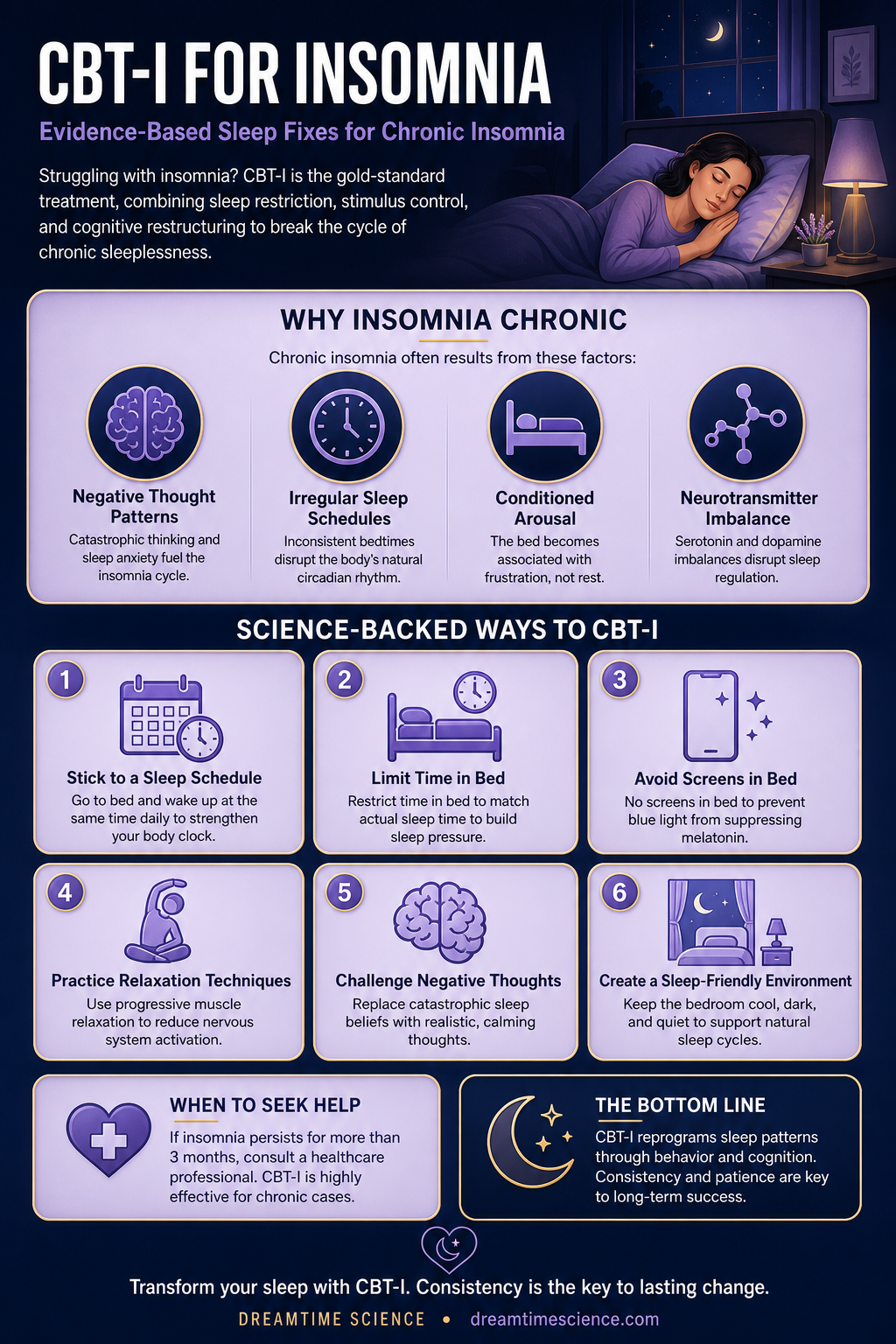
Acute insomnia may start with a stressful event or lifestyle change. However, when it persists, it often evolves into a chronic condition due to factors such as:
- Spending excessive time in bed awake
- Anxiety about sleep
- Irregular sleep schedules
- Conditioned arousal in the bedroom
The bed, a place meant for rest, becomes associated with frustration and wakefulness. The brain learns: bed = wakefulness, a pattern CBT-I aims to reverse.
The Role of Neurotransmitters
Insomnia’s persistence can also be linked to neurotransmitter imbalances. Neurotransmitters like serotonin and dopamine play crucial roles in regulating mood and arousal. When these chemical messengers are out of balance, they can disrupt sleep patterns, making it harder for the brain to transition into a restful state.
For more insights into the insomnia cycle, explore The Science of Why You Can't Sleep: Understanding the Insomnia Cycle.
The Core Components of CBT-I
1. Stimulus Control
Stimulus control therapy focuses on reassociating the bed with sleep only. The rules are simple yet effective:
- Go to bed only when sleepy
- Leave the bed if awake longer than ~20 minutes
- No screens in bed
- Wake at the same time daily
This approach retrains the brain to link the bed with cues for sleep, not wakefulness.
2. Sleep Restriction (Sleep Consolidation)
This counterintuitive step involves limiting time in bed to match actual sleep time. For instance, if you sleep 5.5 hours but spend 8 hours in bed, your schedule might temporarily shrink to build "sleep pressure," enhancing sleep efficiency.
A 2015 study in the journal Sleep Medicine Reviews found that sleep restriction therapy significantly improves sleep quality and reduces insomnia symptoms. This concept also connects to The Sleep Pressure Curve: Why You Get Tired at Specific Times.
3. Cognitive Restructuring
Cognitive restructuring helps challenge and change unhelpful beliefs about sleep, such as:
- “If I don’t sleep 8 hours, tomorrow will be ruined.”
- “I’ll never fix this.”
This process reduces catastrophic thinking and the physiological arousal it causes, creating a calmer mental state conducive to sleep.
4. Relaxation Training
Relaxation techniques such as Progressive Muscle Relaxation (PMR) help lower nervous system activation. According to a 2013 study published in the journal Applied Psychophysiology and Biofeedback, PMR effectively reduces anxiety and improves sleep quality. You can learn more about PMR in our article, Progressive Muscle Relaxation: A Neuroscience-Backed Technique for Better Sleep.
Does CBT-I Work?
Absolutely. According to a comprehensive review by Harvard Medical School, CBT-I:
- Improves sleep onset time
- Reduces nighttime awakenings
- Produces long-term results
- Outperforms medication in durability
Unlike sleep medication, the benefits of CBT-I persist long after treatment ends, making it a viable long-term solution for chronic insomnia.
Who Should Try CBT-I?
CBT-I may be beneficial for:
- Anyone with insomnia lasting longer than 3 months
- People relying on sleep medication
- Individuals with sleep anxiety
- Those experiencing frequent nighttime awakenings
CBT-I can be delivered by trained therapists or through validated digital programs, offering flexible options for those seeking help.
What This Means for You
If you’re struggling with insomnia, CBT-I offers a pathway to restore natural sleep patterns without relying on medications. By addressing the behavioral and cognitive aspects that fuel insomnia, CBT-I reshapes your relationship with sleep, transforming it into a restorative rather than a frustrating experience.
For more immediate strategies to combat insomnia, check out 7 Science-Backed Ways to Beat Insomnia Tonight.
Conclusion: Retraining the Brain
Insomnia isn’t a sign of weakness; it’s often the result of learned hyperarousal. CBT-I is effective because it addresses the behaviors, thoughts, and biology that maintain the insomnia cycle. Over time, sleep becomes not something to be forced or chased, but something natural and restorative.
Want to experience these sleep science concepts with our soothing narration and ambient soundscapes? Check out our latest video on YouTube @dreamtimescience.
Frequently Asked Questions
Is sleep restriction safe?
When supervised properly, yes. Sleep restriction is a controlled process designed to increase sleep efficiency. It is tailored to the individual’s needs, ensuring that it is both safe and effective.
Does it work quickly?
Many individuals notice improvements within 4–8 weeks. The timeline can vary based on personal circumstances and the severity of insomnia, but the gradual adjustments lead to sustainable sleep improvements.
Is it covered by insurance?
Often, yes, especially when working with licensed providers. It's advisable to check with your insurance company and healthcare provider for specific coverage details.
Can it help mild insomnia?
Yes, CBT-I can be beneficial for mild insomnia as well. Motivation and consistency play crucial roles in achieving success, making it an effective approach for varying degrees of insomnia.
Is it difficult?
CBT-I requires consistency and commitment, but its structured approach and proven effectiveness make it a highly rewarding process. The skills learned through CBT-I not only improve sleep but also provide tools for managing stress and anxiety.
Tonight's Listening
 Tonight's episodeHow Gravity Can Bend Time: The Cosmic Clock Puzzle
Fall Asleep to a Science Lecture
Put tonight's reading into practice — pick a gentle, softly-narrated episode and let the Professor talk you to sleep.
Tonight's episodeHow Gravity Can Bend Time: The Cosmic Clock Puzzle
Related articles

Insomnia & Sleep Problems
Beat Insomnia Tonight
Insomnia can be beaten tonight using seven evidence-based techniques: the 4-7-8 breathing method, progressive muscle relaxation, stimulus control, cognitive…

Insomnia & Sleep Problems
Teeth Grinding at Night: Causes and Fixes for Bruxism
You might not even know it's happening. But your jaw does. Teeth grinding, or bruxism, is the midnight symphony that's more clatter than lullaby.

Food, Body & Health
Sleep and Pain: The Bidirectional Relationship Between Rest and Discomfort
Pain and sleep share a complex, bidirectional relationship, with each significantly impacting the other. Roughly 50% to 80% of individuals with chronic pain…