
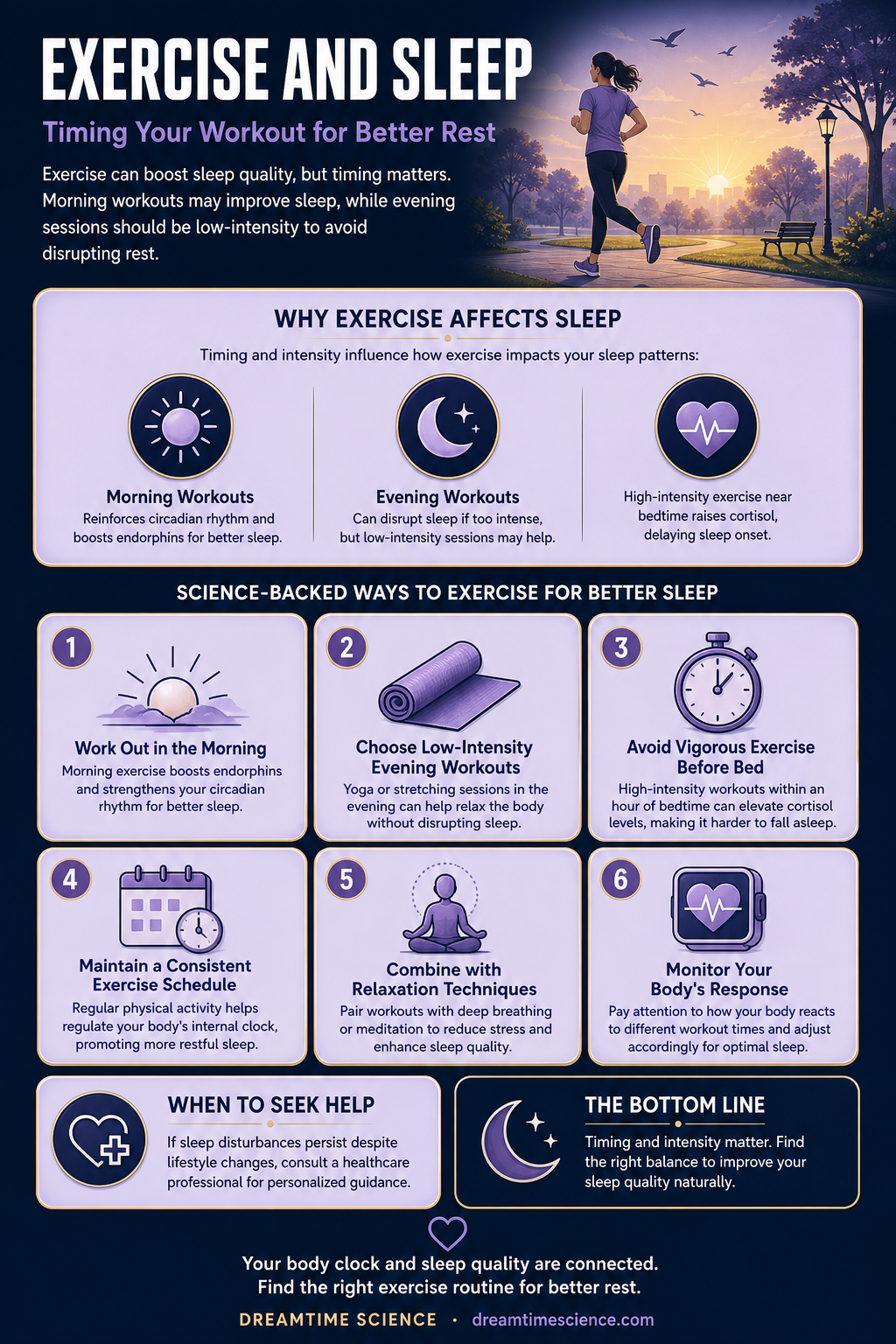
To improve sleep, consider exercising in the morning, or at least avoiding vigorous activity close to bedtime. The impact of exercise on sleep is moderated by circadian alignment, hormonal responses, and individual physiology [1]. While the optimal timing varies, understanding the underlying mechanisms can help individuals optimize their routines for better rest.
Key takeaways
- Regular physical activity can generally improve sleep quality and help you fall asleep faster.
- Morning exercise can strengthen your body’s natural sleep-wake cycle when combined with light.
- Intense workouts close to bedtime can disrupt sleep due to increased levels of stress hormones.
- Allowing one to two hours between exercise and bedtime helps your body recover and prepares for sleep.
- Lower-intensity exercise can improve deep sleep, which is crucial for physical recovery.
What Does Science Say About Exercise and Sleep?
Exercise is broadly recognized as a promoter of health, encompassing both physical and mental wellbeing [4]. However, the relationship between exercise and sleep is complex, and contingent on several factors, notably the timing and intensity of activity. Research suggests that regular physical activity can improve sleep quality, reduce sleep latency (time to fall asleep), and increase sleep duration. The effects are not uniform; individuals respond differently based on their circadian chronotype and exercise habits.
The Circadian Rhythm and Morning Exercise
Exercising in the morning can strongly reinforce the body’s natural circadian rhythm [1]. The circadian rhythm is a roughly 24-hour internal clock that regulates sleep-wake cycles, hormone release, and other physiological processes [3]. Morning activity, particularly when combined with natural light exposure, helps synchronize this internal clock with the external environment. This alignment promotes alertness during the day and prepares the body for sleep later. Metabolically, morning exercise elevates caloric expenditure and can improve blood sugar control throughout the day.
Evening Exercise: Intensity and Timing Considerations
The impact of evening exercise on sleep depends heavily on the intensity of the workout. High-intensity exercise close to bedtime can be detrimental, primarily due to increases in cortisol and adrenaline [2]. Cortisol, a stress hormone, promotes wakefulness and can delay sleep onset. Conversely, low-intensity activities performed several hours before sleep may be beneficial [2]. Activities like yoga, tai chi, or a leisurely walk do not produce the same acute hormonal shift and can aid in relaxation, potentially improving sleep.
The Role of Cortisol in Sleep Disruption
Cortisol levels naturally fluctuate throughout the day, with peaks in the morning and declines in the evening. Exercise acutely elevates cortisol levels, meaning the timing of exercise relative to this natural rhythm is critical [5]. Exercising vigorously less than one hour before bedtime can significantly increase cortisol, interfering with the body’s natural preparation for sleep [2]. Allowing a buffer of at least one to two hours between exercise and bedtime permits cortisol levels to return to baseline, minimizing sleep disruption.
How Exercise Intensity Affects Sleep Stages
The intensity of the exercise also influences sleep architecture – the different stages of sleep. Vigorous exercise, especially when performed late in the day, can increase sympathetic nervous system activity, potentially reducing the amount of restorative slow-wave sleep (deep sleep) [2]. Slow-wave sleep is critical for physical recovery and cognitive function. Lower-intensity exercise, however, can promote parasympathetic nervous system activity, facilitating relaxation and potentially enhancing slow-wave sleep.
Individual Variability and the Perception of Time
The perception of time can also influence how exercise impacts sleep [3]. An individual’s subjective experience of exertion and recovery can vary considerably, impacting hormonal responses and subsequent sleep quality. Factors like stress levels, hydration status, and underlying health conditions can all contribute to individual variability. It’s important to note that time perception and the experience of effort may differ significantly between individuals, highlighting the need for personalized exercise strategies.
The Neuroscience of Sleep and Exercise
Exercise affects sleep via multiple neurobiological pathways. Exercise increases the activity of brain-derived neurotrophic factor (BDNF), a protein that supports neuronal growth and plasticity, which contributes to improved cognitive function and mood regulation [7]. Furthermore, exercise can enhance the responsiveness of GABAergic neurons, which promote relaxation and sleep initiation. The overall effect is to improve the brain’s ability to transition into and maintain sleep states.
References
- Authors (2024). Science must protect thinking time in a world of instant communication.. *Nature* https://doi.org/10.1038/d41586-024-02381-x
- Grgic J, Lazinica B, Mikulic P et al. (2017). The effects of short versus long inter-set rest intervals in resistance training on measures of muscle hypertrophy: A systematic review.. *European journal of sport science* https://doi.org/10.1080/17461391.2017.1340524
- Ring ME (2009). An exploration of the perception of time from the perspective of the Science of Unitary Human Beings.. *Nursing science quarterly* https://doi.org/10.1177/0894318408329338
- Pickler RH (2020). Back to Science.. *Nursing research* https://doi.org/10.1097/nnr.0000000000000439
- Arias EF (2005). The metrology of time.. *Philosophical transactions. Series A, Mathematical, physical, and engineering sciences* https://doi.org/10.1098/rsta.2005.1633
- Murphy EJ (2010). NIH, science, and baseball: time for reform?. *Lipids* https://doi.org/10.1007/s11745-010-3473-5
- Gierasch LM (2020). Faster publication advances your science: The three R's.. *The Journal of biological chemistry* https://doi.org/10.1074/jbc.e119.012417
Frequently Asked Questions
What is the best time of day to exercise to sleep better?
The optimal time of day is highly individual. Morning exercise can reinforce circadian rhythms, but any exercise is preferable to none at all. Avoid high-intensity activity within 1-2 hours of bedtime to prevent elevated cortisol levels.
Does evening exercise always negatively impact sleep?
Not necessarily. Low-intensity exercise, such as yoga or a relaxing walk, can promote relaxation and improve sleep quality in some individuals [2]. Avoid vigorous exercise close to bedtime.
How close to bedtime can I exercise without disrupting sleep?
Aim to finish vigorous exercise at least one to two hours before bedtime to allow cortisol levels to return to baseline. Moderate-intensity exercise may be tolerated closer to bedtime, but individual responses vary.
Can exercise help people who have insomnia?
Yes, regular exercise can improve sleep quality and reduce insomnia symptoms [2]. However, it’s important to avoid overdoing it and to focus on consistency and timing.
What types of exercise are most beneficial for sleep?
Low-to-moderate intensity exercises that promote relaxation, such as yoga, walking, swimming, and cycling, are generally best for sleep. These activities can reduce stress and prepare the body for rest.
Fall Asleep to a Science Lecture
Put tonight's reading into practice — pick a gentle, softly-narrated episode and let the Professor talk you to sleep.
 Tonight's episodeDNA's Silent Blueprint: Uncovering Life’s Deepest Secrets
Related articles

The Science of Power Napping: Timing, Duration, and Benefits
Power naps, ideally lasting 10 to 20 minutes, can provide significant benefits like boosted alertness and improved mood. Timing is key; the early afternoon, between 1…

Sleep Hygiene 101: Building a Better Bedtime Routine From Scratch
Insufficient sleep is linked to serious health conditions like heart disease, diabetes, and depression, highlighting the importance of good sleep hygiene. Creating a…

Sleep Tracking Devices: Do They Actually Help You Sleep Better?
Sleep tracking devices utilize actigraphy and heart rate variability to estimate sleep stages, but their accuracy is limited, with a reported 78% accuracy rate…