
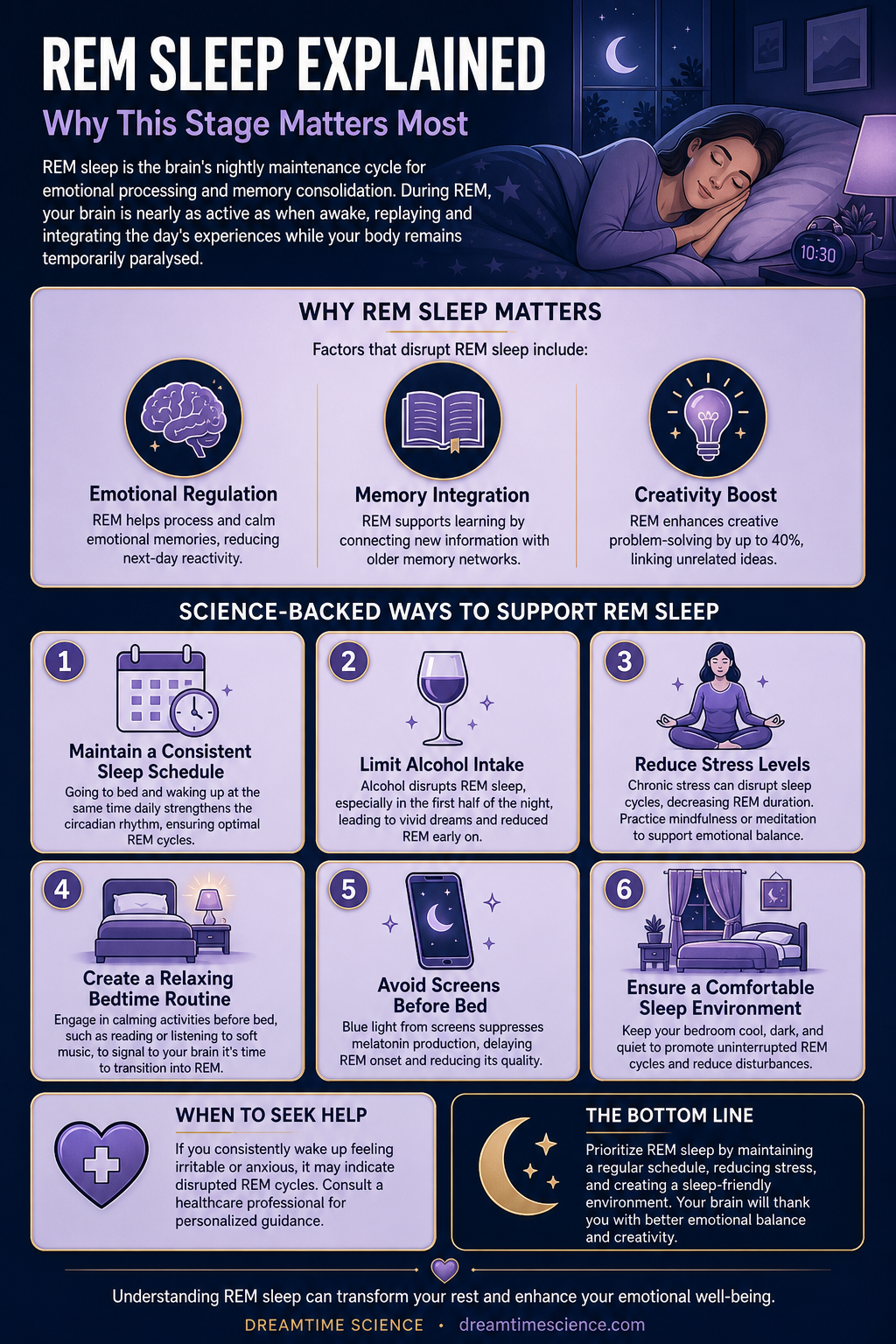
The short answer: REM sleep is the brain's nightly maintenance cycle for emotional processing and memory consolidation. During REM, your brain is nearly as active as when awake, replaying and integrating the day's experiences while your body remains temporarily paralysed. Adults spend about 20-25% of total sleep in REM, with longer REM periods occurring in the later hours of the night.
If sleep were a symphony, REM sleep would be the most mysterious movement.
Your eyes dart beneath closed lids. Your muscles go still. Your brain lights up with dream imagery.
REM sleep explained properly reveals something astonishing: while your body rests, your brain becomes vividly, almost paradoxically, awake. This stage may be one of the most important for emotional balance, memory integration, and creativity.
Let’s explore why REM sleep matters so much.
Key takeaways
- REM sleep typically begins about 90 minutes after falling asleep and recurs throughout the night.
- REM sleep plays a critical role in learning, memory consolidation, and mood regulation.
- Emotional reactivity can be reduced after sufficient REM sleep, acting like a nightly emotional reset.
- REM sleep helps connect new information with older memory networks, enhancing creative problem-solving.
- Longer REM periods occur later in the night, so adjusting sleep schedules can maximize these benefits.
What Is REM Sleep?
REM stands for Rapid Eye Movement. It typically begins about 90 minutes after you fall asleep and recurs every cycle, becoming longer toward morning. During REM, brain activity resembles wakefulness, the body experiences temporary muscle paralysis (atonia), and vivid dreaming occurs.
According to a 2019 study in the journal Sleep, REM sleep plays a critical role in learning, memory consolidation, and mood regulation. It’s not passive rest; it’s active neural integration. Imagine your brain as an artist, painting over the canvas of your experiences, blending colors to create vivid imagery that resonates emotionally and intellectually.
What This Means for You
Understanding that REM sleep is a time of vivid dreaming and active brain work can help you appreciate why waking up feeling refreshed often correlates with having enough REM. It's the stage where your brain not only processes the previous day's information but also prepares you emotionally for what's to come.
Why REM Sleep Is Essential for Emotional Health
One of the most compelling findings about REM sleep involves emotional regulation. A study published in Current Biology in 2007 found that REM sleep reduces next-day emotional reactivity. After sufficient REM, participants showed calmer responses to previously upsetting images, as if the mind had gently softened the harsh edges of those memories.
During REM, the amygdala, which is the brain's emotion center, is active. However, stress-related neurochemicals like norepinephrine are lower. This creates a unique state where emotional memories can be reprocessed without the same intensity of stress. Isn’t it fascinating that your brain may be gently filing away emotional experiences while you dream? This "overnight therapy" is like a nightly reset for your emotional health.
What This Means for You
If you find yourself waking up more irritable or anxious, it might be worth considering whether you're getting enough REM sleep. Emotional volatility can sometimes be a sign of disrupted REM cycles, as your brain didn't have the chance to do its nightly emotional housekeeping.
REM Sleep and Memory Integration
REM also supports learning. Research from Harvard University suggests REM sleep helps connect new information with older memory networks. It's less about memorizing facts and more about weaving meaning, like a master craftsman intricately lacing threads into a complex tapestry.
A 2010 study highlighted that REM sleep can enhance creative problem-solving by up to 40%. This may explain why creative insights sometimes emerge after sleep. Dreams mix ideas; REM builds bridges. It’s during this stage that your brain might be breaking down barriers between seemingly unrelated concepts, leading to those "Eureka!" moments upon waking.
What This Means for You
If you're working on a creative project or trying to solve a complex problem, giving your brain the chance to cycle through REM sleep might just be the key to unlocking your next big idea. Consider it a natural brainstorming session that happens while you rest.
Why REM Increases Toward Morning
In early cycles, deep sleep dominates. In later cycles, REM periods lengthen. That’s why cutting sleep short—even if you get 6 hours—may disproportionately reduce REM sleep. If you wake early consistently, you may be missing the longest REM periods. This connects directly to Sleep Cycles Explained: Why 8 Hours Isn't Always Enough because sleep architecture matters as much as duration.
What This Means for You
Understanding the distribution of REM throughout the night can help you structure your sleep schedule to maximize its benefits. If you're finding it hard to get enough REM, consider adjusting your bedtime to ensure you're not sacrificing those crucial morning hours.
What Suppresses REM Sleep?
Several factors can reduce REM:
- Alcohol: Especially in the first half of the night, alcohol can fragment sleep later and reduce REM early on. According to a 2018 review in Sleep Medicine Reviews, this often leads to vivid REM rebound dreams once alcohol clears.
- Certain Medications: Some antidepressants and blood pressure medications can suppress REM sleep.
- Chronic Stress: High stress levels can disrupt the sleep cycle, reducing REM duration.
- Irregular Sleep Schedules: A consistent routine supports a healthy sleep cycle and balanced REM.
REM Rebound: When Dreams Intensify
If you’re sleep-deprived or REM-deprived, the brain compensates by entering REM more quickly and intensely later. This is called REM rebound. It’s one reason dreams may feel extra vivid after stress or disrupted sleep. Your brain catches up, eagerly diving back into its nocturnal work.
What This Means for You
If you’ve been burning the candle at both ends, you might notice your dreams becoming more vivid or intense when you finally catch up on sleep. This is your brain seizing the opportunity to dive back into REM, making up for lost time.
Conclusion: The Night Shift of the Emotional Brain
REM sleep explained simply shows this: your sleeping brain is not idle. It is integrating, regulating, softening, reorganizing. While your body rests in stillness, your mind travels—weaving emotion and memory into something coherent. And even when you forget your dreams, the work may still be happening.
Want to experience these sleep science concepts with our soothing narration and ambient soundscapes? Check out our latest video on YouTube @dreamtimescience.
Frequently Asked Questions
How much REM sleep do I need?
Adults typically spend 20–25% of total sleep in REM. This translates to roughly 1.5 to 2 hours in an 8-hour sleep period. Ensuring you get a full night’s sleep is crucial to allow your body to cycle through sufficient REM phases.
Is REM the most important sleep stage?
All stages matter. Deep sleep restores the body; REM restores emotional and cognitive networks. Each stage has its unique benefits, contributing to overall health and well-being.
Why do I wake up from dreams more easily?
REM sleep features lighter muscle tone and brain activity closer to wakefulness. This makes transitions between sleep and wakefulness smoother, often leading to waking during or immediately after a dream.
Can I increase REM sleep?
Prioritize full sleep duration, reduce alcohol, and maintain consistent schedules. Techniques like Progressive Muscle Relaxation can also promote better overall sleep quality, indirectly supporting REM.
Are nightmares part of REM?
Yes. Most vivid nightmares occur during REM sleep. They can be a reflection of your mind processing intense emotions or stress. If nightmares become frequent, it may be worth exploring their underlying causes or considering techniques like CBT-I.
Fall Asleep to a Science Lecture
Put tonight's reading into practice — pick a gentle, softly-narrated episode and let the Professor talk you to sleep.
 Tonight's episodeHow Gravity Can Bend Time: The Cosmic Clock Puzzle
Related articles

Sleep and Creativity: How Dreams Unlock Creative Problem-Solving
Dreams facilitate creative problem-solving by allowing the brain to forge connections and process emotions while we sleep. A 2012 study found individuals experiencing…

Sleep Learning: Optimizing Memory Consolidation During Sleep
Sleep learning aims to strengthen existing memories or facilitate the consolidation of recently learned information while asleep, rather than acquiring entirely new…

The Role of Darkness: Why Light Exposure Matters for Sleep
Darkness plays a crucial role in sleep by signaling the brain to release melatonin, the hormone that promotes relaxation and initiates sleep. Exposure to light,…