
The short answer: Insomnia becomes self-perpetuating because worrying about sleep triggers a stress response that makes sleep impossible. This creates a conditioned arousal where the bed becomes associated with wakefulness rather than rest. Breaking the cycle requires addressing the learned anxiety through techniques like stimulus control and cognitive restructuring, not just sleep hygiene.
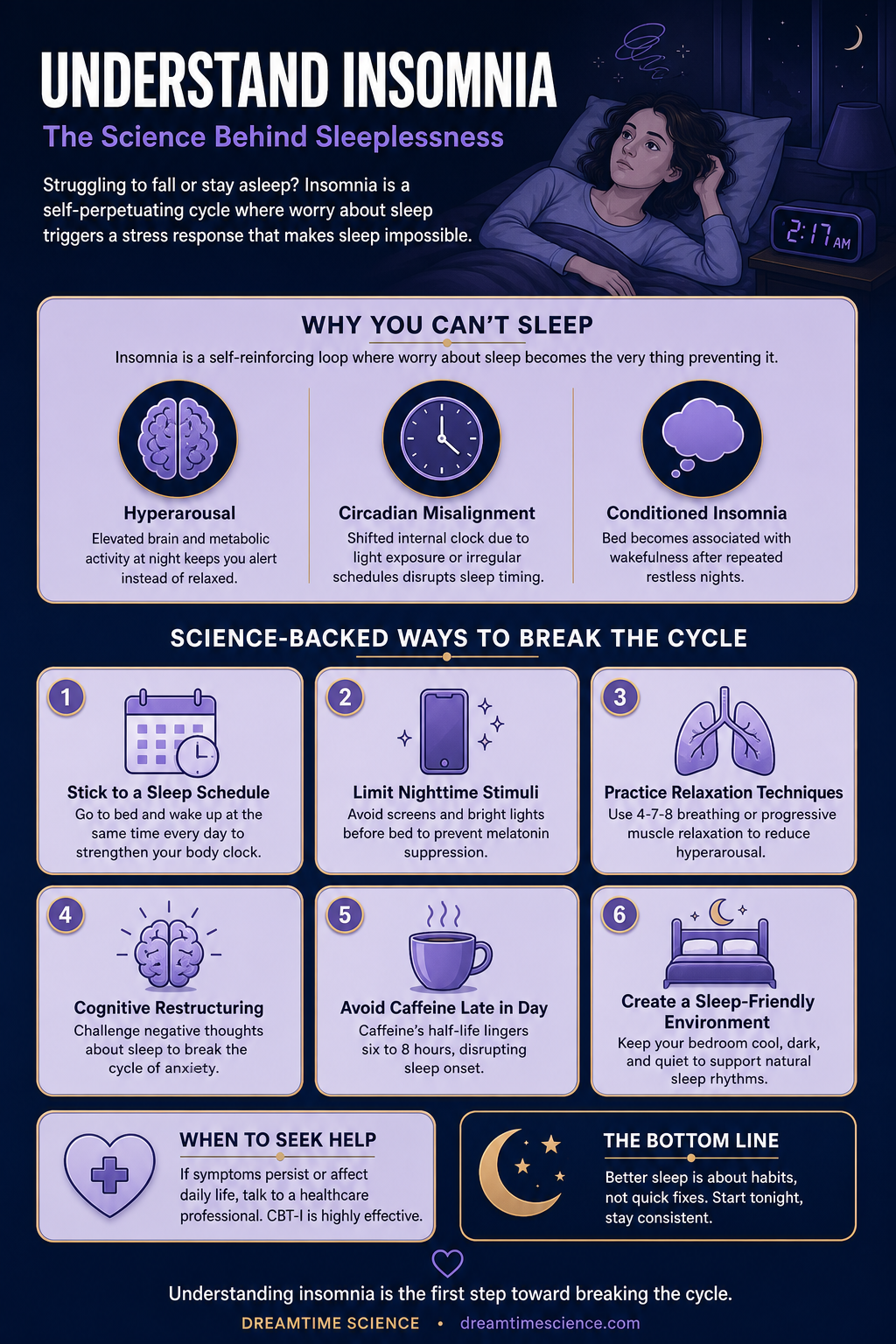
It’s 2:17 AM.
You’re tired. You want to sleep. But your mind is wide awake — replaying conversations, forecasting tomorrow, scanning for dangers that don’t exist. The more you try to sleep, the more impossible it feels.
If you’ve ever wondered why you can’t sleep, the answer often lies in something researchers call the insomnia cycle — a self-reinforcing loop where worry about sleep becomes the very thing preventing it.
Understanding the science behind insomnia doesn’t just explain your sleepless nights. It softens them. Because when you see the mechanism clearly, you realize: nothing is “wrong” with you. Your brain is doing exactly what it evolved to do — just at the wrong time.
Let’s gently unravel the cycle.
Key takeaways
- Insomnia often begins with a common trigger, like stress or a change in routine.
- The insomnia cycle involves a stage where worries about sleep intensify anxiety and activate the body.
- Hyperarousal, a state of heightened brain activity, prevents the body from relaxing into sleep.
- Sleep pressure, a natural drive to sleep, can be blocked by mental activation and anxiety.
- Relearning the association between your bed and sleep is possible through techniques like CBT-I.
What Is Insomnia? (And Why It’s So Common)
Insomnia isn’t just difficulty sleeping. Clinically, it includes:
- Trouble falling asleep
- Waking frequently
- Waking too early
- Feeling unrefreshed despite enough time in bed
According to a 2018 study published in the journal Sleep, up to 30% of adults experience insomnia symptoms at any given time. For many, it becomes chronic.
But here’s the surprising part: insomnia often begins with something completely ordinary — stress.
A deadline. A new baby. Illness. Travel. A breakup.
The first few bad nights make sense.
It’s what happens next that creates the cycle.
The Insomnia Cycle: How One Bad Night Becomes Many
Sleep researchers describe insomnia as a loop with three stages: predisposing, precipitating, and perpetuating factors.
1. Predisposing: Your Natural Sensitivity
Some nervous systems are simply more alert.
If you’re thoughtful, analytical, creative, or prone to anxiety, your brain may have a stronger “threat detection” system. Evolutionarily, this was useful. In modern bedrooms, it’s less helpful.
Your brain doesn’t power down easily because it’s wired to monitor.
2. Precipitating: The Trigger Event
Something disrupts your sleep — stress, illness, emotional upheaval.
You sleep poorly for a few nights.
Completely normal.
3. Perpetuating: The Fear of Not Sleeping
This is where the cycle forms.
After a few restless nights, new thoughts appear:
- What if I don’t sleep again tonight?
- I won’t function tomorrow.
- Why can’t I just fall asleep like everyone else?
Your brain interprets these thoughts as threats.
And what does the brain do when it detects danger?
It activates the fight-or-flight response.
Hyperarousal: When Your Brain Thinks Night Is Dangerous
Insomnia isn’t just “not being tired.” It’s a state researchers call hyperarousal.
A study from the University of Pennsylvania in 2020 found that people with chronic insomnia often have elevated metabolic and brain activity at night compared to good sleepers.
Instead of powering down, the brain stays alert.
- Stress hormones like cortisol remain elevated.
- Heart rate increases.
- Body temperature stays slightly higher.
Your body is prepared for action — not sleep.
And here’s the paradox:
The more you try to force sleep, the more alert you become.
Trying harder activates effort. Effort activates monitoring. Monitoring activates wakefulness.
Sleep, by nature, is something that happens when we stop trying.
Sleep Pressure vs. Anxiety: A Tug-of-War
To understand insomnia fully, we need to talk about two forces:
Sleep Pressure
Throughout the day, a chemical called adenosine builds up in your brain. The longer you’re awake, the stronger your “sleep pressure” becomes. This biological drive to sleep is crucial, as discussed in The Sleep Pressure Curve: Why You Get Tired at Specific Times.
Cognitive Arousal
Now imagine anxiety pouring adrenaline into that system.
You can be physically exhausted — but mentally activated.
It’s like pressing the gas and the brake at the same time.
The result? Restless wakefulness.
Why Lying Awake Feels So Intense
At night, distractions disappear.
No emails. No scrolling (ideally). No conversations.
Your mind suddenly has space.
Research in cognitive science shows that when external input drops, internal thoughts become louder. For someone worried about sleep, that quiet amplifies fear.
And then something subtle happens:
Your bed becomes associated with wakefulness.
According to behavioral sleep research from the National Institutes of Health, the brain forms associations quickly. If you repeatedly lie awake in bed feeling frustrated, your brain learns:
Bed = alertness.
This is called conditioned insomnia.
And it’s reversible.
The Role of Circadian Rhythms
Sometimes insomnia isn’t just anxiety — it’s timing.
Your circadian rhythm is your internal 24-hour clock, as explored in Circadian Rhythms 101: How Your Body's Internal Clock Controls Sleep. If it’s shifted — due to late-night light exposure, irregular schedules, or stress — your body may not be biologically ready for sleep when you get into bed.
This is one reason why 8 hours in bed doesn’t always equal 8 hours asleep, as further explained in Sleep Cycles Explained: Why 8 Hours Isn't Always Enough.
Sleep isn’t a switch. It’s a rhythm.
And rhythm requires alignment.
What This Means for You
Understanding the insomnia cycle can be empowering. It reveals that the struggle isn’t due to personal failure but rather a misalignment in natural processes. This knowledge can be the first step toward healing, as it allows you to approach sleep with compassion instead of frustration.
The insomnia cycle is maintained by learned patterns.
Which means it can be unlearned.
This is why Cognitive Behavioral Therapy for Insomnia (CBT-I) is considered the gold standard treatment. Research published in JAMA Internal Medicine in 2015 shows CBT-I is as effective — or more effective — than sleep medication long-term.
CBT-I gently breaks the cycle by:
- Rebuilding bed = sleep association
- Reducing catastrophic thinking
- Strengthening sleep pressure
- Calming hyperarousal
No force. No shame. Just retraining the nervous system.
Isn’t it fascinating that your brain, which learned wakefulness, can also relearn rest?
Conclusion: You’re Not Broken — You’re Activated
If you can’t sleep, it doesn’t mean you’re failing.
It means your brain is protecting you.
The insomnia cycle is simply your nervous system doing its job too well — scanning for threats in a space meant for surrender.
When you understand the science of why you can’t sleep, something softens. The struggle becomes a pattern. The pattern becomes workable.
And workable means changeable.
Want to experience these sleep science concepts with our soothing narration and ambient soundscapes? Check out our latest video on YouTube @dreamtimescience.
Frequently Asked Questions
Why can’t I sleep even when I’m exhausted?
Exhaustion and sleep are not identical. You may have high sleep pressure but also high cognitive arousal. Anxiety can override fatigue, making it difficult to transition into sleep despite physical tiredness.
Does insomnia damage my brain?
Short-term sleep loss feels awful but is not catastrophic. Chronic severe sleep deprivation has effects, but insomnia often involves lighter, fragmented sleep — not total deprivation. The fear of damage often worsens the cycle more than the sleep loss itself.
Should I stay in bed and try harder?
Counterintuitively, no. For many people, getting up briefly and returning when sleepy helps rebuild the bed-sleep connection. This approach reduces anxiety and reinforces the bed as a place for rest, not wakefulness.
Is insomnia permanent?
No. The brain is adaptable. With behavioral adjustments and nervous system calming, insomnia can improve significantly. Treatments like CBT-I are highly effective in breaking the insomnia cycle and promoting restful sleep.
Why does insomnia get worse the more I think about it?
Monitoring for sleep activates alertness. Sleep requires surrender, not surveillance. The more you focus on trying to sleep, the more likely you are to trigger your brain's wakefulness mechanisms.
Fall Asleep to a Science Lecture
Put tonight's reading into practice — pick a gentle, softly-narrated episode and let the Professor talk you to sleep.
 Tonight's episodeHow Gravity Can Bend Time: The Cosmic Clock Puzzle
Related articles

Cognitive Behavioral Therapy for Insomnia (CBT-I): Evidence-Based Sleep Fixes
CBT-I is the gold-standard treatment for chronic insomnia, recommended as first-line therapy over sleeping pills by every major medical body. It combines sleep…

Beat Insomnia Tonight
Insomnia can be beaten tonight using seven evidence-based techniques: the 4-7-8 breathing method, progressive muscle relaxation, stimulus control, cognitive…

The Sleep Pressure Curve: Why You Get Tired at Specific Times
Sleep pressure is driven by adenosine, a byproduct of neuronal activity that accumulates in the brain throughout waking hours. The longer you stay awake, the more…