
The short answer: Lucid dreaming is a scientifically verified state where the dreamer becomes aware they are dreaming and can exert partial control over the dream narrative. Brain imaging confirms increased prefrontal cortex activity during lucid dreams. Techniques like reality testing and MILD (Mnemonic Induction of Lucid Dreams) can increase lucid dream frequency, though mastery typically takes weeks of practice.
Imagine realizing you’re dreaming — while still inside the dream.
The sky looks slightly too purple.
Gravity feels optional.
And suddenly you think:
“This isn’t real.”
That moment — awareness within dreaming — is called lucid dreaming. But can you really control your dreams? Or is lucid dreaming more internet myth than neuroscience?
The science is surprisingly solid — and deeply fascinating.
Key takeaways
- Lucid dreaming involves recognizing you are dreaming while still asleep.
- Some people can intentionally fly, change scenery, or confront fears in lucid dreams.
- Brain imaging shows increased activity in thinking areas during lucid dreaming.
- Keeping a dream journal can improve dream recall and increase awareness.
- Practicing lucid dreaming techniques can sometimes disrupt healthy sleep cycles.
What Is Lucid Dreaming?
Lucid dreaming occurs when you become aware that you’re dreaming while still asleep. Sometimes awareness alone happens. Other times, dream control follows. Research suggests about 55% of people have experienced at least one lucid dream in their lifetime (Kahan & LaBerge, 1994).
During lucid dreaming:
- REM sleep continues: Rapid Eye Movement (REM) sleep is the stage where most dreaming occurs, characterized by heightened brain activity similar to wakefulness.
- Dream imagery persists: Vivid dream scenarios continue, but now with a new layer of consciousness.
- Self-awareness increases: The dreamer recognizes their state, opening possibilities for intentional actions within the dream.
Brain imaging studies from Goethe University Frankfurt show increased activity in prefrontal brain regions during lucid dreams — areas typically less active in normal REM sleep (Voss et al., 2009). In other words, the rational mind partially “wakes up” inside the dream.
What This Means for You
Understanding lucid dreaming can offer insights into the flexibility of consciousness and the mind's potential. For some, it represents an opportunity to explore dreams with intention, while for others, it simply highlights the complex beauty of the sleeping mind.
Can You Actually Control Dreams?
Control varies. Some lucid dreamers report:
- Flying intentionally
- Changing dream scenery
- Confronting fears
- Practicing skills
Others experience awareness without control. Scientific experiments have even demonstrated communication from lucid dreamers to researchers via pre-arranged eye movement signals during REM sleep. In a 2018 study, lucid dreamers were able to communicate with researchers using specific eye patterns agreed upon before sleep (Konkoly et al., 2021). Lucidity is measurable. It’s not fantasy.
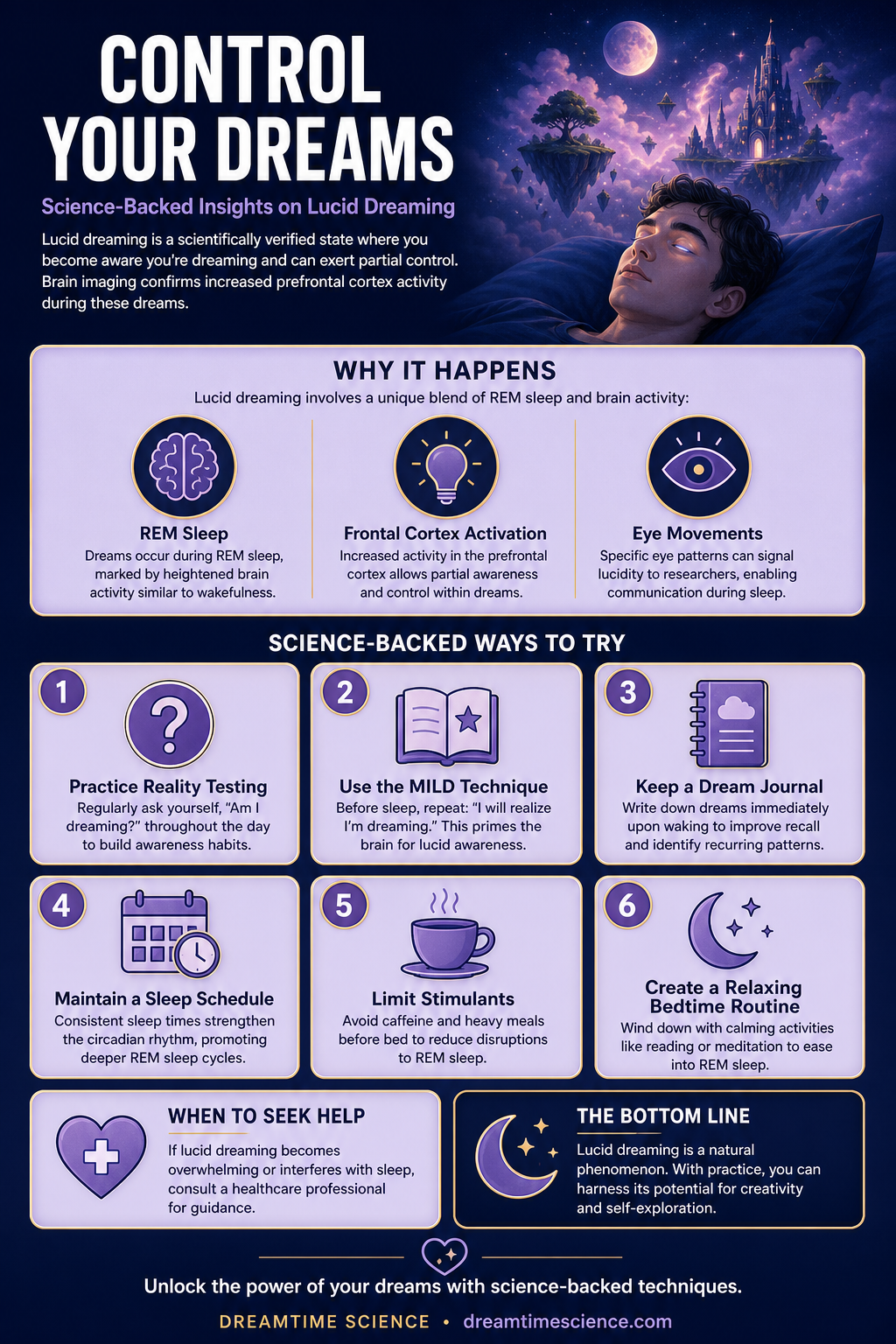
Why Lucid Dreaming Happens
Lucid dreaming appears to involve a hybrid state: REM sleep + partial frontal cortex activation. Normally during REM:
- Emotional regions are active: Areas like the amygdala are engaged, processing emotions and memories.
- Logical regions are quiet: The prefrontal cortex, responsible for decision-making and logical reasoning, usually rests.
But in lucid REM, frontal areas associated with metacognition (thinking about thinking) re-engage. This overlap creates awareness. We explore standard REM architecture in REM Sleep Explained: Why This Stage Matters Most.
What This Means for You
Lucid dreaming demonstrates that even in sleep, our brains can exhibit remarkable complexity. For those interested in exploring their dreams, understanding this state could be the first step in harnessing its potential for personal growth or creativity.
Can You Train Lucid Dreaming?
Some evidence suggests yes. Common techniques include:
- Reality testing during the day: Regularly questioning reality can increase the likelihood of recognizing a dream state.
- Dream journaling: Keeping a dream diary strengthens dream recall and awareness.
- Mnemonic induction: Setting intention before sleep to remember that you are dreaming.
A study published in the journal Dreaming found that certain induction methods modestly increased lucid dream frequency (Taitz et al., 2018). However, lucid dreaming is not guaranteed, and over-effort can disrupt sleep. For those struggling with insomnia, prioritizing stable sleep cycles is more important than dream control. For more strategies to improve sleep without focusing on dreams, see our article on 7 Science-Backed Ways to Beat Insomnia Tonight.
Potential Benefits and Risks
Possible Benefits
- Reducing nightmare distress: By becoming aware during nightmares, some individuals can alter the dream narrative, reducing fear.
- Rehearsing skills: Practicing tasks in dreams may boost confidence and performance in waking life.
- Enhancing creativity: Engaging with dreams can unlock creative problem-solving and inspiration.
Potential Downsides
- Sleep fragmentation if over-practiced: Attempting to induce lucid dreams frequently can disturb sleep patterns.
- Blurring boundaries in rare individuals prone to dissociation: Those with certain psychological conditions may experience confusion between dream and reality.
Balance matters. Sleep is first for restoration. Dream exploration is optional.
Conclusion: Awareness Within the Dream
Lucid dreaming shows something extraordinary: consciousness is flexible. Your mind can become aware within its own simulation. Not everyone needs to control dreams. But knowing it’s possible reveals how dynamic REM sleep truly is. Even in sleep, awareness can flicker. And that flicker is scientifically real.
Want to experience these sleep science concepts with our soothing narration and ambient soundscapes? Check out our latest video on YouTube @dreamtimescience.
Frequently Asked Questions
Is lucid dreaming safe?
For most people, yes — when not pursued obsessively. Lucid dreaming is generally considered a safe practice, but it's important to maintain healthy sleep habits.
Does lucid dreaming reduce sleep quality?
Occasionally inducing lucidity may slightly increase arousal, but evidence is mixed. Some studies suggest minimal impact, while others caution against frequent disruption of REM sleep.
Why don’t I remember my dreams?
Dream recall depends on timing and neurochemistry. Waking during or immediately after REM sleep can enhance recall. For more on this, see Why You Forget Dreams Immediately Upon Waking.
Are lucid dreamers sleeping lightly?
They remain in REM sleep, but with partial cortical activation. This unique state allows for awareness without fully waking the dreamer.
Can lucid dreaming treat nightmares?
Some therapeutic approaches use lucidity for nightmare rescripting, allowing individuals to alter distressing dreams and reduce their emotional impact.
Fall Asleep to a Science Lecture
Put tonight's reading into practice — pick a gentle, softly-narrated episode and let the Professor talk you to sleep.
 Tonight's episodeHow Gravity Can Bend Time: The Cosmic Clock Puzzle
Related articles

The Science Behind Lucid Dreaming: What's Actually Happening in Your Brain
Lucid dreaming occurs when the prefrontal cortex, responsible for logic and self-reflection, becomes highly active during REM sleep, resembling wakefulness. A 2012…

Lucid Dream Benefits: What You Can Actually Accomplish in Lucid Dreams
Lucid dreaming offers a unique opportunity to boost creativity, confront fears, and even improve skill performance. Regularly practicing lucid dreaming can reduce…

Dreaming in Color: Do People Really Dream in Black and White?
Historically, around three-quarters of people reported dreaming in black and white, coinciding with the prevalence of black-and-white television in the 1940s. As…