
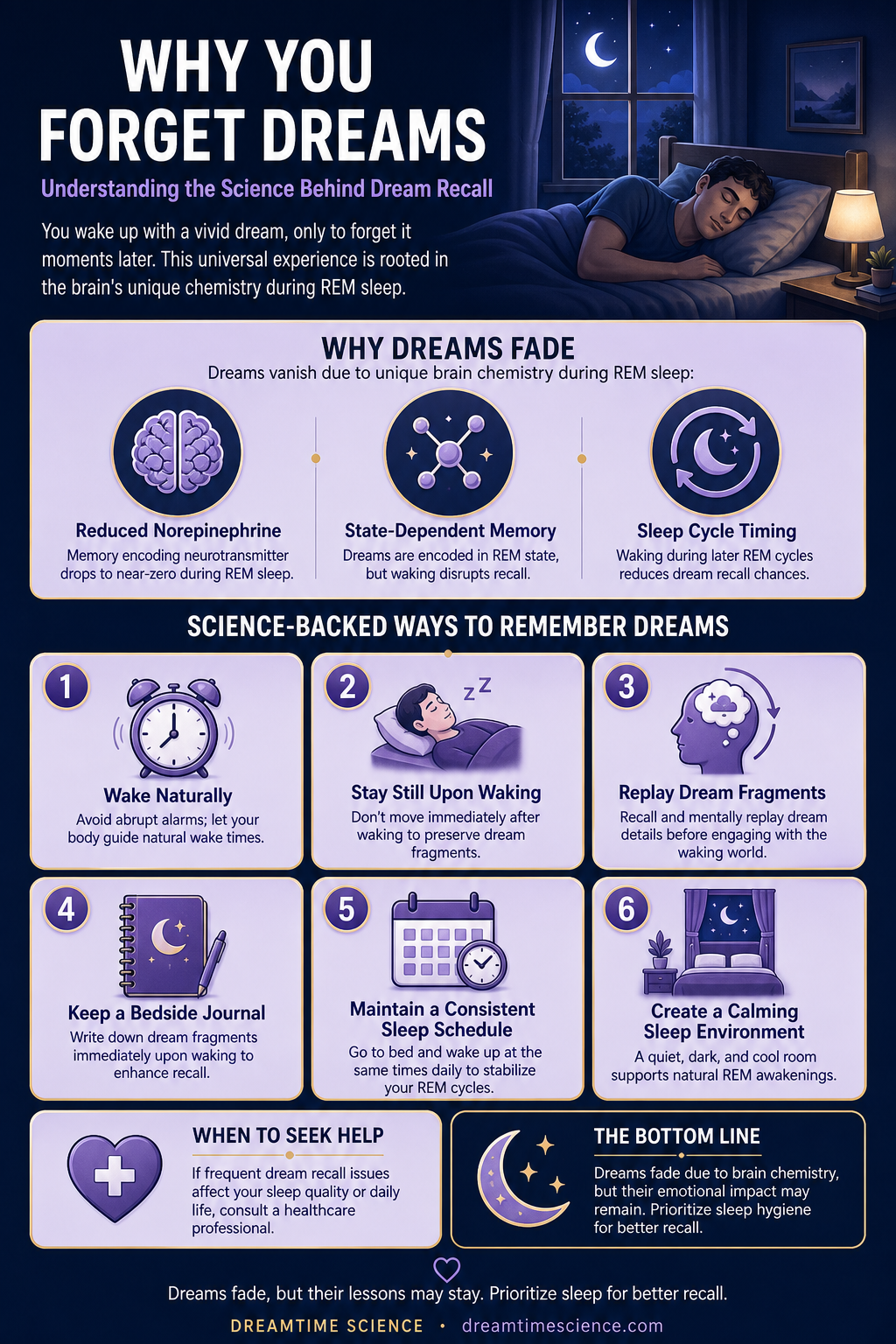
The short answer: You forget dreams because the hippocampus, responsible for transferring short-term memories to long-term storage, operates at reduced capacity during REM sleep. Norepinephrine, a neurotransmitter essential for memory encoding, drops to near-zero levels during dreaming. The abrupt neurochemical shift upon waking means dream memories are never properly consolidated, fading within 5-10 minutes unless deliberately recalled and recorded.
You forget dreams because the brain’s memory consolidation processes are significantly diminished during Rapid Eye Movement (REM) sleep. Specifically, the hippocampus, crucial for transferring information from short-term to long-term memory, operates at a reduced capacity, and the neurochemical environment is unfavorable to encoding. As a result, dream experiences are often lost within minutes of waking, unless conscious effort is made to retain them.
Key takeaways
- Dreams are encoded during REM sleep, a brain state with low norepinephrine levels.
- The hippocampus, important for memory, is less active during REM sleep, hindering dream encoding.
- Memory recall is best when the brain state matches how the memory was formed.
- Waking directly from REM sleep increases the chance of remembering a dream.
- Dream forgetting may help the brain focus on emotional processing, not dream details.
Why You Forget Dreams Immediately Upon Waking: A Neurochemical Explanation
Dreams occur primarily during REM sleep, a distinct brain state characterized by heightened brain activity and reduced muscle tone. This state is fundamentally different from wakefulness, and one critical distinction lies in the levels of key neurotransmitters. During REM, levels of norepinephrine—a neurotransmitter vital for memory consolidation and attention—drop to extremely low concentrations. This reduces the brain’s ability to effectively ‘save’ the experiences unfolding within the dream. Simultaneously, activity in the prefrontal cortex, the area responsible for higher-order cognitive functions like logic and working memory, is suppressed. This reduces the capacity to encode and structure dream content into a coherent, lasting memory trace.
The Role of the Hippocampus in Dream Forgetting
The hippocampus is central to the formation of declarative memories—those that consciously recall facts and events. This brain region is involved in the process of memory consolidation, essentially transferring information from short-term storage to long-term storage. However, the hippocampus exhibits reduced activity and altered function during REM sleep. This diminished hippocampal activity prevents the efficient encoding of dream experiences, leading to their rapid decay upon awakening. While the precise mechanisms of this reduction are still being investigated, the neurochemical environment of REM sleep appears to directly inhibit hippocampal processing.
State-Dependent Learning and Recall & Dream Recall
Memory is demonstrably “state-dependent”, meaning that recall is most effective when the brain is in a similar state to when the memory was originally formed. Dreams are encoded within the unique neurochemical and physiological conditions of REM sleep. Waking represents a significant shift in brain state, and this disparity hinders access to the dream memory. Research indicates that waking directly from REM sleep—rather than later in a sleep cycle—is associated with higher rates of dream recall. This suggests that waking during or immediately following REM allows for a greater overlap in brain states, facilitating memory retrieval. As sleep progresses, the length and intensity of REM periods increase, potentially influencing the strength of any formed dream memories.
The Limited Attentional Resources Upon Waking
Even if dream content is partially encoded, the brain’s limited attentional resources pose a further challenge to dream retention. Upon waking, the brain is immediately bombarded with sensory input and is forced to prioritize present-moment processing. This abrupt shift in focus diverts cognitive resources away from the fragile dream memory, leading to its rapid displacement. External stimuli—such as lights, sounds, or thoughts about daily tasks—compete for neural processing, effectively diminishing the availability of resources necessary to consolidate the dream experience.
Factors Influencing Individual Differences in Dream Recall
The frequency with which people remember dreams varies greatly. Those who report frequent dream recall often exhibit several consistent patterns. They tend to have higher activity in temporo-parietal regions associated with memory retrieval and greater sensitivity to internal stimuli. Furthermore, they are more likely to experience brief awakenings during sleep—particularly during REM—potentially serving as opportunities for memory consolidation. It’s hypothesized that these ‘micro-awakenings’ allow for the partial transfer of dream content into waking consciousness, enhancing the likelihood of recall.
The Biological Purpose of Dream Forgetting
While the inability to recall dreams can be frustrating, it may serve a biological purpose. Some theories suggest that dream content is primarily involved in emotional regulation and information processing, rather than faithful recording of events. The brain may selectively consolidate the emotional themes and broader patterns discovered during dreaming—without necessarily preserving the specific narrative details. This allows for efficient emotional processing and problem-solving without being burdened by the recollection of irrelevant or potentially distressing dream images.
Frequently Asked Questions
Why do we dream every night, if we rarely remember them?
Most adults experience multiple REM sleep periods each night – and with them, dreams. However, the brain’s lowered capacity for memory encoding during REM explains why recall is often poor. Dreaming appears to serve functions besides explicit recall, such as emotional processing and consolidation.
Why do dreams feel so real while we're in them, but disappear so quickly after waking?
Dreams feel vivid due to strong activity in emotion-processing and visual areas of the brain. However, the reduction of norepinephrine prevents the dream experience from being successfully encoded into long-term memory, leading to swift forgetting upon waking.
Does fragmented sleep increase dream recall?
Fragmented sleep—due to external stimuli or sleep disorders—can lead to more frequent awakenings, potentially increasing dream recall. However, frequent disruptions to sleep architecture can reduce overall sleep quality and have negative health consequences.
Are forgotten dreams entirely meaningless?
Not necessarily. Even if a dream is not consciously remembered, the brain may still process its emotional content, contributing to psychological well-being and emotional regulation. The emotional ‘takeaway’ of a dream may be retained even if the narrative details are lost.
Does lucid dreaming improve memory?
Lucid dreams – where you are aware that you are dreaming – tend to be better remembered than non-lucid dreams due to enhanced activity in frontal brain regions responsible for awareness and memory encoding. This is still an active area of research.
Fall Asleep to a Science Lecture
Put tonight's reading into practice — pick a gentle, softly-narrated episode and let the Professor talk you to sleep.
 Tonight's episodeHow Gravity Can Bend Time: The Cosmic Clock Puzzle
Related articles

Dreaming in Color: Do People Really Dream in Black and White?
Historically, around three-quarters of people reported dreaming in black and white, coinciding with the prevalence of black-and-white television in the 1940s. As…

Hypnagogia: The Strange Minutes Between Waking and Sleep
Ever found yourself teetering on the edge of sleep, dancing with dreams and reality in a hazy twilight?

Lucid Dreaming: Can You Really Control Your Dreams? (With Science)
Lucid dreaming is a scientifically verified state where the dreamer becomes aware they are dreaming and can exert partial control over the dream narrative. Brain…