
The short answer: Recurring dreams are repetitive dream scenarios that arise because our brains crave patterns and are reinforcing neural pathways. They often stem from unresolved emotions, lingering fears, or desires, acting as a nightly reminder of issues needing attention. A 2011 study in *Dreaming* linked recurring dreams to emotional conflicts, while a 2015 study in the *Journal of Sleep Research* found that 65% of recurring dreams relate to the dreamer's life experiences.
Recurring dreams happen when you experience the same dream scenarios repeatedly. Understanding them can offer insights into your emotional state and past experiences. This article explores the patterns, science, and potential meanings behind these repeating dreams. We will also consider how your brain creates these narratives and how to potentially shift them.
Key takeaways
- Recurring dreams often highlight feelings you haven’t fully dealt with, signaling a need for emotional processing.
- Recognizing repeating dream sequences is crucial, and a dream journal can help reveal underlying themes and patterns.
- Your brain strengthens neural pathways with repeated use, which explains why frequent dreams are easy to replay.
- Recurring dreams frequently involve memories linked to past experiences, acting as echoes of moments you haven’t fully let go.
- Addressing unresolved emotions or past experiences may help diminish the frequency of recurring dreams.
Why Do I Keep Having the Same Dream?
Recurring dreams feel familiar, like a scene you’ve seen before. They might involve running without progress or falling from a height. These dreams aren’t random; they represent patterns in your thoughts. Your brain seeks order and predictability, even while you sleep.
Our brains naturally look for patterns in everything we experience. This is how we make sense of the world. Even in dreams, your mind wants to find familiar structures. This desire leads to those repeated dream scenarios, or narratives.
Understanding the Sequences
Recognizing these repeating dream sequences is a crucial first step. A dream journal can help you track these patterns over time. Noting details like setting and emotions can reveal underlying themes. This process mirrors how sleep itself follows predictable cycles Sleep Cycles Explained. These cycles aren’t just about sleep stages; they shape our dream experiences.
Why Do My Dreams Keep Repeating?
Dreams are not random events; they often have a purpose. Recurring dreams, in particular, tend to signal something your brain wants to process. Think of this as your mind's way of highlighting an issue. These repeated dreams are not just strange occurrences. They are opportunities for deeper understanding.
Why Dreams Loop Back
Your brain strengthens neural pathways with repeated use. It is like a path through a field; the more often you walk it, the clearer it becomes. Frequent dreams use the same pathways, making them easy for your brain to replay. This repetition may be connected to how your brain organizes memories.
What’s Happening in Your Brain?
The hippocampus, a brain area important for memory, is active during sleep. During REM sleep, the hippocampus works to store and organize memories. This process can trigger recurring dream themes. It is as if your brain is trying to puzzle together new experiences with what you already know. This can involve emotional processing.
Factors Contributing to Repetition
Here are some reasons your dreams might repeat:
- Unresolved emotions: Recurring dreams often highlight feelings you haven't fully dealt with.
- Past experiences: Dreams can replay events you haven’t fully processed.
- Stress and anxiety: Times of high stress may trigger repeated dream themes.
- Memory consolidation: Your brain may be working to integrate new information with older memories.
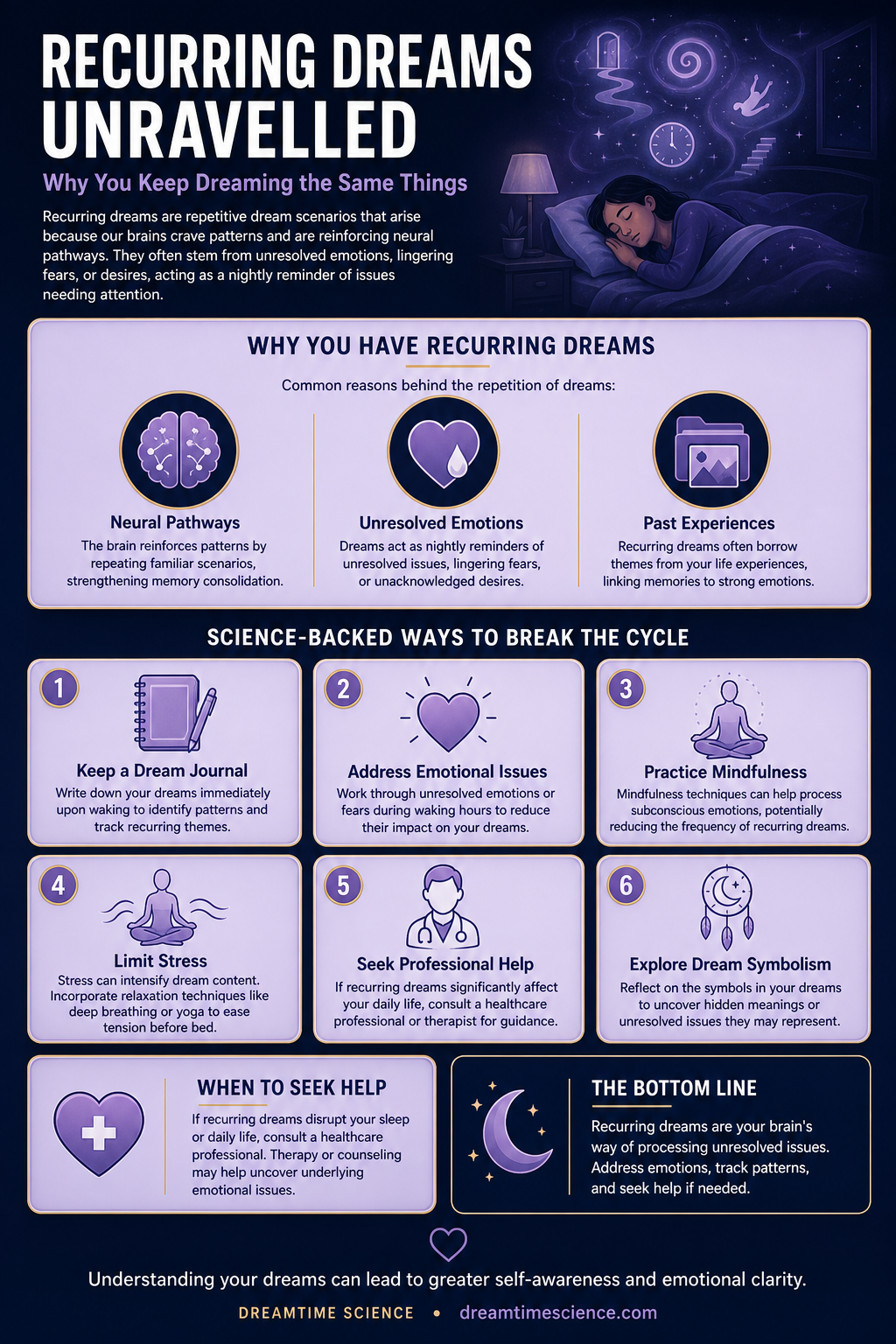
Unresolved Emotions
There’s a reason that recurring dreams often carry an emotional punch. These are not just stories; they are reflections of your inner world. Unfinished business, lingering fears, or desires not fully acknowledged.
Your mind is a stage.
And the dreams are the players acting out what hides below the surface.
But they don’t just vanish when the curtain falls.
Emotional Echoes
A 2011 study published in Dreaming revealed that recurring dreams are often tied to emotional conflicts. This emotional weight makes them memorable and persistent, serving as a nightly reminder of unresolved issues. Addressing these emotions during waking hours may help diminish the frequency of these dreams.
The Psychological Perspective
From a psychological standpoint, recurring dreams may be viewed as manifestations of the subconscious mind's attempt to process emotional turmoil. Cognitive theories suggest that these dreams could be a form of problem-solving, where the mind repeatedly presents a scenario until a resolution is reached. Engaging in practices like mindfulness or therapy can help in processing these emotions, potentially reducing the recurrence of such dreams.
Clues from the Past
Recurring dreams can be echoes of past experiences. Like a photograph of a moment you can’t quite let go. Memories that tie themselves to emotions, sometimes without your conscious consent.
The past isn't just behind you.
It's within you.
And at night, it rises to the surface.
Memory and Dreaming
Our brains are brilliant storytellers, crafting narratives every night. These stories aren't pulled from thin air. They borrow from the day, from our pasts, from our deepest thoughts. A 2015 study in the Journal of Sleep Research found that 65% of recurring dreams involve themes directly related to the dreamer's life experiences. This suggests that our past heavily influences the content and recurrence of dreams.
Historical Context of Dream Interpretation
Historically, recurring dreams have been a subject of fascination. Ancient civilizations often interpreted these dreams as messages from the divine or as omens. In the early 20th century, Sigmund Freud and Carl Jung provided psychological interpretations, viewing dreams as windows into the subconscious. Freud believed that recurring dreams were expressions of repressed desires, while Jung saw them as attempts to integrate aspects of the psyche. For more on the evolution of dream analysis, visit The History of Sleep Science: From Freud to Modern Brain Imaging.
Your Brain, the Storyteller
Our brains are brilliant storytellers, crafting narratives every night. These stories aren't pulled from thin air. They borrow from the day, from our pasts, from our deepest thoughts. Recurring dreams are tales the brain retells, hoping you'll catch the message this time.
The brain whispers through these stories.
Listen, it says.
It has much to tell.
Breaking the Cycle
Can you end these nightly reruns? It begins with understanding. Recognizing the patterns, the emotions, the past experiences. Sometimes, writing them down, sharing them, even confronting them in daylight can break the loop.
- Identify Patterns: Note recurring themes in a dream journal.
- Address Emotions: Confront unresolved emotions with therapy or self-reflection.
- Modify Behavior: Implement stress-reduction techniques like meditation.
The cycle isn’t unbreakable.
It just needs a gentle nudge.
A closure, perhaps.
What This Means for You
Breaking the cycle of recurring dreams involves more than just awareness. Incorporating gentle, bedtime-friendly approaches, like those mentioned in The Perfect Bedtime Routine According to Sleep Scientists, can help create an environment conducive to restful sleep.
Why My Dreams Repeat: What They're Trying to Tell Me
Recurring dreams often feel unsettling, but they are rarely ominous. Instead, they are signals from your mind. These repeated dream scenarios usually point to something you need to address. They offer a chance to understand yourself better.
Your brain uses dreams to process experiences and emotions. Sometimes, a dream will repeat until you acknowledge a problem. This is particularly true if the issue feels difficult or confusing. Consider the dream’s setting and characters. They often represent aspects of your life or personality.
What Causes Dreams to Repeat?
Several factors can contribute to recurring dreams. Here's a look at some of the common ones:
- Stress: Major life changes or ongoing worries can trigger repeating dreams.
- Anxiety: Feelings of worry or unease might surface in your sleep.
- Trauma: Past painful experiences can sometimes replay in dreams.
- Unresolved conflicts: Difficulties in relationships or personal goals can also show up.
- Habitual thought patterns: Your brain may be trying to work through a recurring thought.
Recurring dreams are not a sign of anything supernatural. They are a reflection of your inner world. By recognizing the patterns, you can begin to understand their message.
Frequently Asked Questions
Why do recurring dreams occur?
Recurring dreams often signal unresolved issues or emotions. A study in Dreaming (2011) suggested that these dreams replay due to emotional conflicts or past experiences that need acknowledgment. Additionally, the brain's effort to process and consolidate memories during REM sleep can lead to recurring dream patterns.
Can recurring dreams affect my sleep quality?
Yes, they can. According to a 2012 article in the Journal of Sleep Medicine Reviews , recurring dreams, especially those with negative content, can lead to sleep disturbances and increased awakenings. This disruption can affect overall sleep quality and daytime functioning.
Are recurring dreams common?
Recurring dreams are quite common. Around two-thirds of people have them at some point. These dreams often reflect stress or big changes in life. They may be your brain’s way of working through worries.
Do recurring dreams have specific meanings?
While not universally true, recurring dreams often relate to personal experiences or emotions. A 2015 study found that 65% of these dreams are tied to real-life events or concerns. The interpretation of these dreams can vary based on individual experiences and psychological frameworks.
How can I stop recurring dreams?
Recurring dreams often point to ongoing worries. Working through these feelings can lessen their impact. Dream journaling or talking with a therapist can help. Gentle exercises and relaxation may also reduce how often you experience them.
Fall Asleep to a Science Lecture
Put tonight's reading into practice — pick a gentle, softly-narrated episode and let the Professor talk you to sleep.
 Tonight's episodeHow Gravity Can Bend Time: The Cosmic Clock Puzzle
Related articles

Dreams and Emotions: Why Your Feelings Intensify in Dreams
Dreams feel more intense than waking life because the regulation typically provided by the prefrontal cortex is diminished during REM sleep, allowing the lim...

Lucid Dreaming: Can You Really Control Your Dreams? (With Science)
Lucid dreaming is a scientifically verified state where the dreamer becomes aware they are dreaming and can exert partial control over the dream narrative. Brain…

Dreams About Falling: What They Mean and Why They Happen
Dreams about falling are a common and often startling experience, frequently attributed to a physiological phenomenon called hypnic jerks—involuntary muscle ...