
Ever find yourself scrolling endlessly on your phone, knowing full well you should be asleep? That’s not just insomnia or bad habits. It’s something deeper. Something they call "revenge bedtime procrastination."
It's a mouthful, but it captures a secret rebellion against the constraints of the day. You’re tired. You know it. Yet the quiet of night beckons, offering a taste of freedom. A space where time feels yours alone.
But why do we inflict this self-sabotage? Why do we trade sleep for stolen moments?
Key takeaways
- Revenge bedtime procrastination is a way to regain a sense of control when daytime demands feel overwhelming.
- Staying up late to scroll on devices suppresses melatonin production, delaying sleep onset and disrupting natural rhythms.
- Social media use before bed can mimic real-life connections, tricking the brain and increasing feelings of loneliness.
- Establishing a calming bedtime routine, like reading or listening to music, can help shift the focus away from screen time.
- Recognizing the pattern of revenge bedtime procrastination is the first step towards breaking the habit and prioritizing rest.
The Unseen Hours
During the day, life demands. Work, chores, social obligations—all pulling at your seams. Evening arrives, and for a brief spell, the world pauses.
Here’s your sanctuary.
Revenge bedtime procrastination is the mind’s whispered revolt. It’s a way to reclaim control, even if it costs you precious rest.
But this act of defiance comes with a price tag. One that can’t be paid tomorrow. As we explored in Sleep Cycles Explained, each cycle missed disrupts your body's natural rhythm, leading to a cascade of fatigue.
The Psychology of Delay
Procrastination isn't just a delay; it's a dance with something deeper. Psychologists suggest it's a coping mechanism against the absence of autonomy.
By postponing bedtime, you’re grasping at self-determination. In a world that moves too fast, this late-night ritual feels like a small act of rebellion.
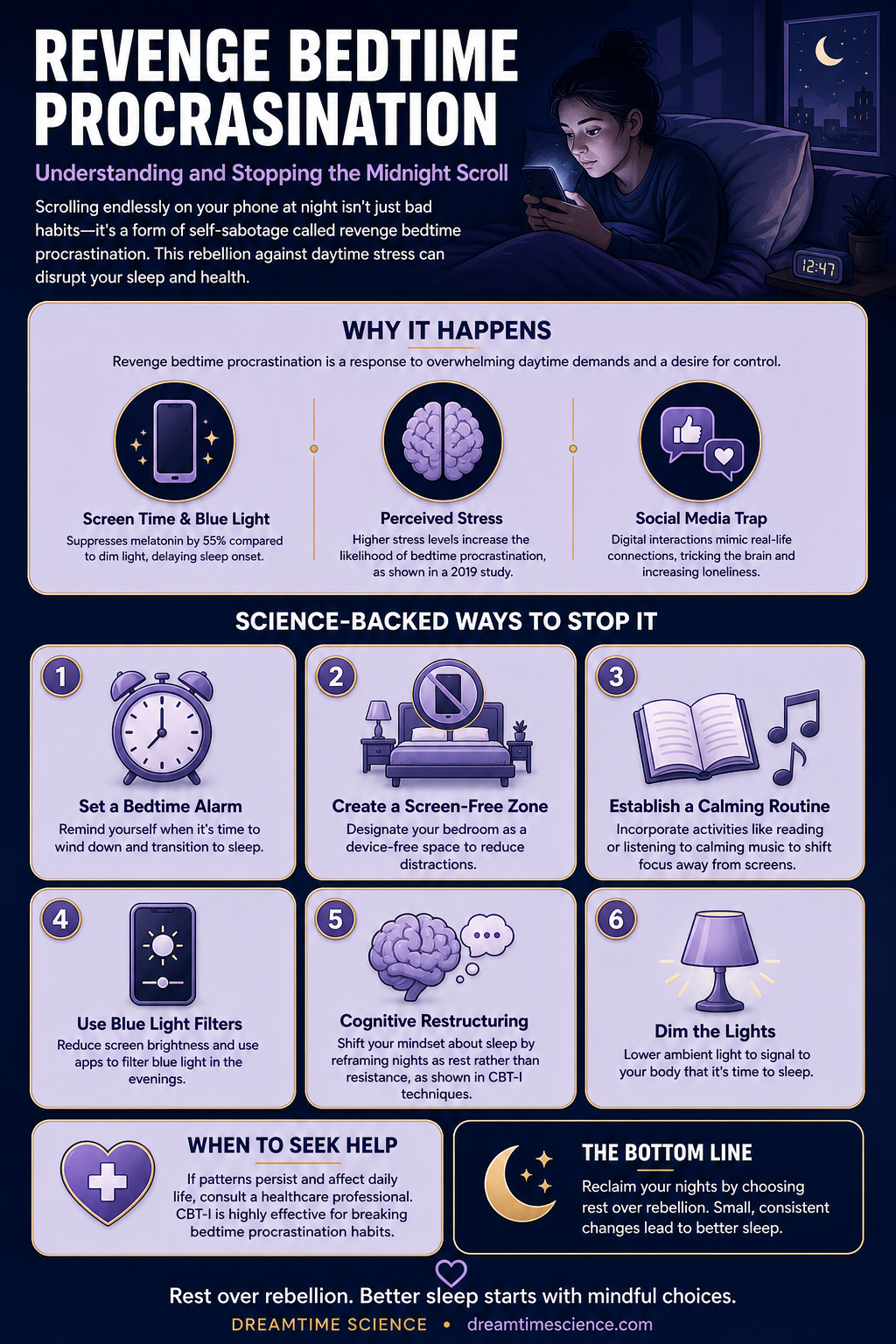
A 2019 study in the Journal of Behavioral Sleep Medicine found that individuals with higher levels of perceived stress are more likely to engage in bedtime procrastination. The clock ticks on, and with every swipe, you assert control over your time, even if fleeting.
The Science of Sleep Loss
Behind the choice to delay are complex rhythms—circadian rhythms—synchronized by daylight but disrupted by screens.
Melatonin, the hormone that gently pulls the sleep curtain down, doesn’t stand a chance against bright displays. When you stay up late scrolling, you’re waging war against your biology. According to a 2014 study in the Journal of Clinical Endocrinology & Metabolism, blue light exposure can suppress melatonin by 55% compared to dim light, delaying sleep onset.
And your body doesn’t forget. Sleep deprivation affects cognitive functions, as detailed in Sleep Deprivation's Impact on Memory, Learning, and Your Immune System, impairing memory, learning, and immune response.
The Biological Clock
Our bodies are governed by an internal clock, known as the circadian rhythm, which regulates sleep-wake cycles. This clock is influenced by external cues like light and temperature. Disruptions to this rhythm, such as those caused by late-night screen use, can lead to significant sleep disturbances. The Circadian Rhythms 101: How Your Body's Internal Clock Controls Sleep article provides a comprehensive overview of how these rhythms function and their critical role in maintaining sleep health.
The Social Media Trap
Social media is a siren. Its endless scroll offers new dopamine kicks with each swipe. But the trade-off is steep. Sleep procrastination psychology shows that these digital interactions mimic real-life connections, tricking the brain into thinking it’s truly engaged.
The irony? The more you scroll for connection, the lonelier the night can feel. A 2018 study in Computers in Human Behavior reported that heavy social media use correlates with increased feelings of loneliness and anxiety, especially before bed.
What This Means for You
So what can you do? Here are practical steps to reclaim your nights:
- Set a bedtime alarm: Remind yourself when it's time to wind down.
- Create a screen-free zone: Designate your bedroom as a device-free space.
- Establish a calming routine: Incorporate activities like reading or listening to calming music.
- Use blue light filters: Reduce screen brightness and use apps to filter blue light in the evenings.
Reframing your nights as a time for rest rather than resistance can transform your relationship with sleep.
The Circle of Tiredness
Morning arrives with groggy reminders of the night before. The cycle is a loop: late night defiance, early morning fatigue, rinse, repeat. Each snooze button press is a quiet nod to the rebellion.
But where does it end?
Breaking the Habit
The good news? Habits can be unlearned. It starts with awareness. Recognizing the pattern is the first step to breaking free.
Consider setting a non-negotiable wind-down time. Dim the lights. Swap your phone for a book. As explored in Cognitive Behavioral Therapy for Insomnia (CBT-I): Evidence-Based Sleep Fixes, cognitive restructuring can help shift your mindset about sleep.
Slumber’s Promise
Each night offers a choice. To reclaim your nights, you must choose rest over rebellion.
Sleep isn’t the enemy. It’s the ally waiting to rejuvenate, to heal, to prepare you for the world’s demands anew. As detailed in The Role of Darkness: Why Light Exposure Matters for Sleep, embracing darkness and reducing light exposure can significantly improve sleep quality.
And when you finally surrender to sleep’s embrace, know this: the night will always give what the day takes away.
Historical Context: The Evolution of Sleep Patterns
Historically, humans have not always adhered to the consolidated sleep pattern typical today. Pre-industrial societies often practiced biphasic or polyphasic sleep, characterized by multiple sleep periods throughout the day and night. This historical perspective offers insight into how modern lifestyles, dominated by artificial lighting and technology, have shifted our natural sleep tendencies. The article Biphasic Sleep: Is Sleeping in Two Shifts Healthier Than One? delves into these historical sleep patterns and their implications for contemporary sleep habits.
Conclusion
Revenge bedtime procrastination is a dance with autonomy, a grasp for freedom in the quiet hours of night. But in choosing rest over rebellion, you align with your natural rhythms. Sleep becomes an ally, rejuvenating and healing.
Want to experience these sleep science concepts with our soothing narration and ambient soundscapes? Check out our latest video on YouTube @dreamtimescience.
Frequently Asked Questions
What is the main cause of revenge bedtime procrastination?
Revenge bedtime procrastination primarily stems from a lack of autonomy during the day. Individuals seek to reclaim control over their time at night, even at the expense of sleep.
Is revenge bedtime procrastination linked to any psychological issues?
Yes, it can be linked to stress and anxiety. A study in the Journal of Behavioral Sleep Medicine (2019) found that individuals with high stress levels are more prone to engage in bedtime procrastination. Chronic stress can exacerbate this behavior, creating a cycle of anxiety and sleep deprivation that further impairs daily functioning.
How does social media contribute to sleep procrastination?
Social media provides a sense of connection and engagement, which increases dopamine levels. However, it can lead to feelings of loneliness and anxiety, further delaying sleep. The overstimulation from constant notifications and the pressure to stay updated can make it difficult to disengage and relax before bed.
Can blue light filters help reduce bedtime procrastination?
Yes, blue light filters can help reduce the impact of screens on melatonin production, making it easier to fall asleep. A 2014 study in the Journal of Clinical Endocrinology & Metabolism confirmed that reducing blue light exposure can improve sleep onset. Using these filters, alongside reducing overall screen time, can aid in reestablishing healthier sleep patterns.
What steps can I take to break the cycle of bedtime procrastination?
Creating a bedtime routine, setting a screen-free zone, and using cognitive behavioral strategies can help break the cycle. Establishing a consistent wind-down time is crucial for resetting your sleep patterns. Incorporating mindfulness or relaxation techniques, as discussed in The Science of Meditation for Sleep: How Mindfulness Improves Rest, can also promote a more restful transition to sleep.
Fall Asleep to a Science Lecture
Put tonight's reading into practice — pick a gentle, softly-narrated episode and let the Professor talk you to sleep.
 Tonight's episodeDNA's Silent Blueprint: Uncovering Life’s Deepest Secrets
Related articles

Sleep Hygiene 101: Building a Better Bedtime Routine From Scratch
Insufficient sleep is linked to serious health conditions like heart disease, diabetes, and depression, highlighting the importance of good sleep hygiene. Creating a…

The Perfect Bedtime Routine According to Sleep Scientists
The ideal bedtime routine lasts 30-60 minutes and follows a neuroscience-backed sequence: dim lights to signal melatonin production, lower room temperature to 16-19…

Bedtime Stories for Adults
Bedtime stories can improve adult sleep by diverting attention from anxious thoughts and activating the parasympathetic nervous system, which regulates the "rest and…