
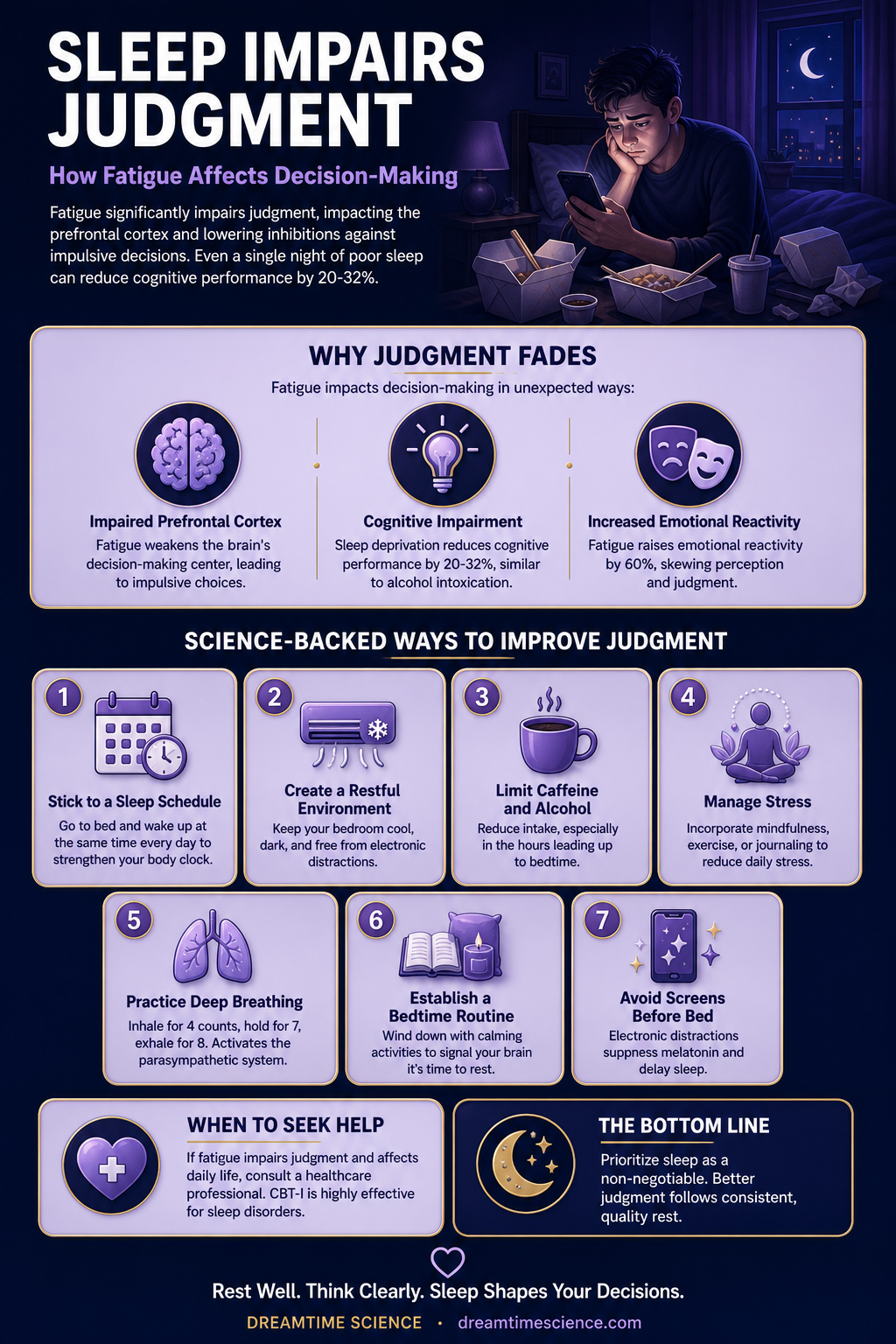
The short answer: Fatigue significantly impairs judgment, impacting the prefrontal cortex and lowering inhibitions against impulsive decisions. Even a single night of poor sleep can reduce cognitive performance by 20-32%, comparable to alcohol intoxication, and increases emotional reactivity by 60%. Prioritizing 7-9 hours of sleep per night and establishing a consistent bedtime routine are crucial for restoring clarity and better decision-making.
Lack of sleep significantly impairs your ability to make sound judgments and decisions. It's a common experience, and understanding why matters for daily life. This article explores how fatigue affects cognitive function and decision-making processes. We will examine the science behind sleep deprivation and discuss strategies for better judgment.
Key takeaways
- Sleep deprivation impairs judgment, making even easy choices feel difficult.
- Fatigue reduces your ability to think through the consequences of your actions.
- Prioritizing a consistent sleep schedule is essential for clear thinking and good decision-making.
- Sleep loss can lead to increased emotional reactivity and impulsive choices.
- Getting 7-9 hours of sleep each night is key to restoring mental clarity and improving judgment.
Does Being Tired Make Bad Decisions?
Fatigue affects your brain beyond simple sleepiness. It creates a mental haze that makes even easy choices hard. This can lead to impulsive actions, like unplanned spending or hasty emails. Your brain’s prefrontal cortex, responsible for planning and judgment, struggles when tired. Think of it as trying to steer a plane through rough weather with limited vision.
When tired, we’re more likely to take risks. Sleep deprivation weakens our self-control. This means we’re less able to stop ourselves from acting on sudden urges. It’s not that we want to be reckless; our ability to assess risks simply declines.
Recognizing the Signs of Fatigue’s Impact
Several factors contribute to poor decisions when you’re tired. These include:
- Reduced ability to think through consequences.
- Difficulty assessing potential risks.
- Increased impulsivity and reactivity.
- Trouble regulating emotions.
- A narrowed focus, missing important details.
To avoid these pitfalls, prioritize a consistent sleep schedule. View sleep as essential for clear thinking, just like food or water. A regular bedtime alarm can help you wind down at night. Aligning your internal clock, as discussed in Circadian Rhythms 101, supports better judgment.
Cognitive Impairment: A Sneaky Saboteur
Ever tried juggling with one hand tied behind your back? That's your brain trying to function when sleep-deprived. Cognitive functions degrade as fatigue creeps in. Memory lapses, slower processing, difficulty concentrating — it’s the perfect storm for poor decision-making.
Fatigue can make you forget where you put your keys or misjudge a friend’s tone in a text. It twists reality, skewing your perception and leading you down paths you'd normally avoid. According to a 2007 study in the Journal of Neuroscience, sleep deprivation results in a 20-32% reduction in cognitive performance, akin to the effects of alcohol intoxication. Cognitive impairment isn't just a minor inconvenience; it's a saboteur lurking in the shadows of sleep deprivation.
How Does Sleep Loss Affect Your Choices?
Decision-making relies on a brain working at its best. Sleep plays a vital role in how we evaluate options. During REM sleep, your brain sorts through emotions, memories, and daily experiences. It’s a crucial process for clear thinking.
When you don’t get enough sleep, this system falters. Imagine a workspace never cleaned; important information gets buried. Sleep deprivation leaves behind mental clutter, which impairs judgment. Every choice can feel uncertain.
The Impact of Lost Sleep
Several factors are affected by sleep loss. These include:
- Emotional Regulation: Sleep helps manage feelings. Lack of sleep amplifies emotional responses.
- Risk Assessment: Tiredness makes it harder to judge risk. It can lead to impulsive choices.
- Memory Consolidation: Sleep strengthens memories. It's vital for learning and recall.
- Cognitive Flexibility: This is the ability to adapt to new situations. Sleep loss reduces flexibility.
Getting enough rest is key to making good decisions. Aim for 7-9 hours of sleep each night. A relaxing bedtime routine can help prepare your body and mind for sleep.
The Science of Sleep Deprivation
What exactly happens when we don't sleep?
Our bodies flood with stress hormones, creating a sense of urgency and anxiety. The brain's wiring frays, and neurotransmitters misfire. It's a biochemical cocktail making rational thought a distant memory. Studies show even a single night of poor sleep can impair brain function akin to being legally drunk. Imagine making crucial decisions in that state — it's a wonder any of us manage.
As fatigue sets in, the amygdala, responsible for emotion regulation, goes into overdrive. Emotions boil over, and logic takes a backseat. You’re not just tired; you’re emotionally charged, and that’s a volatile combination for decision-making. A 2018 study in Nature Reviews Neuroscience revealed that sleep-deprived individuals exhibit a 60% increase in emotional reactivity compared to well-rested individuals.
Practical Steps to Improve Sleep Quality
- Create a Restful Environment: Keep your bedroom cool, dark, and free from electronic distractions.
- Stick to a Sleep Schedule: Go to bed and wake up at the same time every day, even on weekends.
- Limit Caffeine and Alcohol: Reduce intake, especially in the hours leading up to bedtime. For more advice, read our article on How Caffeine Affects Your Sleep (And When to Stop Drinking It).
- Manage Stress: Incorporate relaxation techniques like meditation or deep breathing before bed. Explore our techniques in Progressive Muscle Relaxation: A Neuroscience-Backed Technique for Better Sleep.
Can Sleepiness Lead to Poor Choices?
Fatigue significantly impacts our ability to make sound decisions. Think of it as a filter, clouding your judgment. Sleep deprivation reduces your capacity for rational thought. It makes impulsive choices more likely, and careful planning less so.
Protecting Your Decision-Making Skills
Prioritizing sleep is crucial for maintaining good judgment. Treat it with the same importance as any other vital task. A consistent bedtime routine prepares your brain for rest. This routine can include relaxing activities like reading or gentle stretching.
Creating a sleep-friendly environment helps too. Keep your bedroom cool, dark, and quiet. Avoid screens before bed; the blue light interferes with sleep. Aim for deep, restorative sleep. This type of sleep is key for sharp thinking and clear decisions.
Quality Over Quantity
While getting enough sleep is important, the quality matters just as much. Restorative sleep allows your brain to process information. It consolidates memories and improves cognitive function. This process helps you make better choices when you are awake.
Can Lack of Sleep Hurt Your Decision-Making?
Sleep deprivation impacts how we make choices. It reduces our ability to think clearly. This can lead to errors in judgment, even if we feel okay. Sleep helps our brains process information and plan ahead. Without it, our decision-making skills suffer.
Why Sleep Matters for Good Choices
When tired, we often underestimate risks. We might make impulsive decisions without thinking. This is because sleep loss affects the prefrontal cortex. This area of the brain controls planning and reasoning. A lack of sleep makes it harder to weigh options carefully.
Here's how sleep loss can affect your choices:
- Increased risk-taking
- Poor planning
- Difficulty assessing consequences
- Reduced ability to learn from mistakes
Renewing Your Mental Clarity
Getting enough sleep allows your brain to recover. It restores the ability to make sound judgments. Each night provides a chance to reset. You can wake up with renewed mental clarity. The effects of fatigue gradually fade with rest.
Frequently Asked Questions
How does sleep deprivation affect decision-making?
Sleep deprivation makes it harder to make good decisions. It impacts the part of your brain that weighs risks. A 2016 study showed a 30% drop in decision-making efficiency with sleep loss. This can even affect how you judge what is right and wrong.
Can one night of poor sleep really impair judgment?
Yes, one night of poor sleep can affect your judgment. A 2015 study showed sleep loss can impair thinking like a 0.10% blood alcohol level. This demonstrates how vital sleep is for clear decision-making. Even short sleep loss carries potential risks.
What role does REM sleep play in decision-making?
REM sleep helps us make better decisions. It combines memories and feelings to guide choices. Without enough REM sleep, emotions can feel overwhelming, and judgment may suffer. This process allows us to learn from past experiences.
Why are we more impulsive when tired?
Being tired makes it harder to control impulsive actions. Sleep deprivation weakens the part of your brain that manages impulses. This means you might make riskier choices without thinking them through.
How can I improve my sleep quality?
You can improve sleep quality by making small changes. A consistent sleep schedule helps regulate your body's natural rhythms. A dark, quiet room promotes relaxation and deeper sleep. Reducing screen time before bed may also help.
Fall Asleep to a Science Lecture
Put tonight's reading into practice — pick a gentle, softly-narrated episode and let the Professor talk you to sleep.
 Tonight's episodeHow Gravity Can Bend Time: The Cosmic Clock Puzzle
Related articles

Sleep Debt and Productivity: How Rest Hours Affect Your Work Performance
Sleep debt accumulates when you consistently miss out on the recommended 7-9 hours of sleep each night, creating a deficit that impairs cognitive functions. Research…

Sleep and Mental Health: How Rest Affects Depression and Anxiety
Sleep significantly impacts mental health, with a lack of sleep amplifying negative feelings. A 2007 study found sleep deprivation can increase the brain's reaction…

Sleep Deprivation's Impact on Memory, Learning, and Your Immune System
After 24 hours without sleep, cognitive impairment equals a blood alcohol level of 0.10%, beyond the legal driving limit. Reaction times slow by 300%, emotional…