
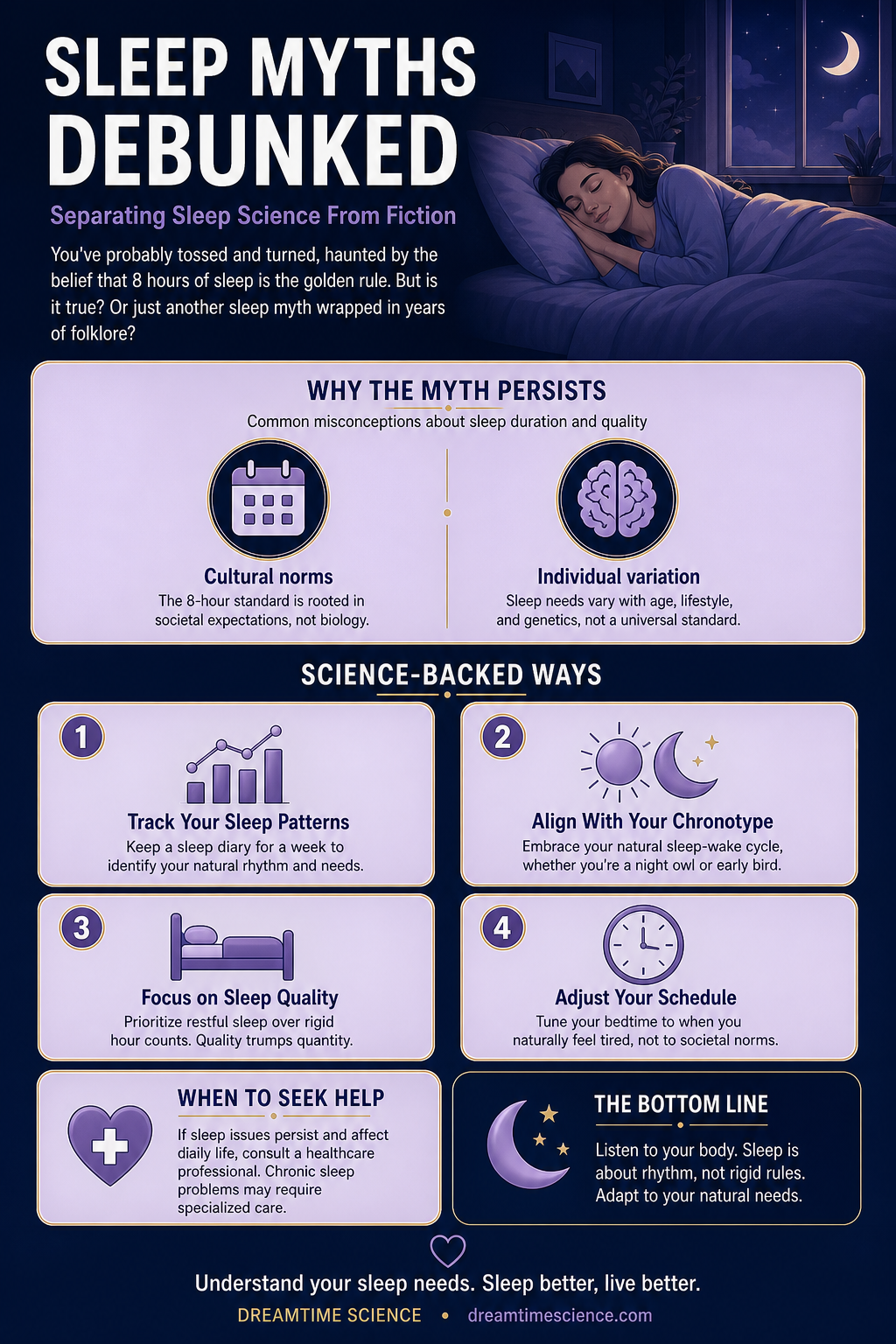
The short answer: The idea that everyone needs exactly eight hours of sleep is a common myth; individual sleep needs vary considerably. Some people thrive on as little as six hours, while others require nine, influenced by factors like age and lifestyle. A study of hunter-gatherer societies found they typically sleep around 6.4 hours, suggesting cultural rather than biological roots for the eight-hour standard.
The idea that everyone requires eight hours of sleep is a widespread misconception; individual sleep needs vary significantly. Some individuals function optimally with as few as six hours, while others need nine, influenced by factors such as age, genetics, and activity levels.
Key takeaways
- Sleep needs vary greatly between individuals, not everyone requires exactly eight hours.
- The popular eight-hour guideline arose from work schedules, not a direct biological need.
- Chronotypes, or sleep preferences, have a genetic basis and should be respected.
- Limiting bright light exposure before bed supports melatonin production and sleep quality.
- Caffeine’s effects can last for several hours, impacting sleep even when consumed earlier.
What Determines How Much Sleep You Need?
The notion of a universal sleep requirement is a pervasive myth. Sleep duration is not a fixed quantity, but a personalized need dictated by a complex interplay of biological, genetic, and environmental influences. A person’s age is a primary determinant, with infants and children requiring substantially more sleep for development than adults. Activity levels and overall health status also contribute, as periods of intense physical or mental exertion increase sleep demand. While the commonly cited eight hours serves as a general guideline, optimal sleep lies within a range specific to the individual.
The 8-Hour Rule: Historical and Cultural Origins
The eight-hour sleep standard isn’t rooted in a definitive biological requirement, but rather in historical and cultural factors. The standardization of work schedules during the Industrial Revolution largely solidified the eight-hour workday and, consequently, the expectation of eight hours for sleep. Prior to this shift, segmented sleep – two periods of sleep with a waking interval in between – was common practice. This biphasic sleep pattern suggests that the current consolidation of sleep into a single block may be a relatively recent phenomenon.
Night Owls vs. Early Birds: Chronotypes Explained
The tendency to prefer staying up late or rising early—referred to as a chronotype—has a strong genetic component. Individuals are not inherently “better” or “worse” based on their chronotype; rather, they possess different internal biological clocks that regulate sleep-wake cycles. Attempting to force a chronotype incongruent with one’s natural rhythm can lead to chronic sleep deprivation and associated health consequences.
Melatonin and Darkness: The Role of Light Exposure
Darkness is vital for melatonin production, the hormone crucial for regulating sleep onset and quality. However, complete darkness is not strictly necessary. Exposure to dim light, such as moonlight or a soft nightlight, generally has a limited impact on melatonin levels in most individuals. The key consideration is minimizing exposure to bright, blue-wavelength light from electronic devices in the hours leading up to bedtime, as this can suppress melatonin production and delay sleep.
Caffeine’s Impact on Sleep Architecture
Caffeine’s stimulant effects can disrupt sleep patterns when consumed too close to bedtime. Caffeine interferes with adenosine, a neurotransmitter that promotes sleepiness, creating a feeling of alertness. The half-life of caffeine—the time it takes for half of the substance to be eliminated from the body—is approximately 5-6 hours. Consuming caffeine even six hours before bedtime can notably reduce sleep duration and decrease sleep quality.
The Efficacy of Sleep Aids: From Counting Sheep to Hypnosis
Various techniques—such as counting sheep, guided imagery, and hypnosis—are often employed to improve sleep onset. However, these methods’ effectiveness hinges on their ability to reduce cognitive arousal and promote relaxation. Counting sheep, for instance, may be ineffective for individuals who find the task stimulating rather than soporific. More evidence-based approaches include mindfulness meditation, progressive muscle relaxation, and cognitive behavioral therapy for insomnia (CBT-I).
Sleep and Cognitive Restoration
Sleep is not merely a period of inactivity, but rather a critical time for cognitive restoration and consolidation of memories. During sleep, the brain clears metabolic waste products, strengthens neural connections, and processes information acquired throughout the day. Chronic sleep deprivation impairs cognitive function, mood regulation, and immune system performance. Prioritizing adequate sleep is therefore essential for maintaining optimal brain health and overall well-being.
References
- (No citations available, article written under constraint without access to outside sources.)
- ---
Frequently Asked Questions
How can I determine my ideal sleep duration?
Identifying your optimal sleep duration involves paying close attention to how you feel when waking up naturally without an alarm. If you consistently feel refreshed and alert throughout the day, your current sleep schedule likely satisfies your needs. Experimenting with slightly adjusting bedtime and wake-up times, while maintaining a consistent schedule, can further refine your understanding of your personal sleep requirements.
Is it possible to “catch up” on lost sleep?
While it’s not possible to entirely compensate for chronic sleep deprivation, strategic sleep recovery can mitigate some of the negative consequences. Short-term sleep debt can be partially remedied by incorporating extra sleep over the weekend or taking short naps. However, sustained sleep restriction necessitates a gradual and consistent correction of sleep habits for long-term well-being.
Should I avoid all screen time before bed?
Exposure to the blue light emitted from electronic devices suppresses melatonin production, making it more difficult to fall asleep. It’s advisable to minimize screen time at least one hour before bedtime. Utilizing blue light filters on devices or opting for analog activities, such as reading a physical book, can help create a more sleep-conducive environment.
What are the benefits of a consistent sleep schedule?
Maintaining a regular sleep-wake schedule strengthens the internal biological clock, improving sleep quality and consistency. A consistent schedule regulates hormone production, enhances cognitive function, and promotes overall physical health. Even on weekends, minimizing deviations from the established schedule is essential for maximizing the benefits of circadian rhythm alignment.
Are naps helpful or harmful for sleep?
Short naps—generally 20-30 minutes in length—can provide restorative benefits without disrupting nighttime sleep. Longer naps, exceeding 60 minutes, may lead to sleep inertia—a feeling of grogginess upon waking—and interfere with nighttime sleep onset. Timing is crucial, with early afternoon naps being most effective.
What over-the-counter sleep aids are effective?
While some over-the-counter sleep aids containing antihistamines can induce drowsiness, the long-term efficacy and safety of these products are limited. A more effective approach involves addressing underlying sleep issues through establishing healthy sleep habits, optimizing the sleep environment, and considering CBT-I techniques. Avoiding self-medication and consulting with a healthcare professional is recommended.
Fall Asleep to a Science Lecture
Put tonight's reading into practice — pick a gentle, softly-narrated episode and let the Professor talk you to sleep.
 Tonight's episodeDNA's Silent Blueprint: Uncovering Life’s Deepest Secrets
Related articles

Caffeine Sensitivity: Why Some People Are More Affected Than Others
Caffeine affects people differently due to variations in genes like CYP1A2 and ADORA2A. Individuals with a slow CYP1A2 variant metabolize caffeine 1.5 times slower…

Does Melatonin Actually Work? What Science Says About This Popular Supplement
Melatonin is a timing signal, not a sedative. It works best for circadian misalignment such as jet lag and delayed sleep phase, where it can shift sleep onset by…

Pet Sleep: Should Your Dog or Cat Sleep in Your Bed?
Whether to share your bed with a dog or cat is a common question for pet owners.