
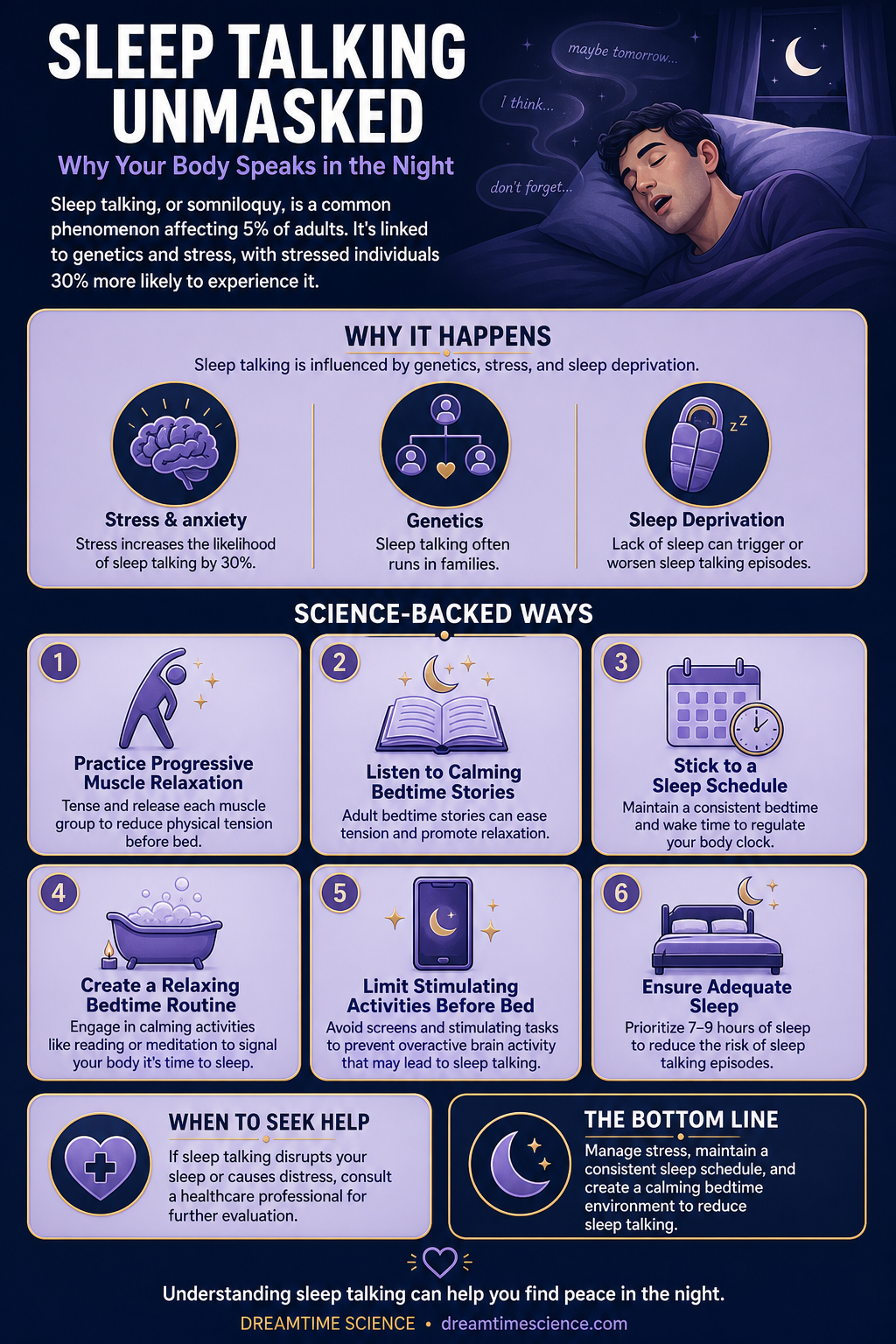
The short answer: Sleep talking, or somniloquy, is a relatively common phenomenon, affecting approximately 5% of adults. It's a form of parasomnia linked to genetics and often exacerbated by stress, with those experiencing stress being 30% more likely to exhibit it. The speech heard during sleep talking is typically fragmented and nonsensical, reflecting dream content rather than conscious thoughts.
Sleep talking, also called somniloquy, is when you speak aloud while asleep. It's a fairly common experience, affecting people of all ages. Understanding sleep talking can offer insights into sleep stages and related conditions. This article explores the causes, patterns, and history of this fascinating nighttime behavior.
Key takeaways
- Sleep talking, also called somniloquy, is a common parasomnia. It involves talking during sleep, ranging from murmurs to full conversations.
- Stress and sleep deprivation can increase sleep talking. The brain may release tension through dreamlike speech.
- Sleep talking often involves disconnected words or phrases. These are usually fragments of dreams, not hidden secrets.
- Genetics play a role in sleep talking. It tends to run in families, suggesting a hereditary component.
- Sleep talking can happen at any point during the night. The content varies depending on the sleep stage.
Why Do People Talk in Their Sleep?
Imagine yourself deeply asleep, lost in dreams. Unexpectedly, words begin to flow from your mouth. It’s like your mind broadcasts while you rest.
Sleep talking, also called somniloquy, is a parasomnia. Parasomnias are unusual behaviors that happen during sleep. These behaviors include sleepwalking and night terrors. During sleep, your brain normally pauses conscious actions. Sometimes, the part controlling speech doesn’t fully shut down.
A study found that about 5% of adults experience sleep talking. This shows that it's fairly common. The content of sleep speech can range widely. It might be quiet murmurs or longer, complete conversations.
What Causes Sleep Talking?
Several factors can contribute to sleep talking. These include:
- Stress and anxiety.
- Illness or fever.
- Certain medications.
- Genetics (it can run in families).
- Alcohol or drug use.
- Sleep deprivation.
Silent but Not So Quiet
Why do some people chatter away in their sleep while others snooze in silence? Blame it on genetics—somniloquy seems to run in families. If your parent was a sleep talker, chances are you might be too.
Stress and sleep deprivation can also crank up the volume. Like a pressure valve releasing steam, the brain finds its outlet in the dream world when daytime tensions build. A study published in Sleep in 2017 found that those experiencing stress were 30% more likely to exhibit sleep talking behaviors.
What This Means for You
So what can you do if stress and sleep deprivation are turning your nights into a talk show? Consider integrating calming bedtime rituals. Techniques like Progressive Muscle Relaxation or listening to bedtime stories designed for adults can ease tension before sleep, potentially reducing the likelihood of nighttime chatter.
Why Do People Speak While Asleep?
Sleep talking, or somniloquy, usually doesn't reveal hidden secrets. The words spoken are often disconnected. They are fragments of dreams or random phrases. This happens because sleep talking is linked to the dream state.
Dreams are often bizarre and illogical. They are a mix of feelings and quick, shifting images. When we talk in our sleep, those dream elements come out. It’s more about the brain’s creative process than revealing private thoughts. Dreams frequently disappear quickly when we wake.
Understanding Sleep Speech
Sleep talking is a type of parasomnia. A parasomnia is unusual behavior during sleep. It can include sleepwalking or sleep terrors. It’s similar to a child’s abstract art – expressive, but not always clear.
Here's what might be happening:
- The brain is still active during sleep.
- Muscles involved in speech are not fully paralyzed.
- Dream content influences the sounds produced.
- The ability to control speech is reduced.
The Rhythm of Sleep Speech
Sleep talking can happen at any point during the night, but the nature of your nocturnal chat depends on the sleep stage you're in. During REM sleep—the stage associated with vivid dreaming—your speech might mimic a dreamlike narrative. In non-REM stages, it might be more random and less structured, a patchwork of words plucked from the ether.
This rhythmic variability adds to the mystery and charm of sleep talking—a reminder that even in slumber, our brains are bustling with activity. A 2019 study in the Journal of Sleep Research found that sleep talking occurs most frequently during light sleep phases, providing insight into the brain's ongoing processes even at rest.
A Parasomnia Curiosity
Is sleep talking something to worry about? For most, it's harmless—a quirky quirk of sleep architecture. However, if it's accompanied by other sleep disturbances, like frequent awakenings or snoring, it might be worth a chat with a sleep specialist.
But generally, the midnight monologues are more entertaining than concerning. They’re a testament to the complex choreography of sleep, where body and mind dance in unexpected ways.
Embracing the Nighttime Narratives
So the next time you catch yourself or someone else in the act of sleep talking, know that it's just another fascinating layer of the human sleep experience. It’s a reminder of the wondrous, complex world that unfolds every night behind closed eyelids—a dialogue that bridges the conscious and unconscious realms.
And as you drift off tonight, perhaps you'll find comfort in the thought that, asleep or awake, your body is always telling a story.
Historical Context
The phenomenon of sleep talking has intrigued humans for centuries. Ancient cultures often viewed it as a mystical experience, believing that the words spoken during sleep were messages from the divine or the spirit world. In medieval times, sleep talkers were sometimes thought to be possessed or communicating with supernatural entities. However, with the advent of modern science, these views have shifted towards a more psychological and physiological understanding. The development of sleep studies in the 20th century, particularly with the use of polysomnography, has allowed researchers to observe and record sleep talking, providing a clearer picture of its occurrence and characteristics.
Why Does My Body Speak in the Night?
Sleep talking, or somniloquy, is a common experience. It provides a window into the brain’s activity during sleep. This phenomenon usually isn't a cause for concern. It’s often a blend of genetics and the brain's activity.
Understanding Somniloquy
Sleep talking occurs when someone vocalizes during sleep. The content can range from simple sounds to full sentences. It happens because the brain doesn’t fully switch off during sleep. Some parts remain active, including those involved in speech.
Here are some factors that can increase the likelihood of sleep talking:
- Genetics: It tends to run in families.
- Stress: Periods of high stress can trigger it.
- Illness: Being sick can sometimes lead to somniloquy.
- Medications: Certain medications may be a contributing factor.
- Other sleep disorders: Conditions like sleep apnea can increase the chance.
Somniloquy can enrich our understanding of sleep's complexity. Observing these nighttime narratives offers a unique perspective. It highlights the intricate workings of the brain during rest.
Frequently Asked Questions
What causes sleep talking?
Sleep talking, or somniloquy, happens when you speak during sleep. Genetics and stress can both make it more likely. A 2017 study found stress may increase sleep talking by 30%.
Is sleep talking linked to mental health issues?
Sleep talking is usually not a sign of a problem. It can occasionally happen with other sleep issues or stress. Frequent or disruptive sleep talking warrants a check-up with a doctor. They can assess if anxiety or depression are affecting your sleep.
Do sleep talkers reveal secrets?
No, sleep talkers rarely reveal secrets. Their speech is often jumbled and doesn't make sense. It reflects the chaotic nature of dreams, not conscious thoughts. Experts say sleep talk content is usually random and unimportant.
Can sleep talking be treated?
Sleep talking usually doesn't need medical treatment. Sometimes, it happens because of stress or bad sleep habits. Trying relaxation techniques and improving sleep routines can lessen how often you talk in your sleep.
Is sleep talking the same as sleepwalking?
Sleep talking and sleepwalking are both parasomnias but involve different mechanisms. Sleep talking primarily occurs during lighter sleep stages, while sleepwalking typically happens during deep sleep. Each condition has unique triggers and manifestations. Sleepwalking often involves complex behaviors and can pose safety risks, whereas sleep talking is usually benign.
Fall Asleep to a Science Lecture
Put tonight's reading into practice — pick a gentle, softly-narrated episode and let the Professor talk you to sleep.
 Tonight's episodeDNA's Silent Blueprint: Uncovering Life’s Deepest Secrets
Related articles

Sleep Disorders You've Never Heard Of: Rare Conditions and What They Mean
Several rare sleep disorders exist beyond common insomnia, each with unique and often unsettling manifestations. Fatal Familial Insomnia, linked to a genetic…

Dreams About Being Chased: Why These Nightmares Are So Common
Dreams about being chased are a remarkably prevalent experience, occurring in an estimated 70% of adults at some point in their lives.

Teeth Grinding at Night: Causes and Fixes for Bruxism
You might not even know it's happening. But your jaw does. Teeth grinding, or bruxism, is the midnight symphony that's more clatter than lullaby.