← Back to Articles
Sleep Science

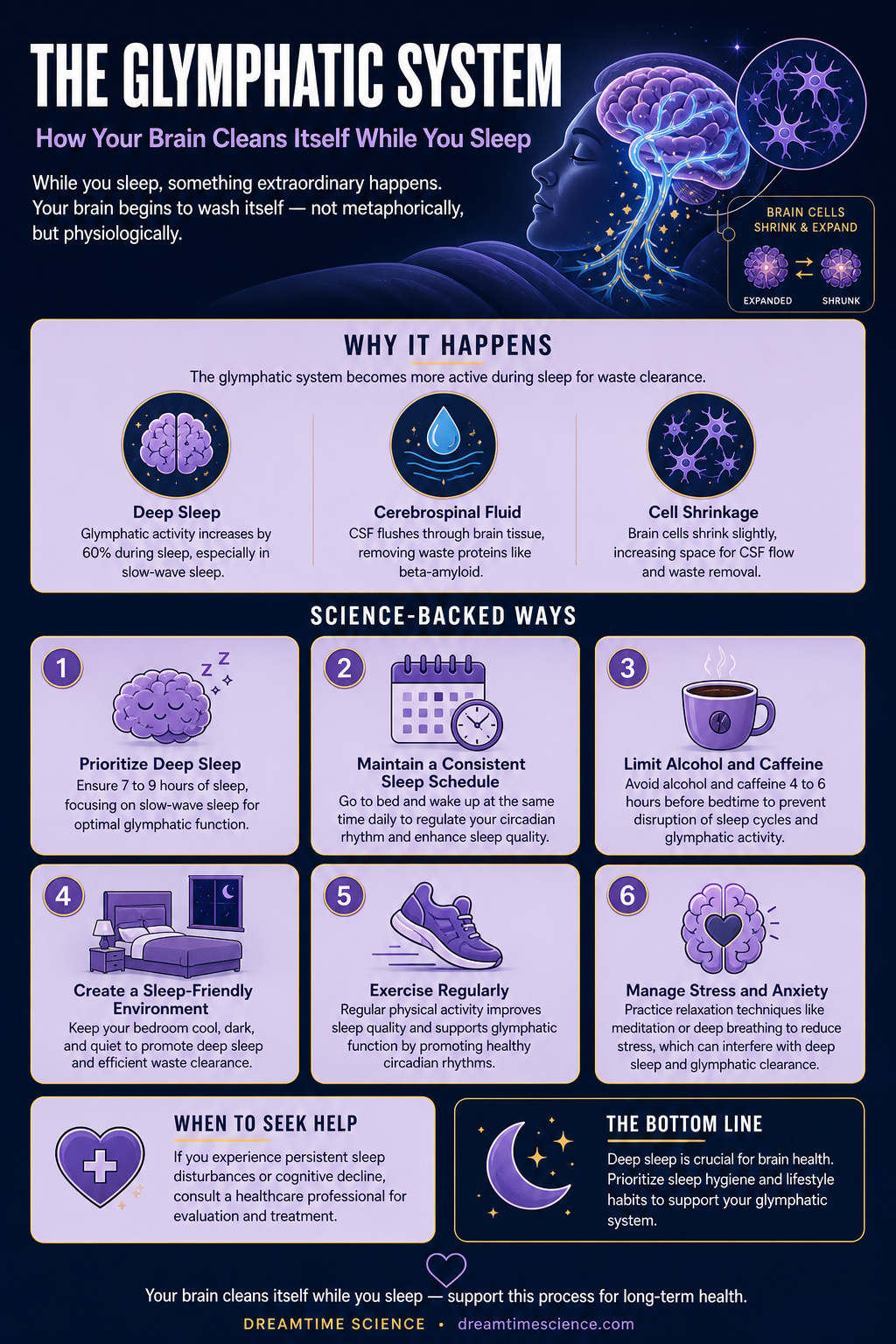
The short answer: The glymphatic system is your brain's waste-clearance network that activates primarily during deep sleep. Cerebrospinal fluid flushes through brain tissue along channels surrounding blood vessels, removing metabolic waste including beta-amyloid, the protein linked to Alzheimer's disease. Glymphatic activity increases by 60% during sleep compared to wakefulness, making deep sleep essential for long-term brain health.
While you sleep, something extraordinary happens.
Your brain begins to wash itself.
Not metaphorically. Physiologically.
The glymphatic system — a remarkable waste-clearing network discovered in the last decade — becomes significantly more active during sleep. This might be one of the most crucial biological reasons we need deep rest. Understanding this system not only illuminates the mysteries of sleep but also reveals how our brains maintain health and function. Let's explore how your brain cleans itself while you sleep.
Key takeaways
- Prioritizing good sleep hygiene can optimize your brain's natural waste-clearing processes.
- During deep sleep, brain cells shrink, allowing cerebrospinal fluid to flow more freely.
- The glymphatic system clears beta-amyloid and tau proteins linked to neurodegenerative diseases.
- Sleep is not passive shutdown, but an active period of restoration and neural renewal.
- Fragmented or shortened deep sleep may reduce the brain’s ability to effectively clear waste.
What Is the Glymphatic System?
The glymphatic system is a fluid transport pathway that clears metabolic waste from the brain. It was identified in 2012 by researchers at the University of Rochester Medical Center. This system is akin to the lymphatic system found throughout the rest of the body but is unique to the brain. Unlike other parts of the body, the brain doesn't have a conventional lymphatic drainage system. Instead, it relies on cerebrospinal fluid (CSF) flowing through brain tissue to remove waste proteins such as beta-amyloid and tau proteins, which are associated with neurodegenerative diseases like Alzheimer's.
According to a 2013 study published in Science Translational Medicine, the glymphatic system is primarily active during sleep, particularly during slow-wave sleep, when the brain is most efficient at clearing waste. This nocturnal activity is vital for preventing the buildup of toxic substances that can impair brain function.
What Happens During Deep Sleep?
During slow-wave (deep) sleep, several fascinating biological processes occur:
-
Brain Cells Shrink Slightly: This shrinkage increases the space between cells, allowing CSF to flow more freely and clear waste more effectively.
-
Spaces Between Cells Expand: The expansion of interstitial space facilitates the movement of CSF, enhancing the clearance process.
-
Enhanced CSF Flow: The increased flow of CSF during deep sleep contributes to a significant rise in waste clearance efficiency.
Research published in Science in 2013 found that glymphatic activity is notably higher during sleep compared to wakefulness. The brain literally changes its structure to facilitate cleaning. Isn't it astonishing that your mind reorganizes itself physically each night?
What This Means for You
Understanding the glymphatic system underscores the importance of prioritizing good sleep hygiene. Practices such as maintaining a consistent sleep schedule, creating a restful environment, and managing stress can enhance deep sleep quality, optimizing your brain's natural cleaning processes. For more tips on improving sleep, see our article 7 Science-Backed Ways to Beat Insomnia Tonight.
What Does the Glymphatic System Remove?
The glymphatic system helps clear:
-
Beta-Amyloid Proteins: Accumulation of these proteins is linked to Alzheimer's disease.
-
Tau Proteins: These proteins are associated with several neurodegenerative disorders, including tauopathies.
-
Metabolic Byproducts: Everyday brain activity generates waste that needs to be cleared to maintain cognitive function.
These substances accumulate during wakefulness, and sleep allows for their removal. Chronic sleep restriction may impair this process, potentially leading to cognitive deficits and increasing the risk of neurodegenerative diseases. This connects to Sleep Deprivation's Impact on Memory, Learning, and Your Immune System, as sleep supports not just cognition, but also neural housekeeping.
Why Deep Sleep Matters Most
Glymphatic activity appears to be strongest during slow-wave sleep, which is also when the brain's memory consolidation processes are most active. A 2019 study published in Nature Communications emphasized the critical role of deep sleep in supporting both waste clearance and memory function.
Fragmented sleep or shortened deep sleep may reduce optimal clearance. Environmental factors such as temperature, darkness, and sound significantly influence deep sleep quality. Cooler temperatures and stable, dark conditions are known to support slow-wave cycles, as discussed in our article Temperature, Darkness, and Sound: The Ideal Sleep Environment (By the Numbers).
The Bigger Picture
The glymphatic system is still being extensively studied, but it reinforces a powerful truth: sleep is not passive shutdown; it is active restoration. Your brain is busy at night performing a symphony of tasks:
-
Reorganizing Memory (REM Sleep): Memory consolidation occurs during rapid eye movement sleep.
-
Repairing Tissue (Deep Sleep): Tissue repair and growth happen most effectively during deep sleep stages.
-
Regulating Emotion: Sleep plays a critical role in emotional regulation and mental health.
-
Clearing Waste: This is where the glymphatic system shines, ensuring your brain remains clear of harmful waste.
For more on the significance of sleep stages, see REM Sleep Explained: Why This Stage Matters Most.
Conclusion: Nightly Neural Renewal
The glymphatic system reveals something quietly profound: while you rest, your brain cleans, clears, and recalibrates. Each night is maintenance. Each deep cycle is renewal. Sleep is not wasted time. It is biological preservation. And perhaps that knowledge alone makes rest feel a little more meaningful.
Want to experience these sleep science concepts with our soothing narration and ambient soundscapes? Check out our latest video on YouTube @dreamtimescience.
Frequently Asked Questions
Does the glymphatic system work during naps?
Some glymphatic activity likely occurs during naps, especially if the nap includes deeper stages of sleep. However, nighttime sleep provides the most comprehensive waste clearance.
Can poor sleep increase toxin buildup?
Yes, chronic sleep restriction may reduce optimal waste clearance, leading to an accumulation of toxins that can impair cognitive function and increase the risk of neurodegenerative diseases.
Is this related to dementia?
Yes, the accumulation of beta-amyloid and tau proteins, which the glymphatic system helps clear, is associated with neurodegenerative conditions like Alzheimer's disease. However, sleep is only one factor in dementia risk.
How can I support glymphatic function?
Prioritize deep sleep through consistent sleep schedules, a comfortable sleep environment, and stress management techniques. Consider exploring our article on Cognitive Behavioral Therapy for Insomnia (CBT-I): Evidence-Based Sleep Fixes for additional strategies.
Is this proven science?
Yes, the existence and function of the glymphatic system are well-supported by research, though the field is continually evolving as imaging techniques and scientific understanding improve.
Tonight's Listening
 Tonight's episodeHow Gravity Can Bend Time: The Cosmic Clock Puzzle
Fall Asleep to a Science Lecture
Put tonight's reading into practice — pick a gentle, softly-narrated episode and let the Professor talk you to sleep.
Tonight's episodeHow Gravity Can Bend Time: The Cosmic Clock Puzzle
Related articles

Sleep, Mind & Mood
The History of Sleep Science: From Freud to Modern Brain Imaging
Sleep science began with Freud's dream interpretation in 1899, but the field transformed in 1953 when Aserinsky and Kleitman discovered REM sleep using…

Food, Body & Health
Sleep and Heart Health: How Rest Protects Your Cardiovascular System
Insufficient sleep significantly impacts cardiovascular health. Individuals with chronic insomnia face a 45% increased risk of cardiovascular diseases, while…

Food, Body & Health
Sleep and the Immune System: How Rest Protects Your Health
Lack of sleep significantly weakens the immune system, making you more susceptible to illness. Individuals getting less than six hours of sleep per night are four…