
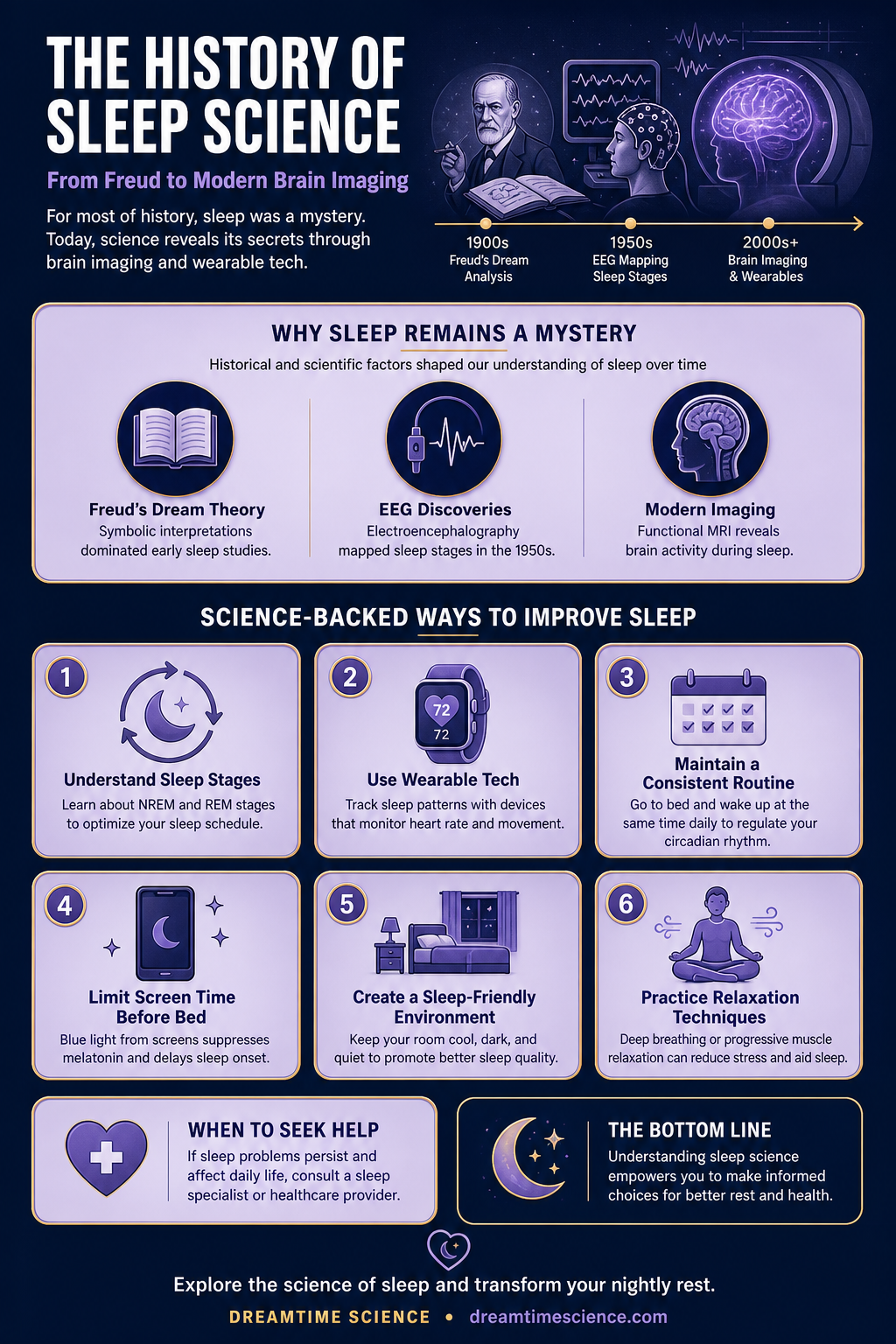
The short answer: Sleep science began with Freud's dream interpretation in 1899, but the field transformed in 1953 when Aserinsky and Kleitman discovered REM sleep using electroencephalography. The 1960s-80s mapped the full sleep architecture of NREM stages, and the 2010s brought the discovery of the glymphatic system. Today, wearable technology and AI-powered analysis are opening new frontiers in understanding individual sleep patterns.
For most of history, sleep was a realm shrouded in mystery. It was sacred, symbolic, and unmeasured—a nightly voyage into the unknown. Only in the last century have we begun to observe it scientifically, peeling back the layers of myth and symbolism. The history of sleep science is a tale of transformation, moving from dream interpretation to electrical recordings and, finally, to real-time brain imaging.
Key takeaways
- Sigmund Freud’s work initially sparked widespread interest in the scientific study of dreams and sleep.
- The discovery of REM sleep in 1953 fundamentally changed sleep research by focusing on physiological measurements.
- EEG technology enabled the categorization of distinct sleep stages, aiding in diagnosing sleep disorders.
- Sleep medicine emerged as a recognized specialty, leading to the development of treatments for sleep apnea and insomnia.
- Modern brain imaging techniques reveal intricate processes like brain waste clearance during sleep.
Sigmund Freud: Dreams as Wish Fulfillment
In 1900, Sigmund Freud published "The Interpretation of Dreams," proposing that dreams were the disguised expressions of unconscious desires. While many of Freud’s theories lack empirical support and are often considered speculative, his work was pivotal in placing dreams at the center of psychological inquiry. According to a 1999 analysis by the American Psychological Association, Freud's theories ignited widespread interest in the scientific study of dreams and sleep, making these subjects a topic of serious academic discourse.
The Discovery of REM Sleep
The scientific landscape of sleep research took a dramatic turn in 1953 with the discovery of Rapid Eye Movement (REM) sleep by researchers Eugene Aserinsky and Nathaniel Kleitman at the University of Chicago. They observed rapid eye movements, distinct EEG patterns, and muscle atonia, all of which were associated with dream reporting upon awakening. This discovery shifted the focus of sleep research from symbolic analysis to physiological measurement. As we explored in REM Sleep Explained: Why This Stage Matters Most, this breakthrough led to the mapping of sleep stages and the definition of sleep cycles, fundamentally changing our understanding of sleep.
EEG and the Mapping of Sleep Stages
The advent of electroencephalography (EEG) allowed researchers to categorize various sleep stages: N1 (light sleep), N2, N3 (deep sleep), and REM sleep. Institutions like Stanford University advanced sleep lab research, establishing modern classification systems that quantified sleep. According to a 2015 study published in the journal "Nature and Science of Sleep," these classifications helped in diagnosing sleep disorders and understanding the sleep architecture across different ages, as further elaborated in Sleep Architecture Across Your Lifespan: How Sleep Changes as You Age.
The Rise of Sleep Medicine
By the late 20th century, sleep medicine emerged as a recognized specialty. Sleep apnea was identified and treated, insomnia research expanded, and circadian rhythm disorders were categorized. Professional bodies like the American Academy of Sleep Medicine formalized diagnostic criteria, making sleep medicine a vital component of healthcare. According to a 2006 review in the "Journal of Clinical Sleep Medicine," the establishment of these criteria was crucial for the effective treatment of sleep disorders, as explored in Cognitive Behavioral Therapy for Insomnia (CBT-I): Evidence-Based Sleep Fixes.
Modern Brain Imaging
Today, functional MRI (fMRI) and advanced imaging technologies allow researchers to observe the brain's intricate dance during sleep. These tools enable the study of glymphatic flow, memory reactivation, and emotional processing during REM sleep. A 2013 study in "Science" demonstrated the importance of sleep in clearing brain metabolic waste via the glymphatic system, a topic we delve into in The Glymphatic System: How Your Brain Cleans Itself While You Sleep. Modern neuroscience continues to ask profound questions: Which brain regions activate during sleep? Which neurotransmitters fluctuate? How does sleep restore cognition? These questions highlight the shift from symbolic interpretations to measurable phenomena.
What This Means for You
Understanding the history of sleep science isn't just an academic exercise; it has practical implications for improving sleep quality and overall health. The discoveries of sleep stages and cycles, for example, have led to effective interventions for insomnia and other sleep disorders. Recognizing the role of REM sleep in emotional processing and memory consolidation can help you appreciate the necessity of a full night's sleep. For actionable advice on improving sleep, see 7 Science-Backed Ways to Beat Insomnia Tonight.
Conclusion: The Ongoing Exploration of Night
Sleep science began with interpretation, moved to electrodes, then imaging, and now delves into fluid dynamics and neural networks. What was once mystical is now measurable, yet the wonder of sleep remains. Every night, as consciousness fades, we embark on a journey into a quiet mystery that science continues to explore.
Want to experience these sleep science concepts with our soothing narration and ambient soundscapes? Check out our latest video on YouTube @dreamtimescience.
Frequently Asked Questions
When did sleep research become scientific?
Sleep research became more scientific in the mid-20th century with the discovery of REM sleep and the development of EEG technology. This allowed for the physiological study of sleep, moving beyond purely psychological interpretations.
Was Freud wrong in his theories?
Many of Freud's theories lack empirical support, but they were instrumental in bringing psychological discourse to dreams and sleep. His work laid the groundwork for future scientific exploration, even if the specifics of his theories are no longer widely accepted.
Is sleep science still evolving?
Yes, sleep science continues to evolve, particularly in areas like glymphatic research and memory consolidation. New technologies like fMRI are opening up possibilities for understanding how sleep affects long-term brain health.
Are dreams still studied psychologically?
Yes, dreams are still studied within neuroscientific frameworks, focusing on their physiological and psychological significance. This includes understanding the role of REM sleep in emotional processing and memory, as discussed in Why Do We Dream? The Science Behind Your Nighttime Adventures.
What’s the next frontier in sleep science?
The next frontier in sleep science involves understanding how sleep influences long-term brain health and the prevention of neurodegenerative diseases. Researchers are also exploring how sleep quality can be optimized to enhance cognitive function and emotional well-being.
Fall Asleep to a Science Lecture
Put tonight's reading into practice — pick a gentle, softly-narrated episode and let the Professor talk you to sleep.
 Tonight's episodeHow Gravity Can Bend Time: The Cosmic Clock Puzzle
Related articles
The Glymphatic System: How Your Brain Cleans Itself While You Sleep
The glymphatic system is your brain's waste-clearance network that activates primarily during deep sleep. Cerebrospinal fluid flushes through brain tissue along…

Famous Scientists’ Sleep Habits: Da Vinci, Einstein, and Others
History's greatest scientists had wildly different sleep habits. Einstein slept 10 hours nightly plus daytime naps. Da Vinci reportedly used polyphasic sleep in…

Sleep in Nature vs. Urban Environments: A Scientific Comparison
People sleep an average of 20 minutes longer and experience 18% more deep sleep in natural environments compared to urban settings. Reduced artificial light, lower…