← Back to Articles
Dreams

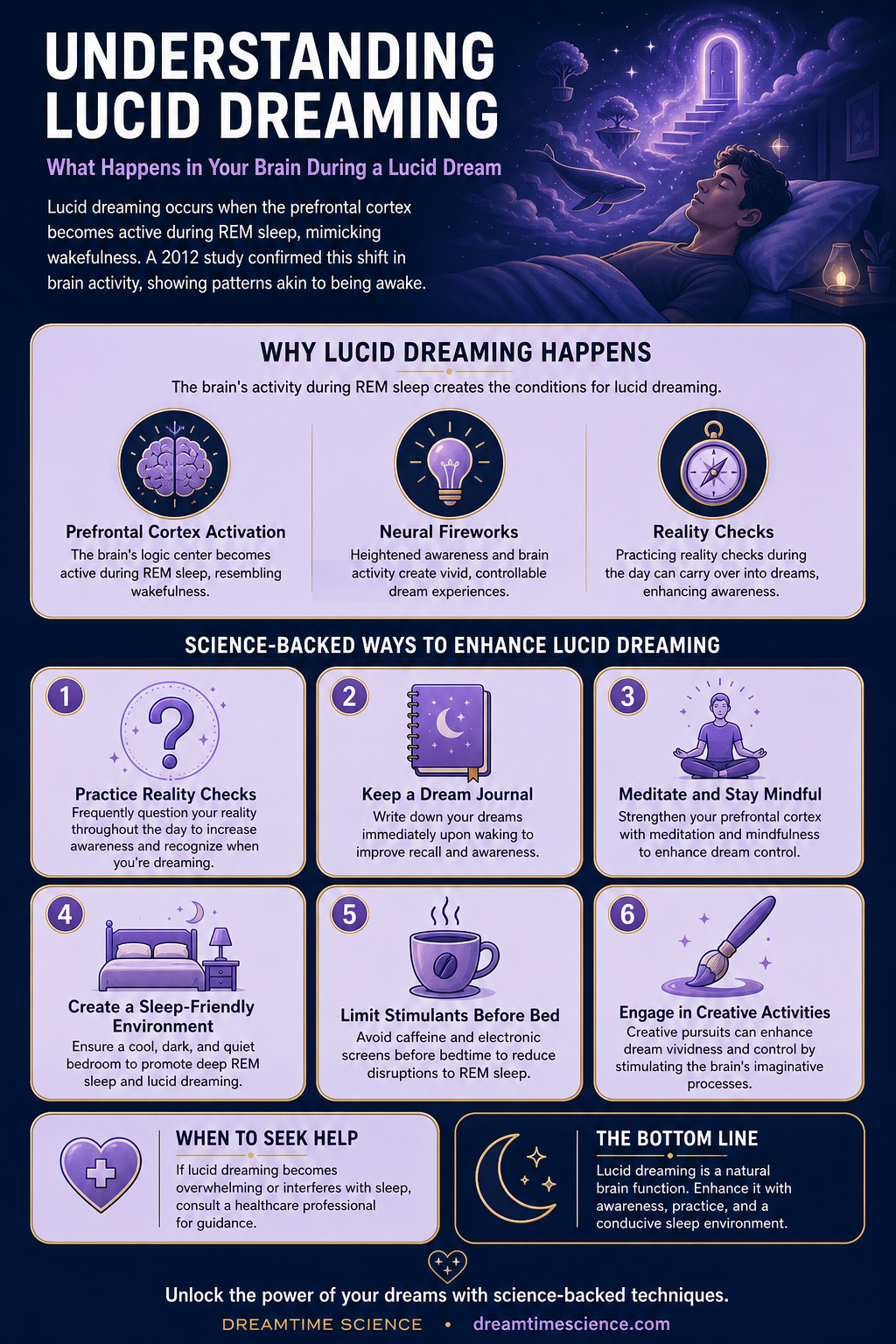
The short answer: Lucid dreaming occurs when the prefrontal cortex, responsible for logic and self-reflection, becomes highly active during REM sleep, resembling wakefulness. A 2012 study in *Nature Neuroscience* confirmed this shift in brain activity, demonstrating patterns akin to being awake. By practicing techniques like meditation and reality checks, individuals can harness this state to explore their subconscious, rehearse skills, and potentially enhance creativity.
Ever been the star of your own nighttime movie, fully aware you're dreaming? If so, you've dipped into the surreal world of lucid dreaming. Lying there, in a realm where the usual rules are suspended, you pilot your own dream like a director on a surrealist set. But what does this mean for your brain? That's where things get fascinating.
Key takeaways
- Lucid dreaming involves heightened brain activity, particularly in the prefrontal cortex, which handles logic and self-reflection.
- During lucid dreams, your brain exhibits electrical activity patterns similar to wakefulness, while your body remains in REM sleep paralysis.
- Engaging in practices like meditation and mindfulness can strengthen the prefrontal cortex and enhance dream awareness.
- Lucid dreaming allows you to manipulate dream scenarios, offering opportunities for skill practice and creative problem-solving.
- Experienced lucid dreamers show increased activity in the precuneus, a brain region associated with self-reflection and agency.
Navigating the Dreamscape
In the depths of sleep, your brain is anything but quiet. When you experience a lucid dream, it's like your mind flips a switch. Suddenly, you're the captain of your own slumber ship, navigating the waters of your subconscious with clarity and control.
Lucid dreaming brain activity is a dance of neural fireworks. Unlike the dreamy haze of normal REM (Rapid Eye Movement) sleep, lucidity comes with heightened awareness. The prefrontal cortex, your brain’s seat of logic and self-reflection, lights up like a city skyline at night. Isn't that curious?
What This Means for You
Understanding the role of the prefrontal cortex in lucid dreaming can help you nurture your dream control. Engage in activities that strengthen this brain region, like meditation and mindfulness, to enhance your awareness both awake and asleep.
Awake, Yet Asleep
In a lucid dream, you're awake in a way. Your conscious mind clicks on, even as your body remains wrapped in the gentle paralysis of REM sleep. It's not fantasy—it's science. A 2012 study in Nature Neuroscience revealed that during lucid dreams, the brain's electrical activity shifts, resembling the patterns of wakefulness.
Neuroscience lucid dreams are a paradox. Your brain thinks it’s awake, yet the body remains in deep slumber, muscles switched off as if nature’s dimmer switch has been flicked all the way down. The experience is like straddling two worlds, with your mind the only bridge. It’s a delicate dance.
The Role of REM Sleep
REM sleep is essential for dreaming and memory consolidation. During this stage, your brain is highly active, akin to being awake, yet your body is in a state of atonia—a temporary paralysis that prevents you from acting out your dreams. As we explored in REM Sleep Explained, this stage is crucial for emotional processing and creativity.
Perception and Reality
Awareness in dreams blurs the line between perception and reality. Have you ever tasted a chocolate cake in a dream? Felt the sun on your skin, or the cool breeze of a sea you’ve never seen? That’s your brain, painting vivid pictures on the canvas of your closed eyelids.
This heightened sensory experience is your brain’s doing, creating a surrogate reality with the tools at hand. The sensory areas spark to life, making the unreal feel uncannily real. The brain is quite the artist.
What This Means for You
Harnessing the power of lucid dreaming can enhance your waking life. Use dreams to practice skills, rehearse challenging scenarios, or explore creative solutions to problems. This practice can boost confidence and creativity, as discussed in Sleep and Creativity: How Dreams Unlock Creative Problem-Solving.
The Power of Intention
Ever heard the phrase, “You create your own reality”? In lucid dreaming, this idea takes on new meaning. Intent plays a major role. When you realize you’re dreaming, you can steer the narrative, deciding to fly, to speak with imaginary characters, or explore fantastical landscapes.
Your intention actually changes brain activity. The prefrontal cortex, associated with complex cognitive behavior and decision-making, hums with activity, allowing you to manipulate your dream world with precision. It's mind-bending.
The Science of the Impossible
To imagine is human, but to control dreams? That’s a leap for many. Lucid dreaming remains a frontier, where science meets the edges of imagination. A 2014 study in the Journal of Neuroscience found that experienced lucid dreamers show increased activity in the precuneus, a brain region linked to self-reflection and agency.
In this state, your brain’s activity echoes waking life. Yet, it’s a form of consciousness that transcends everyday limits, making the impossible possible. Your mind becomes the stage, and every neuron plays its part. The implications are profound.
Unlocking Potential
The potential of lucid dreaming extends beyond entertainment. Cognitive behavioral techniques, creativity enhancement, problem-solving skills—a dream can be a laboratory for life’s challenges. Athletes practice their craft, artists explore new visions, and some find solace in facing their fears.
Your brain isn’t just dreaming; it’s training, healing, and creating new pathways. It’s as if you’re holding the controls to a simulator of your own making, tailoring experiences to your desires. The power is in your grasp.
Practical Steps for Lucid Dreaming
- Reality Checks: Frequently question your reality throughout the day. This habit can carry over into your dreams, helping you recognize when you're dreaming.
- Dream Journals: Keep a journal by your bed and write down your dreams as soon as you wake up. This practice improves dream recall and enhances awareness.
- Meditation and Mindfulness: These practices strengthen your prefrontal cortex, improving your ability to recognize and control your dreams.
Awakening to Awareness
As you slip between the sheets tonight, consider the extraordinary realm of lucid dreaming. A realm where your brain defies the ordinary boundaries of sleep, offering a playground for consciousness. Whether you dip in occasionally or often, know that each dream holds the potential for exploration and insight.
In this landscape, understanding the science behind lucid dreaming illuminates the path. Your brain, a master of both the known and the unknown, dances across the night, crafting stories only you can imagine. And when morning comes, you awaken, aware of the magic within.
Conclusion
Lucid dreaming offers a unique insight into the workings of the conscious brain. It blurs the line between reality and imagination, providing a playground for the mind. Whether used for entertainment or self-improvement, the potential is vast. As you explore this surreal realm, remember: each dream is an opportunity for growth and discovery.
Want to experience these sleep science concepts with our soothing narration and ambient soundscapes? Check out our latest video on YouTube @dreamtimescience.
Frequently Asked Questions
What triggers a lucid dream?
Lucid dreams can be triggered by various techniques such as reality checks, dream journaling, and meditation. These practices enhance self-awareness, making it easier to recognize when you're dreaming.
Is lucid dreaming scientifically proven?
Yes, lucid dreaming is a scientifically recognized phenomenon. Studies, such as the one from Nature Neuroscience in 2012, have identified distinct brain activity patterns in lucid dreamers, confirming its existence.
Can everyone learn to lucid dream?
While some people naturally experience lucid dreams, others can learn through practice. Techniques like reality checks and maintaining a dream journal can increase the likelihood of having lucid dreams.
Are there any risks associated with lucid dreaming?
Lucid dreaming is generally safe. However, some individuals may experience sleep disturbances or heightened anxiety if they struggle to distinguish dreams from reality. It's important to approach lucid dreaming with a balanced mindset.
Can lucid dreaming be used for therapy?
Yes, lucid dreaming has therapeutic potential. It can help individuals confront and overcome nightmares, improve problem-solving skills, and foster creativity, as detailed in studies and articles like Cognitive Behavioral Therapy for Insomnia (CBT-I).
Tonight's Listening
 Tonight's episodeHow Gravity Can Bend Time: The Cosmic Clock Puzzle
Fall Asleep to a Science Lecture
Put tonight's reading into practice — pick a gentle, softly-narrated episode and let the Professor talk you to sleep.
Tonight's episodeHow Gravity Can Bend Time: The Cosmic Clock Puzzle
Related articles

Dreams & Nightmares
Lucid Dreaming: Can You Really Control Your Dreams? (With Science)
Lucid dreaming is a scientifically verified state where the dreamer becomes aware they are dreaming and can exert partial control over the dream narrative. Brain…

Dreams & Nightmares
Lucid Dream Benefits: What You Can Actually Accomplish in Lucid Dreams
Lucid dreaming offers a unique opportunity to boost creativity, confront fears, and even improve skill performance. Regularly practicing lucid dreaming can reduce…

Dreams & Nightmares
Sleep and Creativity: How Dreams Unlock Creative Problem-Solving
Dreams facilitate creative problem-solving by allowing the brain to forge connections and process emotions while we sleep. A 2012 study found individuals experiencing…