
The short answer: Meditation offers a powerful, accessible tool for improving sleep quality by calming mental chatter and promoting relaxation. A 2015 study showed mindfulness meditation significantly improved sleep in older adults with sleep disturbances, reducing insomnia and fatigue. Simple techniques, like focusing on breath or using guided meditations for even just five minutes nightly, can help normalize melatonin levels and ease the transition to restful sleep.
Meditation offers a non-pharmacological approach to improving sleep quality by reducing mental activity and cultivating relaxation. A 2015 study demonstrated significant improvements in sleep quality with mindfulness meditation in older adults experiencing sleep disturbances [8]. Techniques utilizing focused attention, such as breath awareness or guided imagery, can facilitate the normalization of physiological processes conducive to sleep.
Key takeaways
- Mindfulness meditation can reduce cortisol levels, easing the body’s stress response.
- Regular meditation increases alpha and theta brainwaves, promoting relaxation and calmness.
- Meditation may improve slow-wave sleep, the deepest and most restorative sleep stage.
- Meditation can lessen wakefulness during the night, leading to longer sleep duration.
- Breath awareness and body scan meditations are useful techniques for better sleep.
The Physiological Mechanisms of Meditation for Sleep
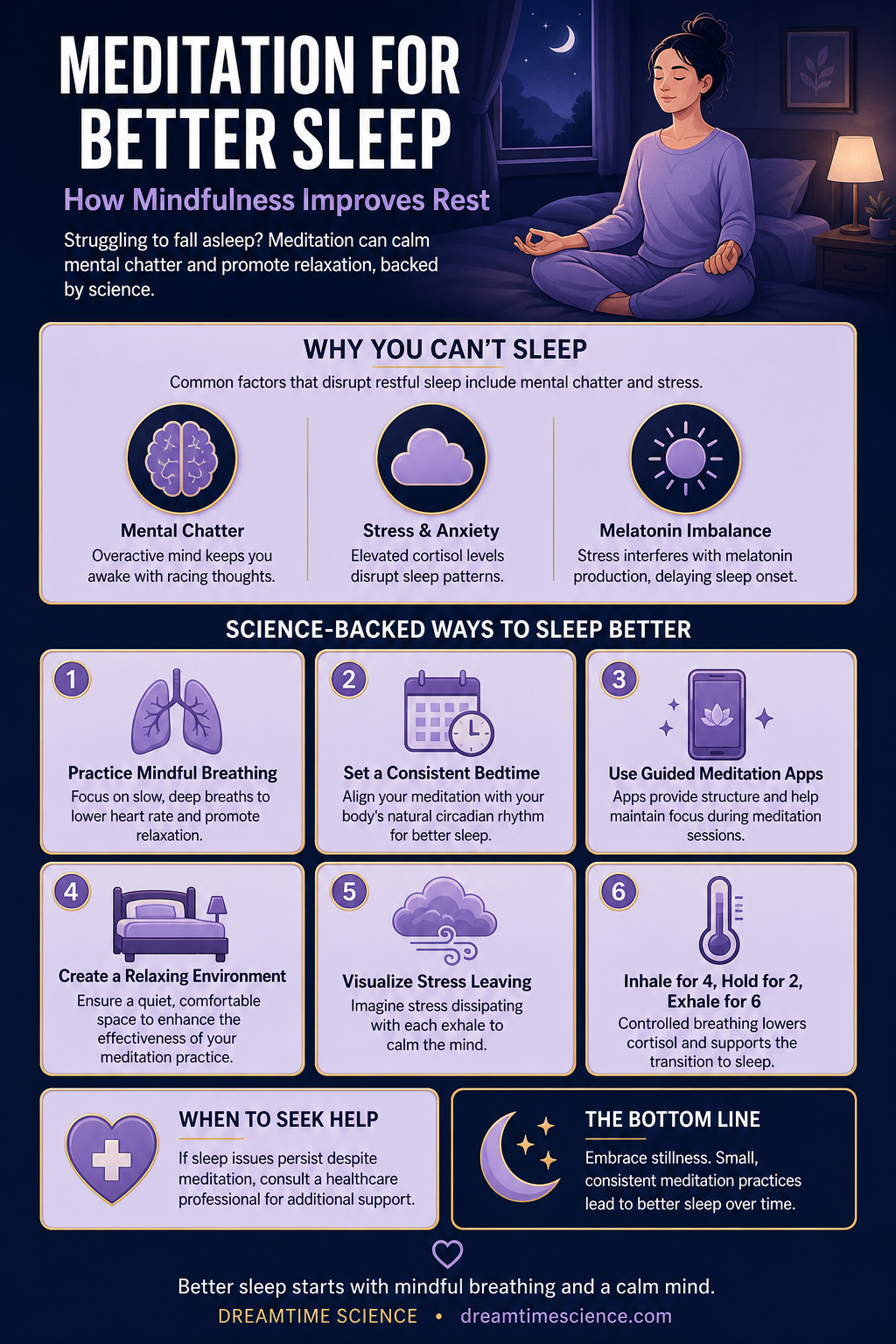
Meditation is not merely a relaxation technique; it initiates specific changes in brain activity and autonomic nervous system function that directly support sleep onset and maintenance. Core to these effects is the modulation of the hypothalamic-pituitary-adrenal (HPA) axis, the central stress response system. Chronic stress leads to HPA axis dysregulation, elevating cortisol levels and impairing sleep [3]. Mindfulness meditation has been shown to reduce cortisol secretion, promoting a shift toward parasympathetic nervous system dominance – the “rest and digest” state – which is essential for sleep [1, 7]. This reduction in physiological arousal creates a more favorable internal environment for sleep initiation.
How Mindfulness Meditation Affects Brain Activity During Sleep
Neuroimaging studies reveal that regular mindfulness practice alters brainwave patterns, particularly increasing alpha and theta activity. Alpha waves, prominent during relaxed wakefulness, are associated with a state of calm alertness, while theta waves are indicative of early sleep stages [4]. These changes correlate with reported reductions in rumination and worry – common impediments to falling asleep. Furthermore, meditation strengthens connectivity within default mode network (DMN) regions, which are often overactive in individuals with insomnia, contributing to intrusive and repetitive thoughts. Strengthening the DMN through meditation can regulate thinking patterns and reduce mental clutter [3].
The Role of Cortisol Reduction in Meditation-Induced Sleep Improvements
Cortisol, often termed the “stress hormone,” is released in response to perceived threats, preparing the body for “fight or flight.” Elevated cortisol levels disrupt circadian rhythms, suppress melatonin production, and promote wakefulness. Research indicates that mindfulness meditation can lower both acute and chronic cortisol levels [1]. A brief structured respiration practice, for example, significantly reduced cortisol and enhanced mood in study participants [7]. By mitigating the negative effects of stress on hormone balance, meditation supports the natural release of melatonin, a hormone critical for regulating the sleep-wake cycle. This process enhances sleep propensity and improves overall sleep architecture.
The Impact of Meditation on Sleep Stages and Duration
While meditation’s primary effect is often on sleep onset latency—the time it takes to fall asleep—emerging research suggests a wider influence on sleep stages. Studies observing polysomnographic data (sleep studies) indicate that individuals who regularly practice meditation may experience increases in slow-wave sleep (SWS), the deepest and most restorative stage of sleep [8]. Additionally, meditation has been linked to reduced wakefulness after sleep onset (WASO), minimizing nocturnal disturbances. The cumulative effect is improved sleep duration and subjective sleep quality.
Meditation Techniques for Enhanced Sleep Quality
Several meditation techniques are particularly well-suited for promoting sleep. Breath awareness meditation, involving focused attention on the sensation of breathing, activates the parasympathetic nervous system and reduces mind wandering. Body scan meditation, systematically directing attention to different body parts, enhances body awareness and promotes relaxation. Guided imagery, visualizing peaceful scenes, engages the mind in a calming narrative and reduces stress. Mobile meditation apps, such as Calm, have demonstrated efficacy in reducing stress among college students [2], providing accessible structure for incorporating these practices into nightly routines. Telehealth mindfulness-based interventions have also been effectively implemented for chronic pain, potentially aiding sleep quality through pain management [5, 6].
Mindfulness for Specific Sleep Disorders
The benefits of meditation extend beyond general sleep improvement, showing potential in addressing specific sleep disorders. For example, research involving pregnant women with insomnia found that online mindfulness programs significantly reduced insomnia symptoms and improved sleep efficiency [10]. In individuals with migraine, enhanced mindfulness practices not only reduced pain but also improved sleep quality, anxiety, and depression [9]. Similarly, cognitive rehabilitation programs integrating mindfulness techniques can address attention deficits often associated with sleep disturbances post-traumatic brain injury [4]. These findings highlight the applicability of mindfulness across a range of clinical populations, reinforcing its versatility as a sleep intervention.
References
- Balban MY, Neri E, Kogon MM et al. (2023). Brief structured respiration practices enhance mood and reduce physiological arousal.. Cell reports Medicine. doi:10.1016/j.xcrm.2022.100895
- Huberty J, Green J, Glissmann C et al. (2019). Efficacy of the Mindfulness Meditation Mobile App "Calm" to Reduce Stress Among College Students: Randomized Controlled Trial.. JMIR mHealth and uHealth. doi:10.2196/14273
- Bower JE, Partridge AH, Wolff AC et al. (2021). Targeting Depressive Symptoms in Younger Breast Cancer Survivors: The Pathways to Wellness Randomized Controlled Trial of Mindfulness Meditation and Survivorship Education.. Journal of clinical oncology : official journal of the American Society of Clinical Oncology. doi:10.1200/jco.21.00279
- Ponsford J, Velikonja D, Janzen S et al. (2023). INCOG 2.0 Guidelines for Cognitive Rehabilitation Following Traumatic Brain Injury, Part II: Attention and Information Processing Speed.. The Journal of head trauma rehabilitation. doi:10.1097/htr.0000000000000839
- Burgess DJ, Calvert C, Hagel Campbell EM et al. (2024). Telehealth Mindfulness-Based Interventions for Chronic Pain: The LAMP Randomized Clinical Trial.. JAMA internal medicine. doi:10.1001/jamainternmed.2024.3940
- Day MA, Ciol MA, Mendoza ME et al. (2024). The effects of telehealth-delivered mindfulness meditation, cognitive therapy, and behavioral activation for chronic low back pain: a randomized clinical trial.. BMC medicine. doi:10.1186/s12916-024-03383-2
- van der Zwan JE, de Vente W, Huizink AC et al. (2015). Physical activity, mindfulness meditation, or heart rate variability biofeedback for stress reduction: a randomized controlled trial.. Applied psychophysiology and biofeedback. doi:10.1007/s10484-015-9293-x
- Black DS, O'Reilly GA, Olmstead R et al. (2015). Mindfulness meditation and improvement in sleep quality and daytime impairment among older adults with sleep disturbances: a randomized clinical trial.. JAMA internal medicine. doi:10.1001/jamainternmed.2014.8081
- Burrowes SAB, Goloubeva O, Stafford K et al. (2022). Enhanced mindfulness-based stress reduction in episodic migraine-effects on sleep quality, anxiety, stress, and depression: a secondary analysis of a randomized clinical trial.. Pain. doi:10.1097/j.pain.0000000000002372
- Wi D, Lee RY, Kantrowitz-Gordon I (2025). Efficacy of online mindfulness for the treatment of insomnia in pregnancy: A randomized clinical trial.. PloS one. doi:10.1371/journal.pone.0322931
Frequently Asked Questions
How does meditation improve sleep?
Meditation improves sleep by quieting the mind and reducing activity in the HPA axis, leading to lower cortisol levels and a shift to parasympathetic nervous system dominance [1]. This promotes relaxation and enhances the natural release of sleep-promoting hormones like melatonin.
Can meditation replace sleeping pills?
Meditation should not be considered a direct replacement for prescription sleeping pills without consulting a healthcare professional. However, it can be a valuable complementary therapy alongside established sleep hygiene practices, potentially reducing dependence on medication [8]. Regular practice can improve the body's ability to regulate sleep naturally.
How long should I meditate before bed?
Begin with 5-10 minutes of daily meditation before bed and gradually increase the duration as you become more comfortable. Even short, consistent sessions can yield significant benefits; consistency is more important than length.
What type of meditation is best for sleep?
Mindfulness meditation, body scan meditation, and guided imagery are particularly effective for sleep. Experiment with different techniques to discover what resonates with you and promotes the greatest sense of calm.
Does meditation help with insomnia?
Yes, meditation can be a very helpful tool for reducing insomnia symptoms. By addressing the underlying causes of insomnia – stress, anxiety, and racing thoughts – it promotes relaxation and improves sleep onset and duration [10].
How does mindful breathing help me sleep?
Mindful breathing exercises activate the parasympathetic nervous system, slowing heart rate and lowering blood pressure [1]. This physiological shift prepares the body for sleep by reducing feelings of stress and allowing for a calmer transition into rest.
Fall Asleep to a Science Lecture
Put tonight's reading into practice — pick a gentle, softly-narrated episode and let the Professor talk you to sleep.
 Tonight's episodeHow Gravity Can Bend Time: The Cosmic Clock Puzzle
Related articles

The Connection Between Stress and Insomnia and How to Break It
Stress significantly disrupts sleep architecture, notably reducing slow-wave sleep, a restorative stage, by up to 18% according to a 2016 study. Elevated cortisol…

Breathing Techniques for Sleep: How Your Breath Affects Rest
Breathing techniques like the 4-7-8 method and deep breathing exercises can significantly improve sleep quality by activating the parasympathetic nervous system. A…

Sleep Rituals Across Cultures: How Different Societies Approach Rest
Cultural sleep practices vary widely across the globe, from Norway's use of blackout blinds to Japan’s acceptance of “inemuri” or brief naps during the day. In Spain,…