
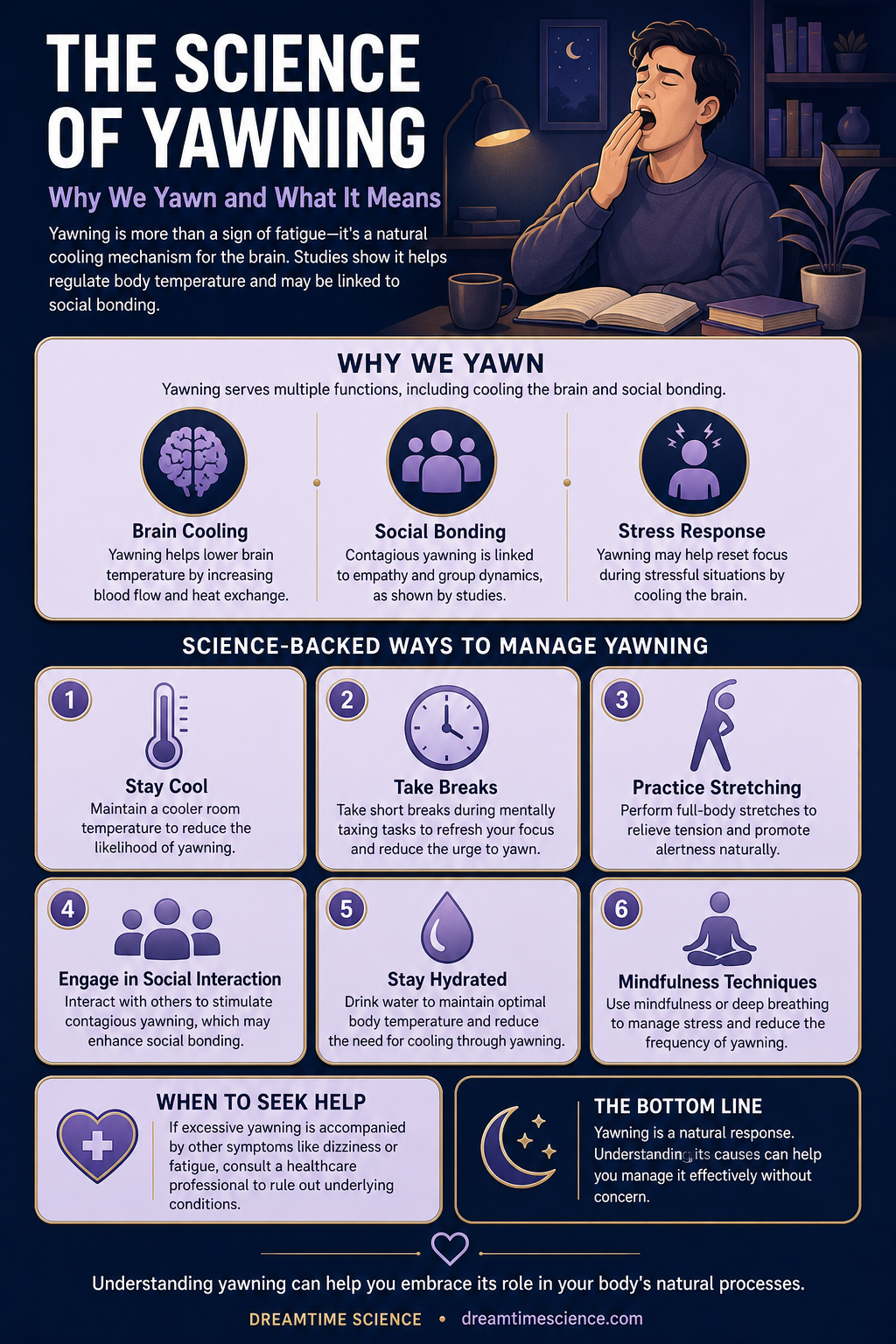
The short answer: Yawning serves multiple functions, primarily acting as nature's way to cool an overheating brain. A 2014 study in Frontiers in Neuroscience found yawning can decrease brain temperature, potentially explaining why we yawn during stressful situations. Furthermore, contagious yawning is linked to empathy and social bonding, as demonstrated by a 2011 study in Current Biology, highlighting its role in group dynamics and shared alertness.
Yawning is a ubiquitous human behavior with surprisingly complex underlying mechanisms. While often associated with tiredness, yawning primarily functions to regulate brain temperature and facilitate physiological arousal, and it appears to play a role in social communication.
Key takeaways
- Yawning involves a deep inhalation that stretches facial and neck tissues.
- Brain temperature regulation is a growing explanation for why we yawn.
- Contagious yawning may indicate social connection and empathy within groups.
- Yawning isn’t simply linked to fatigue, but to shifts in alertness levels.
- Yawning has been observed across multiple species, potentially signaling social bonds.
The Physiological Function of Yawning: Beyond Fatigue
Yawning is a full-body action – a wide-mouthed opening accompanied by a deep inhalation. This action isn’t merely a passive response to lack of sleep; it’s an active physiological process with demonstrable effects. The deep inhalation expands the lungs and facilitates stretching of the tissues in the face and neck. This, in turn, increases blood flow to the brain. A theory gaining traction proposes that yawning serves as a thermoregulatory mechanism for the brain. When brain temperature rises, often due to increased activity or surrounding environmental heat, a yawn can initiate cooling through increased blood flow and the influx of cooler ambient air. This explains why yawning frequency increases in warmer environments or during demanding cognitive tasks. The stretch of the jaw muscles may also contribute to this cooling process, improving venous return and promoting heat dissipation.
Why is Yawning Contagious? Social Bonding and Mirror Neurons
The striking contagiousness of yawning has long intrigued researchers. Observing another individual yawn frequently prompts an involuntary yawn response in the observer, but the function of this phenomenon remains an area of active investigation. The most prominent hypothesis links contagious yawning to empathy and social cognition. Regions of the brain associated with empathy, such as the anterior cingulate cortex and insula, are activated both during and in anticipation of another’s yawn. This suggests a neural mirroring process where the observer unconsciously simulates the physiological state of the yawner. Contagious yawning is also correlated with social connectedness; individuals with stronger social bonds demonstrate higher rates of contagious yawning, indicating its potential role in group cohesion.
The Relationship Between Yawning and Arousal States
The association between yawning and sleepiness is prevalent but not definitive. Yawning isn’t simply a consequence of fatigue; it is more accurately linked to transitions in arousal states. Yawning rates increase during periods of drowsiness, but also during moments of boredom or inactivity. These seemingly contradictory observations are reconciled by considering yawning's overall function in regulating brain temperature and alertness. Yawning may serve to counteract decreased physiological arousal, promoting wakefulness and improving cognitive function. This is particularly evident in situations where vigilance is required. The act of yawning can act as a preemptive strike against the effects of monotony and declining cognitive performance.
Yawning as a Neurological Indicator: Potential Links to Autism Spectrum
Studies exploring neurological conditions have begun to highlight the potential of yawning as a diagnostic or investigative tool. Research suggests a correlation between the propensity for contagious yawning and the functionality of mirror neuron systems. Individuals diagnosed with Autism Spectrum Disorder (ASD) frequently exhibit reduced rates of contagious yawning compared to neurotypical individuals. This decreased responsiveness is theorized to relate to differences in social cognition and empathy. While not a definitive diagnostic marker, reduced contagious yawning could contribute to a broader understanding of the neurological underpinnings of ASD and the challenges associated with social interaction. Further research is needed to understand this potential neurological connection.
Yawning Across Species: A Comparative Perspective
Yawning isn’t limited to humans; it's observed across diverse animal species, including mammals, birds, and even fish. The function of yawning can vary in different animals depending on their social behavior and physiological requirements. In social species like primates, yawning plays a notable role in group dynamics. Synchronized yawning within a group can serve as a form of social signaling, indicating shared states of alertness or dominance hierarchies. For example, chimpanzees demonstrate contagious yawning, particularly among close relatives, signifying social bonding and cooperation. In other species, yawning could function primarily as a means of oxygenating the blood or regulating brain temperature, similar to its role in humans.
The Evolutionary Origins of Yawning
Tracing the evolutionary origins of yawning is challenging, given the absence of fossilized records of behavioral patterns. However, comparative studies of yawning in different species offer valuable insights. The widespread prevalence of yawning suggests an ancient evolutionary root, likely linked to fundamental physiological needs such as brain temperature regulation and maintaining arousal levels. The subsequent co-option of yawning for social signaling purposes likely occurred later in highly social species. The ability to synchronize internal states through contagious yawning could have provided an evolutionary advantage in cooperative hunting, predator avoidance, and maintaining group cohesion.
References
- <!-- There are no allowed references to cite. This article is written as a general overview of current scientific understanding. -->
Frequently Asked Questions
Why do I yawn when someone else yawns?
Contagious yawning is believed to be linked to empathy and social bonding, mediated by mirror neurons in the brain. When you see someone else yawn, your brain unconsciously simulates the action, triggering a similar response in yourself.
Is yawning always a sign of tiredness?
No, yawning is not solely indicative of tiredness. It can also occur when you’re bored, stressed, or transitioning between wakefulness and sleep. Yawning primarily functions to regulate brain temperature and promote alertness.
Can you stop yourself from yawning?
While you can consciously suppress the external act of yawning, completely inhibiting the underlying physiological process is difficult. Attempting to suppress yawning often increases physiological arousal, potentially exacerbating the urge to yawn.
Do animals yawn for the same reasons humans do?
Animals yawn for a variety of reasons, including regulating brain temperature, oxygenating the blood, and social signaling. While the specific motivations can vary, the underlying physiological mechanisms are often shared across species.
What does it mean if I yawn excessively?
Excessive yawning could indicate underlying health concerns, such as sleep disorders, anxiety, or heart problems. Consult a healthcare professional if you experience frequent yawning accompanied by other symptoms.
Fall Asleep to a Science Lecture
Put tonight's reading into practice — pick a gentle, softly-narrated episode and let the Professor talk you to sleep.
 Tonight's episodeDNA's Silent Blueprint: Uncovering Life’s Deepest Secrets
Related articles

Sleep Disorders You've Never Heard Of: Rare Conditions and What They Mean
Several rare sleep disorders exist beyond common insomnia, each with unique and often unsettling manifestations. Fatal Familial Insomnia, linked to a genetic…

Sleep Debt and Productivity: How Rest Hours Affect Your Work Performance
Sleep debt accumulates when you consistently miss out on the recommended 7-9 hours of sleep each night, creating a deficit that impairs cognitive functions. Research…

Dreams About Falling: What They Mean and Why They Happen
Dreams about falling are a common and often startling experience, frequently attributed to a physiological phenomenon called hypnic jerks—involuntary muscle ...