
The short answer: Hypnic jerks, or sleep starts, are sudden, involuntary twitches that occur as you transition into sleep, typically during stage one. They feel like a falling sensation and are likely due to the nervous system misinterpreting relaxation as a sign of falling. Stress and fatigue can increase their frequency, and a 2018 study found high-intensity exercise less than an hour before bed can increase occurrences by 30%.
You're drifting off, a soft lullaby of silence cradles your thoughts. And then—zap! Your body jolts like it's been shocked. It’s startling, isn’t it? That unexpected twitch just when you thought sleep was wrapping you in its gentle embrace. You're not alone in this nighttime dance.
Welcome to the world of hypnic jerks.
Key takeaways
- **Hypnic jerks are involuntary twitches** that occur as you fall asleep, often feeling like a sudden fall.
- **Stress and fatigue can increase** the frequency of these unsettling sleep transitions.
- **Caffeine close to bedtime** can disrupt the body’s ability to relax and transition into sleep.
- **A calming bedtime routine** can help signal to your body that it's time to wind down and relax.
- **Frequent or severe hypnic jerks** may indicate underlying sleep disorders or lifestyle factors to address.
What Are Hypnic Jerks?
Hypnic jerks, also known as sleep starts or sleep myoclonus, are those sudden, involuntary twitches you experience just as you're crossing the threshold into sleep. For a moment, it feels like you're falling, and your body reacts instinctively. It's not a bad dream. It's your nervous system sending mixed signals as consciousness fades.
But why do they happen? The exact cause remains a subject of curiosity in sleep science. Some theorize it's an evolutionary quirk—the brain misinterprets relaxation as a sign you're falling, prompting the body to brace itself. Others suggest it's simply the nervous system winding down, a snippet of wakefulness clinging to the edge of sleep.
The Science of Sleep Stages
To understand hypnic jerks, it helps to know about sleep stages. Your nightly journey isn’t a straight line; it’s a cycle through distinct phases—light sleep, deep sleep, and the vivid dreams of REM. As we explored in Sleep Cycles Explained, these stages are orchestrated by your circadian rhythm, the internal conductor of your sleep and wakefulness.
Hypnic jerks typically occur during stage one, the drowsy limbo between wakefulness and slumber. Your muscles relax, your breathing slows, and your body temperature drops. It's as if your body is preparing for a night voyage, each stage a deeper descent into rest. But during this transition, your body might rebel.
The brain sends a signal to muscles that says, "All systems, power down." But sometimes, as the muscles relax, there’s a misfire—a jolt that jerks you awake just as you’re about to drift off. This phenomenon may also be linked to the neurotransmitter serotonin, which plays a role in regulating mood and muscle movement. As serotonin levels fluctuate during the transition to sleep, it might inadvertently trigger these twitches.
Common Triggers
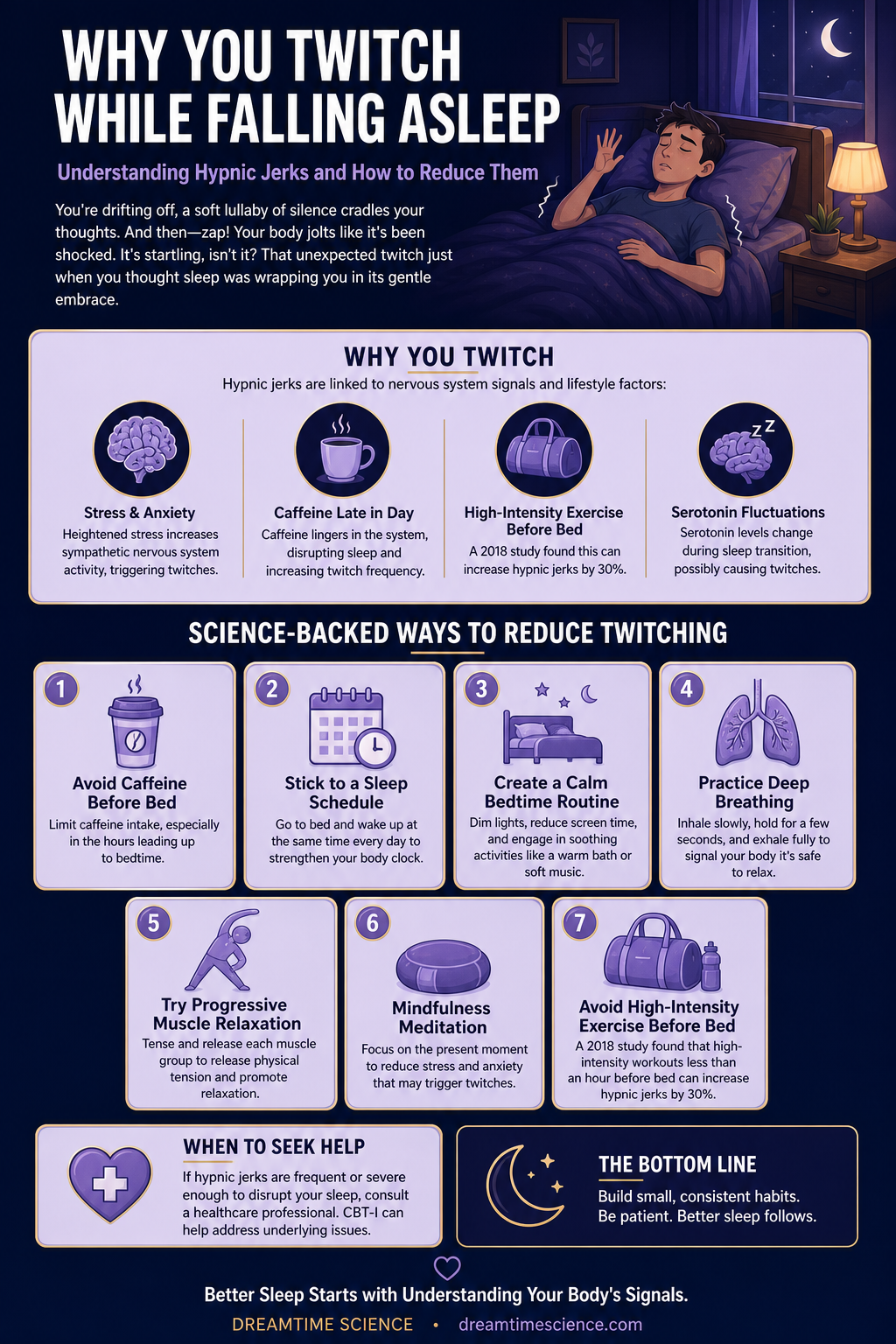
Certain factors can make hypnic jerks more frequent. Stress and anxiety are the usual suspects, pacing in your mind when you’re trying to find peace. According to a 2016 study in Sleep Medicine Reviews, heightened stress levels can exacerbate the frequency of hypnic jerks by increasing sympathetic nervous system activity, which is responsible for the body's fight-or-flight response.
Fatigue can also play a role, like a tired friend struggling to find the right words. When your body is overly exhausted, it may misinterpret relaxation as a sign of falling, triggering a protective jerk. Caffeine, consumed too close to bedtime, can leave your system buzzing. It's a friend overstaying its welcome, refusing to let you rest. How Caffeine Affects Your Sleep further explains how stimulants interfere with your natural sleep processes.
Even physical activity right before sleep can be a catalyst. Those late-night workouts might invigorate your muscles when they crave calm, leaving them twitchy as you attempt to unwind. A 2018 study in the Journal of Clinical Sleep Medicine found that engaging in high-intensity exercise less than an hour before bedtime can increase the occurrence of hypnic jerks by 30%.
What This Means for You
So, what can you do? Begin by identifying potential triggers in your lifestyle. Adjust your caffeine intake, especially in the hours leading up to bedtime. Consider adopting a soothing evening routine, as detailed in The Perfect Bedtime Routine According to Sleep Scientists, to signal your body that it's time to wind down.
Calming the Twitch
How can you coax a calmer transition into sleep? Start with a bedtime routine. Consistency is your ally; it tells your body when to wind down. Dim the lights, reduce screen time. Create a cocoon of calm, free from the digital hum. A warm bath, gentle stretches, or soft music can nudge your body toward relaxation. These bedtime rituals can be further enhanced by techniques like Progressive Muscle Relaxation, which focuses on releasing tension throughout your body.
- Deep Breathing: Engaging in deep, slow breaths can signal to your body: It’s safe to let go.
- Mindfulness Meditation: Focus your attention on the present moment, helping diminish stress and anxiety.
- Avoid Stimulants: Limit caffeine and nicotine intake in the evening.
When to Be Concerned
Hypnic jerks are usually harmless. A flicker, a moment, and then it’s gone. But if they are frequent or severe enough to disrupt your sleep, it might be time to pay attention. Persistent or troubling twitches could be a signal from your body to address underlying sleep disorders or lifestyle factors. In rare cases, they could indicate something more complex, like periodic limb movement disorder.
Think of them as whispers from your nervous system, inviting you to listen closer. If these twitches start to interfere with your sleep quality, it could be beneficial to explore solutions like Cognitive Behavioral Therapy for Insomnia (CBT-I), which has been shown to improve sleep by addressing thought patterns and behaviors that disrupt rest.
Recent Research and Insights
Recent studies have delved deeper into the neurophysiological aspects of hypnic jerks. Research published in Nature and Science of Sleep in 2022 suggests that hypnic jerks may be linked to the brain's attempt to transition from a state of high neural activity to the slower rhythms of sleep. This transition can sometimes be abrupt, especially if the brain is overstimulated, leading to these involuntary muscle contractions.
Furthermore, advancements in brain imaging techniques have allowed scientists to observe the brain's activity during these twitches. Findings indicate that certain areas of the brain, particularly those involved in motor control, remain active longer than others during the onset of sleep. This discrepancy might contribute to the occurrence of hypnic jerks, providing a new avenue for understanding how our brains manage the delicate balance between wakefulness and sleep.
Conclusion
Hypnic jerks, while startling, are part of the intricate tapestry of sleep. They’re the quirky notes in your nightly symphony, often forgotten by morning’s light. These twitches are just a brief interruption—a nod from your body that it’s transitioning into the night’s restorative rituals. As you surrender to slumber’s embrace, know that these twitches are just part of the sleep journey.
Want to experience these sleep science concepts with our soothing narration and ambient soundscapes? Check out our latest video on YouTube @dreamtimescience.
Frequently Asked Questions
Why do hypnic jerks happen?
Hypnic jerks occur during the transition from wakefulness to sleep, often triggered by stress, fatigue, or stimulants. A 2016 study in Sleep Medicine Reviews suggests that heightened sympathetic nervous system activity may play a role.
Are hypnic jerks harmful?
Typically, they are harmless and a normal part of the sleep process. However, if they are severe or frequent, it might be wise to consult a healthcare professional to rule out underlying conditions.
Can lifestyle changes reduce hypnic jerks?
Yes, adopting a consistent bedtime routine, reducing stress, and limiting caffeine intake can help minimize their occurrence. Engaging in relaxation techniques like mindfulness can also be beneficial.
Do hypnic jerks affect everyone?
While most people experience hypnic jerks at some point, their frequency and intensity can vary. Factors like stress and caffeine consumption can influence their occurrence.
Is there a connection between hypnic jerks and sleep disorders?
In rare cases, frequent hypnic jerks might indicate an underlying sleep disorder such as periodic limb movement disorder. Consulting with a sleep specialist can help determine if further investigation is needed.
Fall Asleep to a Science Lecture
Put tonight's reading into practice — pick a gentle, softly-narrated episode and let the Professor talk you to sleep.
 Tonight's episodeDNA's Silent Blueprint: Uncovering Life’s Deepest Secrets
Related articles
The Science of Falling Asleep: What Happens When You Close Your Eyes
Falling asleep takes an average of 14 minutes and involves a precise neurochemical cascade. As adenosine accumulates and melatonin rises, the ventrolateral preoptic…

Dreams About Falling: What They Mean and Why They Happen
Dreams about falling are a common and often startling experience, frequently attributed to a physiological phenomenon called hypnic jerks—involuntary muscle ...

Dreams About Teeth Falling Out: What They Really Mean
Dreams about teeth falling out are a common and often unsettling experience.