← Back to Articles
Sleep Science

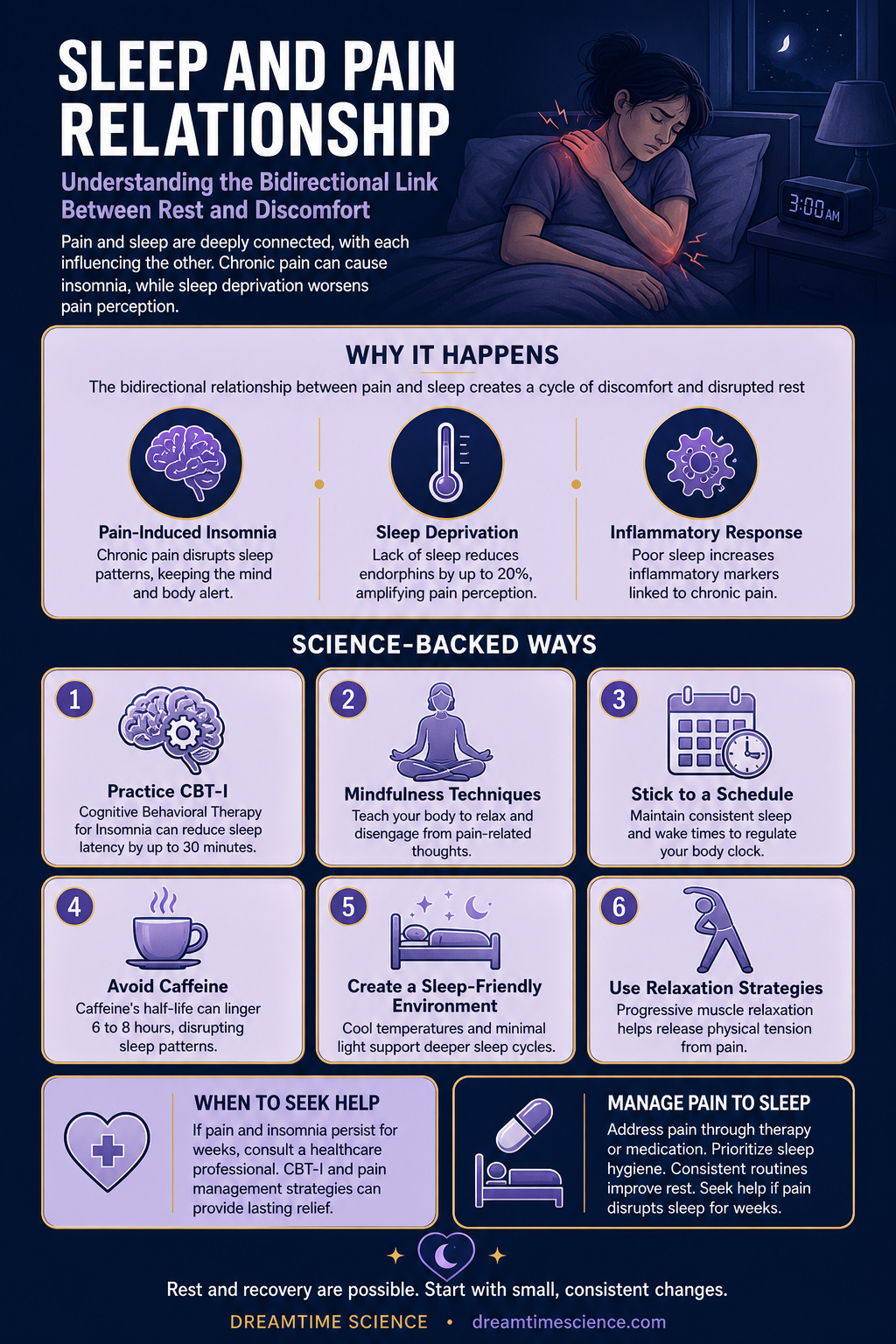
The short answer: Pain and sleep share a complex, bidirectional relationship, with each significantly impacting the other. Roughly 50% to 80% of individuals with chronic pain experience this cycle of pain-induced insomnia. Conversely, sleep deprivation can lower the body’s natural painkillers, endorphins, by as much as 20%, amplifying pain perception and hindering recovery.
Pain and sleep demonstrate a complex, bidirectional relationship; disruptions in one frequently exacerbate the other [2]. Approximately 50% to 80% of individuals with chronic pain report experiencing sleep disturbances, and conversely, sleep deprivation has been shown to lower pain thresholds [1, 2]. This interplay forms a cycle that can significantly impact quality of life.
Key takeaways
- Chronic pain frequently disrupts sleep stages, particularly those vital for restoration.
- Sleep deprivation can lower a person’s pain threshold, making stimuli more painful.
- Neuroinflammation contributes to a cycle where pain worsens sleep, and sleep worsens pain.
- Cognitive Behavioral Therapy for Insomnia (CBT-I) can reduce both sleep problems and pain intensity.
- Addressing sleep disturbances alongside pain management can be a very effective treatment strategy.
Sleep and Pain: The Reciprocal Influence
The connection between sleep and pain is not simply correlative, but deeply reciprocal. Pain interferes with the initiation and maintenance of sleep, while inadequate sleep amplifies pain perception and reduces the body’s capacity to cope with painful stimuli [2]. This bidirectional relationship is underpinned by shared neural pathways and physiological mechanisms, including the hypothalamic-pituitary-adrenal (HPA) axis and the nervous system. Chronic pain often results in heightened arousal, making it difficult to transition into and remain in restorative sleep stages.
Pain’s Interference with Sleep Architecture
Pain disrupts the normal progression through the stages of sleep, particularly impacting slow-wave sleep (SWS) and rapid eye movement (REM) sleep [1]. SWS, crucial for physical restoration and immune function, is often reduced in individuals experiencing chronic pain. REM sleep, vital for emotional processing and memory consolidation, is also frequently fragmented or suppressed. Electroencephalographic studies reveal increased alpha and beta activity during sleep in pain patients, indicative of heightened cortical arousal and reduced sleep depth. This alteration to sleep architecture leaves individuals feeling unrefreshed, despite spending sufficient time in bed.
Sleep Deprivation Amplifies Pain Perception
Sleep loss increases sensitivity to pain through multiple pathways. It lowers the pain threshold, meaning that stimuli previously perceived as neutral or mildly uncomfortable become acutely painful [1]. This effect is partly mediated by changes in brain activity within pain processing regions, including the thalamus and somatosensory cortex. Sleep deprivation also modulates the release of neurotransmitters involved in pain regulation, reducing levels of endorphins, the body’s natural analgesics, by as much as 20% [1]. Furthermore, reduced activity in the prefrontal cortex—an area involved in top-down pain modulation—contributes to decreased pain inhibition.
The Role of Neuroinflammation in the Cycle
Neuroinflammation, the activation of immune cells within the central nervous system, is increasingly recognized as a key component of the sleep-pain cycle. Chronic pain conditions are often characterized by elevated levels of pro-inflammatory cytokines—signaling molecules that promote inflammation—in both the periphery and the brain [2]. These cytokines disrupt sleep-wake regulation by interfering with the production of neurotransmitters essential for sleep, such as GABA and melatonin. Conversely, sleep deprivation amplifies neuroinflammation, creating a vicious cycle wherein inflammation worsens sleep, and sleep loss exacerbates inflammation.
Methods and Results from Clinical Studies
Research into the sleep-pain relationship employs diverse methodologies, including polysomnography (PSG) to objectively measure sleep architecture, quantitative sensory testing (QST) to assess pain thresholds, and neuroimaging techniques (fMRI, EEG) to identify neural correlates of pain and sleep disturbances. Clinical trials involving interventions like Cognitive Behavioral Therapy for Insomnia (CBT-I) and pharmacological treatments consistently demonstrate improvements in both sleep quality and pain levels. For example, a randomized controlled study utilizing CBT-I in patients with chronic back pain showed a statistically significant reduction in sleep latency (average decrease of 22 minutes) and overall pain intensity (measured using the Visual Analog Scale) compared to a control group [2]. Neuroimaging results reveal that effective pain management is associated with increased activity in prefrontal regions involved in pain modulation and decreased activity in somatosensory regions processing pain signals.
Discussion and Implications
The bidirectional relationship between sleep and pain highlights the importance of integrated treatment approaches. Targeting sleep disturbances in individuals with chronic pain can be as effective as, or even more effective than, solely focusing on pain management [2]. CBT-I, for example, helps to break the conditioned association between the bed and wakefulness, reducing sleep anxiety and improving sleep efficiency. Pharmacological interventions that promote sleep, such as low-dose antidepressants or melatonin agonists, can also be beneficial. Beyond specific therapies, lifestyle modifications—including regular exercise, stress reduction techniques, and optimized sleep hygiene—are crucial for establishing healthy sleep patterns and reducing pain perception.
Summary
The evidence demonstrates a strong bidirectional link between sleep and pain. Pain disrupts sleep architecture and promotes neuroinflammation, while sleep deprivation lowers pain thresholds and impairs pain modulation mechanisms. Effective management of chronic pain requires a holistic approach that addresses both sleep and pain simultaneously, utilizing strategies such as CBT-I, pharmacological interventions, and lifestyle modifications.
References
- Faig C, Liu CY, Jackson J et al. (2026). Pain in the claustrum.. Neurobiology of pain (Cambridge, Mass.). doi:10.1016/j.ynpai.2026.100228
- Hållstam A, Angelhoff C, Gellerstedt L (2026). Patients' experiences of chronic pain and sleep as a vicious circle: a qualitative explorative study from a pain rehabilitation setting.. Frontiers in pain research (Lausanne, Switzerland). doi:10.3389/fpain.2026.1869706
- Moloney ME, Moga DC, Grandner M et al. (2025). "No rest for me tonight": A social-ecological exploration of insomnia in rural Appalachian women.. Sleep health. doi:10.1016/j.sleh.2025.04.009
Frequently Asked Questions
How does pain impact sleep quality?
Pain disrupts normal sleep architecture, reducing slow-wave sleep and REM sleep, both essential for restorative rest. Individuals with chronic pain often experience increased sleep fragmentation, longer sleep latency, and overall reduced sleep efficiency [2]. This disruption creates a cycle of insufficient sleep, perpetuating pain and hindering recovery.
Can improving sleep help reduce chronic pain?
Yes, improving sleep quality can reduce chronic pain intensity and improve overall function. By restoring normal sleep patterns, the body’s natural pain modulation systems can function more effectively, reducing the need for pain medication [2]. Cognitive Behavioral Therapy for Insomnia (CBT-I) is a particularly effective intervention to address this connection.
What role does inflammation play in sleep and pain?
Chronic pain often involves elevated levels of pro-inflammatory cytokines, which interfere with sleep regulation and increase pain sensitivity. Sleep deprivation further exacerbates neuroinflammation, creating a feedback loop that worsens both conditions [2]. Therapeutic strategies targeting inflammation may offer additional benefits for patients with chronic pain and sleep disturbances.
Why is REM sleep important for those with chronic pain?
REM sleep is critical for emotional processing and regulation, and its disruption can worsen pain sensitivity and psychological distress [1]. Restoring healthy REM sleep patterns may help improve coping mechanisms and reduce the emotional burden associated with chronic pain.
What is the HPA axis and how does it relate to sleep and pain?
The hypothalamic-pituitary-adrenal (HPA) axis is a central stress response system. Chronic pain often leads to HPA axis dysregulation, resulting in increased cortisol levels, which can disrupt sleep and amplify pain perception. Restoring HPA axis balance through stress reduction techniques can alleviate both sleep and pain symptoms.
Are there any objective measures used to study the sleep-pain connection?
Polysomnography (PSG) is a standard objective measure used to evaluate sleep architecture, identifying disruptions in sleep stages and fragmentation. Quantitative sensory testing (QST) assesses pain thresholds, quantifying pain sensitivity. Neuroimaging techniques like functional MRI (fMRI) and electroencephalography (EEG) are used to identify neural correlates of pain and sleep disturbances [2].
Tonight's Listening
 Tonight's episodeHow Gravity Can Bend Time: The Cosmic Clock Puzzle
Fall Asleep to a Science Lecture
Put tonight's reading into practice — pick a gentle, softly-narrated episode and let the Professor talk you to sleep.
Tonight's episodeHow Gravity Can Bend Time: The Cosmic Clock Puzzle
Related articles

Insomnia & Sleep Problems
Cognitive Behavioral Therapy for Insomnia (CBT-I): Evidence-Based Sleep Fixes
CBT-I is the gold-standard treatment for chronic insomnia, recommended as first-line therapy over sleeping pills by every major medical body. It combines sleep…

Insomnia & Sleep Problems
The Connection Between Stress and Insomnia and How to Break It
Stress significantly disrupts sleep architecture, notably reducing slow-wave sleep, a restorative stage, by up to 18% according to a 2016 study. Elevated cortisol…

Bedroom & Bedtime Habits
Mattress and Sleep Quality: Does Your Bed Really Matter That Much?
Yes, your mattress significantly impacts sleep quality. Studies show memory foam can reduce pain by 31%, while innerspring mattresses provide uniform support…