← Back to Articles
Dreams

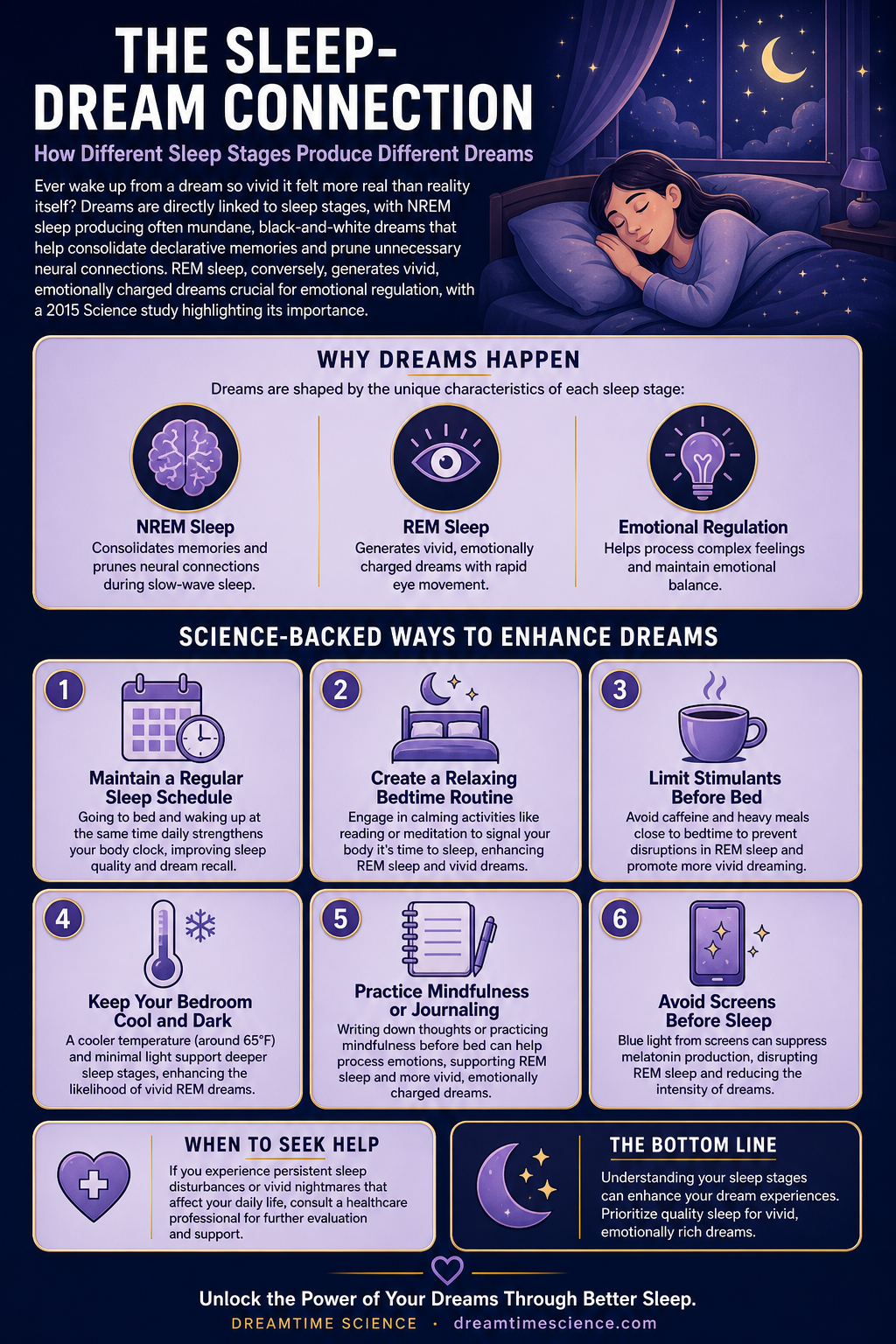
The short answer: Dreams are directly linked to sleep stages, with NREM sleep producing often mundane, black-and-white dreams that help consolidate declarative memories and prune unnecessary neural connections. REM sleep, conversely, generates vivid, emotionally charged dreams crucial for emotional regulation, with a 2015 Science study highlighting its importance. Even NREM dreams can contribute to problem-solving, as demonstrated by a 2011 Journal of Cognitive Neuroscience study.
Ever wake up from a dream so vivid it felt more real than reality itself? Or from a fleeting fog of fragmented images that slipped through your fingers like sand? These nighttime narratives are not the whimsical work of your imagination alone. They’re crafted in the secret workshops of your sleep stages, each contributing uniquely to the symphony of your night's rest.
Key takeaways
- Dreams during NREM sleep are often less vivid, appearing in black and white and focusing on daily events.
- REM sleep is associated with vivid, emotional, and often illogical dreams, contributing to emotional regulation.
- Consistent sleep schedules can help regulate your body's natural rhythms, promoting more restful REM sleep.
- NREM sleep plays a crucial role in memory consolidation and synaptic pruning, impacting learning and cognitive function.
- Dreams, regardless of their stage, offer insights into emotional processing and problem-solving, reflecting the brain's activity.
The Stage is Set
Sleep isn’t a single act. It’s a play in five scenes, each with its own mood lighting and script. REM and NREM stages each have their starring roles. When you drift off, the curtain rises on NREM sleep. It leads with a soft, quiet introduction that slowly deepens.
In these early acts, your mind moves through lighter stages before sinking into the depths of slow-wave sleep. Dreams here are often draped in mundane black-and-white, like old family films. They’re less about the wild and more about reorganizing yesterday’s puzzle pieces.
The Science Behind NREM Sleep
NREM sleep is characterized by a slower frequency of brain waves, known as delta waves. These waves lull you into a restorative slumber, acting like a meticulous librarian sorting through a chaotic library. A 2012 study published in Nature Neuroscience found that during NREM sleep, the brain consolidates declarative memories, which are memories related to facts and events. This quiet stage is where mental housekeeping occurs, preparing you for the challenges of the next day.
Moreover, NREM sleep is crucial for the process of synaptic pruning, where unnecessary neural connections are eliminated, enhancing cognitive efficiency. According to research in the Journal of Neuroscience, this pruning process is vital for learning and memory retention, highlighting the importance of NREM sleep in cognitive development and function.
When REM Takes the Stage
Rapid Eye Movement, or REM, is the headline act. This is where your dreams don their most colorful costumes. Your eyes dart beneath closed lids, chasing the vivid stories unfurling in your mind. REM dreams are cinematic, charged with emotion, and boundless in creativity.
During REM, your brain is alight with activity, almost as if you’re awake. This stage crafts dreams that are strange, intense, and sometimes illogical. The kind that makes you wake up questioning everything. According to a 2015 study published in Science, REM sleep is crucial for emotional regulation, helping you process and make sense of complex feelings.
What This Means for You: Enhancing REM Sleep
- Create a regular sleep schedule: Consistency helps regulate your body's internal clock, encouraging more REM sleep.
- Limit caffeine and alcohol: Both can disrupt REM sleep, as detailed in How Caffeine Affects Your Sleep (And When to Stop Drinking It).
- Engage in relaxing activities before bed: Calm your mind with activities like reading or meditation, which can improve sleep quality.
A Secret in the Night
But here’s the twist: NREM dreams aren’t always the quiet understudy. As the night deepens, they sometimes steal the spotlight. These dreams are less flashy but rich in thought, like philosophical musings woven into sleep.
Scientists suggest NREM dreams help process emotions and solve problems. Here, your brain is like a wise old sage, sorting through memories with the care of an archivist. It’s less about spectacle, more about introspection. In fact, a 2011 study in the Journal of Cognitive Neuroscience found that problem-solving tasks improved when participants dreamed about them during NREM sleep.
The Science of Scenes
It may feel like magic, but there’s science behind the spectacle. Your brain is a theater of electrical signals and chemical whispers. In REM, acetylcholine floods your brain, igniting neural pathways like fireworks. Meanwhile, serotonin and norepinephrine take a backseat, making room for the surreal.
In NREM, neurotransmitter activity is more subdued. The brain’s waves slow, lulling you into restorative slumber. This is where your brain does its housekeeping, consolidating memories like a librarian with a meticulous touch. According to a 2014 study published in Neuron, these stages are crucial for synaptic homeostasis, maintaining brain efficiency.
When Night Meets Day
As dawn creeps closer, the balance of power shifts again. REM stages lengthen, and dreams become more vivid. Your mind begins rehearsing for wakefulness, practicing scenarios and emotions like an eager actor waiting in the wings.
This is why those early morning dreams are the ones you remember — they’re fresher, more recent, still warm with the night’s breath. It’s like a final bow before the sleep cycle closes, preparing you for the day ahead.
What This Means for You: Remembering Dreams
- Keep a dream journal: Writing down dreams as soon as you wake can help improve recall.
- Allow natural light to wake you: Gradual exposure to light can help ease the transition from sleep to wakefulness, as explained in Circadian Rhythms 101: How Your Body's Internal Clock Controls Sleep.
The Final Act
When your alarm jolts you awake, it’s easy to dismiss these nighttime performances as mere entertainment. But your sleep stages are doing more than spinning tales. They’re crafting a tapestry of cognitive health, emotional resilience, and creative thought.
Next time you wake from a dream, savor it. Whether it's a kaleidoscopic REM odyssey or a contemplative NREM reverie, your dreaming brain is both artist and engineer, sculpting through slumber the story of you. For more on how dreams can unlock creativity, see Sleep and Creativity: How Dreams Unlock Creative Problem-Solving.
Conclusion
Your sleep stages are not mere passive rest; they're dynamic, creative, and crucial for your well-being. Understanding the dance between REM and NREM sleep can help you appreciate the intricate tapestry of dreams that weave through your nights. Each stage plays its part, crafting a narrative as unique as you are.
Want to experience these sleep science concepts with our soothing narration and ambient soundscapes? Check out our latest video on YouTube @dreamtimescience.
Frequently Asked Questions
How do sleep stages affect dream recall?
Dream recall is often linked to the timing of awakening. A 2009 study in Sleep Medicine Reviews found that waking during REM sleep increases the likelihood of remembering dreams due to the heightened brain activity and emotional intensity. Additionally, the transition from sleep to wakefulness can influence memory retention, with the prefrontal cortex playing a pivotal role in encoding dream memories.
What role does acetylcholine play in REM sleep?
Acetylcholine is a neurotransmitter that enhances the brain's electrical activity during REM sleep, facilitating vivid dreaming. It essentially acts as a conductor, orchestrating the night's vivid symphony. This neurotransmitter's activity is crucial for the activation of the brain's visual and emotional centers, which explains the vivid and emotional nature of REM dreams.
Can NREM sleep influence creativity?
Yes, NREM sleep can enhance creativity by allowing the brain to process and organize information from the day. A 2020 study in Psychological Science showed that sleep, particularly NREM, fosters insightful problem-solving. The restructuring of information during NREM sleep can lead to novel connections and ideas, supporting creative thinking.
Why are my dreams more intense in the morning?
Dreams are more intense in the morning because REM stages lengthen throughout the night. This extended REM sleep allows for more elaborate and emotionally charged dreams. The increased duration of REM sleep towards the morning also correlates with heightened brain activity, making these dreams more vivid and memorable.
How can I improve my overall sleep quality?
Improving sleep quality involves maintaining a regular sleep schedule, creating a restful environment, and managing stress. Techniques such as those discussed in Cognitive Behavioral Therapy for Insomnia (CBT-I): Evidence-Based Sleep Fixes can be highly effective. Incorporating practices like mindfulness and reducing exposure to blue light before bed can also enhance sleep quality, as detailed in Blue Light Before Bed: Myth or Reality? What Research Actually Shows.
Tonight's Listening
 Tonight's episodeHow Gravity Can Bend Time: The Cosmic Clock Puzzle
Fall Asleep to a Science Lecture
Put tonight's reading into practice — pick a gentle, softly-narrated episode and let the Professor talk you to sleep.
Tonight's episodeHow Gravity Can Bend Time: The Cosmic Clock Puzzle
Related articles

Dreams & Nightmares
Dreaming in Color: Do People Really Dream in Black and White?
Historically, around three-quarters of people reported dreaming in black and white, coinciding with the prevalence of black-and-white television in the 1940s. As…

Dreams & Nightmares
Dreams and Relationships: How Sleep Affects Intimacy and Connection
Dreams, particularly those occurring during REM sleep, play a significant role in relationship health. A 2017 study in the Journal of Neuroscience found that REM…

Sleep, Mind & Mood
Sleep Learning: Optimizing Memory Consolidation During Sleep
Sleep learning aims to strengthen existing memories or facilitate the consolidation of recently learned information while asleep, rather than acquiring entirely new…