
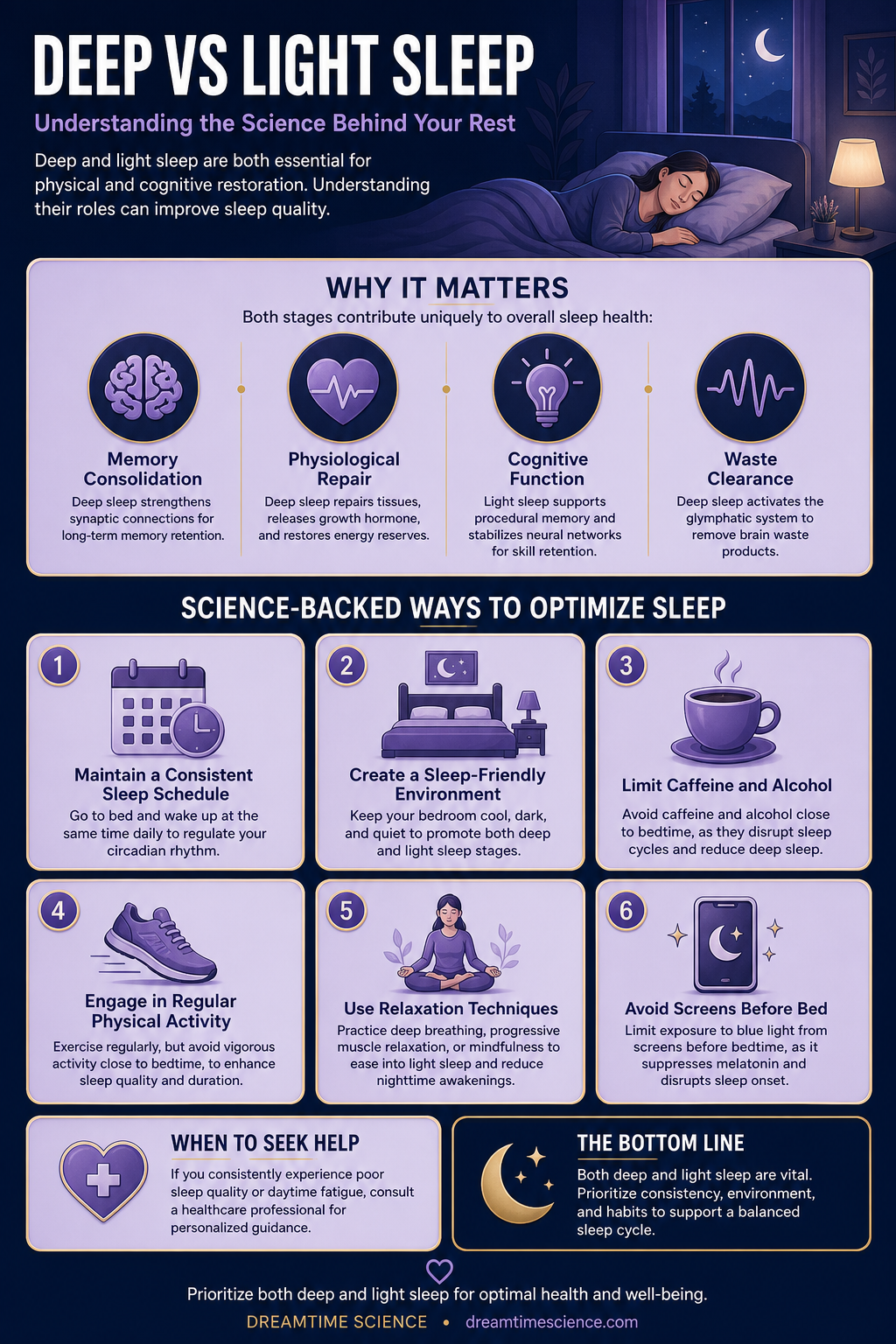
Both deep and light sleep are essential components of a complete sleep cycle, contributing uniquely to physical and cognitive restoration. Deep sleep, characterized by slow brain waves, is vital for physical repair and memory consolidation, while light sleep facilitates the transition between wakefulness and deeper stages and supports crucial neurological functions [1].
Many individuals focus intently on maximizing deep sleep, believing it to be the most important phase. However, a comprehensive understanding of sleep architecture reveals a more nuanced picture: both stages are integral to overall sleep quality and health.
Key takeaways
- Deep sleep, or slow-wave sleep, is vital for physical restoration and tissue repair.
- Light sleep plays a key role in procedural memory and learning new skills.
- Sleep spindles, prominent during light sleep, protect sleep and aid memory.
- Sleep cycles involve a shifting balance of deep, light, and REM sleep stages.
- Maintaining a consistent sleep schedule supports healthy sleep architecture.
Deep Sleep: Physiological Restoration and Consolidation
Deep sleep, also known as slow-wave sleep (SWS) or NREM stage 3 sleep, is the most physically restorative stage of the sleep cycle. During deep sleep, the body concentrates on repairing and regenerating tissues, releasing growth hormone, and restoring energy reserves. This process is not merely passive; it requires significant physiological effort [1]. Growth hormone secretion peaks during SWS, contributing to muscle repair, bone growth, and immune function.
Furthermore, deep sleep plays a critical role in memory consolidation, specifically the transfer of information from short-term to long-term memory. Synaptic connections are strengthened during SWS, enabling the brain to retain and recall information more effectively [1]. The glymphatic system, a waste clearance pathway in the brain, is also highly active during deep sleep, removing metabolic byproducts accumulated during wakefulness.
Light Sleep: The Gateway to Deep Sleep and Cognitive Function
Light sleep, or NREM stage 2 sleep, often receives less attention than its deeper counterpart, but it is far from inconsequential. This stage represents a transitional phase between wakefulness and deep sleep, characterized by a slowing heart rate and relaxed muscle tone. While the brain is less responsive to external stimuli than in wakefulness, it is still partially alert, making it easier to be awakened.
Crucially, light sleep is not simply a prelude to deeper stages; it actively supports cognitive function. Research indicates that light sleep plays a key role in procedural memory—the learning and retention of skills and habits [1]. The brain stabilizes neural networks involved in motor skills and cognitive processes, contributing to improved performance upon awakening.
The Role of Sleep Spindles in Light Sleep
A hallmark of light sleep is the presence of sleep spindles – bursts of rapid brain activity. These spindles are believed to play a critical role in learning, memory consolidation, and protecting sleep from external disturbances [1]. They actively suppress sensory information, allowing the brain to transition to deeper stages uninterrupted.
Deep Sleep vs Light Sleep: A Cyclical Relationship
Sleep is not a linear progression through stages but rather a cyclical process. Individuals typically experience four to six sleep cycles per night, each lasting approximately 90-120 minutes. Within each cycle, the proportion of time spent in each stage varies, with deep sleep predominating in the first half of the night and REM sleep increasing towards morning [1].
Light sleep serves as the essential bridge between these stages. It facilitates the descent into deep sleep and the ascent back towards wakefulness. Disruptions to light sleep can therefore impact the quality of both subsequent deep sleep and overall sleep efficiency.
The Interplay with Other Sleep Stages
While often framed as a "deep sleep vs. light sleep" comparison, it is crucial to recognize that all sleep stages—including REM sleep—are interdependent. REM sleep, characterized by rapid eye movement and vivid dreaming, is vital for emotional processing and procedural memory consolidation. A healthy sleep architecture necessitates adequate time spent in all stages [1].
For example, insufficient light sleep can lead to a fragmented sleep architecture, reducing the amount of time spent in restorative deep sleep and hindering memory consolidation. Similarly, disruptions to REM sleep can negatively impact mood regulation and cognitive function.
Determining Your Ideal Sleep Stage Balance
There is no one-size-fits-all answer to the question of which sleep stage is "more important." However, healthy adults typically spend approximately 50-60% of their total sleep time in light sleep, 20-25% in deep sleep, and 20-25% in REM sleep [1]. Individual needs can vary based on age, genetics, and lifestyle factors.
Older adults tend to experience a decline in deep sleep as part of the natural aging process [1]. While they may not obtain the same amount of SWS as younger individuals, maintaining sufficient light and REM sleep remains critical for cognitive health and overall well-being.
Factors Influencing Sleep Stage Distribution
Several factors can impact the distribution of sleep stages. These include:
- Age: Deep sleep declines with age.
- Sleep Debt: Chronic sleep deprivation can reduce the overall proportion of time spent in deep sleep.
- Alcohol Consumption: Alcohol may initially induce sleepiness, but it disrupts sleep architecture and reduces deep sleep.
- Exercise: Regular physical activity can promote deep sleep, but intense exercise close to bedtime can be disruptive.
- Stress: Chronic stress can fragment sleep and reduce the proportion of restorative sleep stages.
Achieving Optimal Sleep Through Sleep Hygiene
Optimizing sleep hygiene is paramount for promoting a healthy sleep architecture and maximizing the benefits of both deep and light sleep. This includes:
- Maintaining a Consistent Sleep Schedule: Going to bed and waking up at the same time each day, even on weekends, helps regulate the body’s natural circadian rhythm.
- Creating a Relaxing Bedtime Routine: Activities such as taking a warm bath, reading a book, or practicing mindfulness can promote relaxation and prepare the body for sleep.
- Optimizing Your Sleep Environment: Ensure your bedroom is dark, quiet, and cool.
- Limiting Caffeine and Alcohol Intake: Both substances can disrupt sleep architecture.
- Regular Exercise: Regular physical activity can improve sleep quality, but avoid intense exercise close to bedtime.
References
- Arrona-Palacios A, Lee JH, Czeisler CA et al. (2023). The Timing of the Melatonin Onset and Phase Angle to Sleep Onset in Older Adults after Uncontrolled vs. Controlled Lighting Conditions.. *Clocks & sleep*. doi:10.3390/clockssleep5030026
Frequently Asked Questions
How do I know if I'm getting enough deep sleep?
You can estimate deep sleep levels with sleep tracking technologies like wearables or polysomnography in a sleep lab. However, feeling rested, alert during the day, and experiencing consistent cognitive performance are better indicators. A lack of deep sleep often manifests as persistent fatigue, difficulty concentrating, and impaired memory.
What happens if I consistently miss out on light sleep?
Consistent disruption of light sleep can hinder your ability to reach and maintain deep sleep phases. This can lead to poor overall sleep quality, impacting cognitive function, and daytime performance.
Is it better to get 7 hours of uninterrupted sleep or 9 hours of fragmented sleep?
Generally, 7 hours of uninterrupted sleep is preferable to 9 hours of fragmented sleep. Sleep continuity allows for more complete cycles through the various sleep stages, maximizing restorative benefits.
Can certain supplements improve deep sleep?
Melatonin supplements may help regulate the sleep-wake cycle and promote the onset of sleep, particularly in individuals with circadian rhythm disorders [1]. However, the impact of other supplements on deep sleep is less well-established.
How does light exposure affect the timing of deep sleep stages?
Exposure to light, especially blue light from electronic devices, can suppress melatonin production and delay the onset of sleep [1]. Conversely, controlled lighting conditions can help regulate the circadian rhythm and optimize the timing of sleep stages.
Fall Asleep to a Science Lecture
Put tonight's reading into practice — pick a gentle, softly-narrated episode and let the Professor talk you to sleep.
 Tonight's episodeDNA's Silent Blueprint: Uncovering Life’s Deepest Secrets
Related articles

The Role of Darkness: Why Light Exposure Matters for Sleep
Darkness plays a crucial role in sleep by signaling the brain to release melatonin, the hormone that promotes relaxation and initiates sleep. Exposure to light,…

Blue Light Before Bed: What Research Actually Shows
Blue light exposure before bed does suppress melatonin production, potentially delaying melatonin onset by around 30 minutes with two or more hours of bright screen…

Weighted Blankets: The Science of Deep Pressure and Sleep
Tossing and turning, tangled in sheets, the clock's relentless march toward morning.